Plant Disease Management Handbook

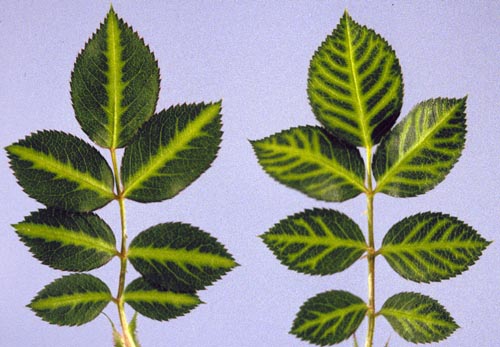
Cause A physiologic problem when temperatures drop into the 50s during early flower development. During this time there are major changes in the balance of different growth regulators present within the flowers. Prevalent in the cultivars Baccara and Talisman and those in the Columbia family of roses. The plant is not permanently affected.

Lesions on leaf

Cause Chlaropsis thielavioides (formerly Chalara thielavioides), a fungus. It grows on the ends of 'Manetti' cuttings (Rosa chinensis var. manetti) and on wounds left by disbudding, resulting in poor callus formation and, subsequently, poor root formation. It develops under bud shields on field-budded 'Manetti', thus preventing callus formation and causing the bud to die.

Image related to Rose (Rosa spp.) and hybrids-Bacterial Leaf Spot and Blast

Cause An undetermined pathovar of Pseudomonas syringae, a bacterium. This disease is different from the various symptoms on roses previously attributed to P. syringae and/or P. syringae pv. morsprunorum in the literature. An aggressive cane blight has been observed in the Treasure Valley of Idaho since 1996.

Image related to Rose (Rosa spp.) and hybrids-Bacterial Cane Blight

Cause Armillaria mellea, a fungus, infects roots, killing the cambium and decaying the underlying xylem. Occasionally found on rose, this root pathogen is native to the Pacific Northwest where it occurs on the roots of many forest tree species, agronomic and ornamental hosts. The host range includes over 500 species of woody plants. The fungus spreads slowly, below ground, from root to root and can survive on woody host roots for long periods.

Cause Several viruses can infect rhubarb including arabis mosaic virus, cherry leafroll virus, cucumber mosaic virus, strawberry latent ringspot virus, and turnip mosaic virus. It is unclear from scant reports, which ones are prevalent in the Pacific Northwest. Turnip mosaic virus is reportedly the most common in British Columbia. Mosaic symptoms as described below have been observed. Many of these viruses can be found on weed hosts, and some are transmitted by nematodes.

Cause The bacterium, Erwinia rhapontici (syn. = Bacterium rhapontici), can cause a crown rot of rhubarb, known as Red leaf or Bacterial soft rot. How the pathogen survives and is dispersed is not well understood. It is suspected that the disease may be spread by plant-feeding insects or by the use of infected root stock.

Image related to Rhubarb (Rheum rhabarbarum)-Red Leaf