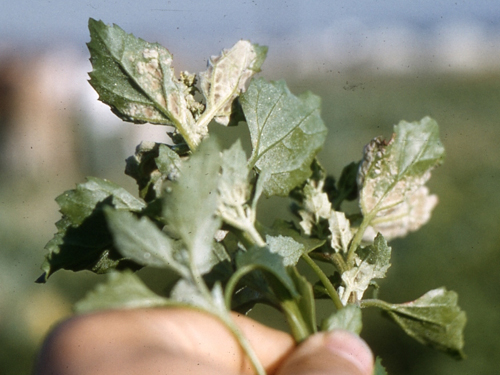
Cause The beet curly top virus is spread in North America only by the beet leafhopper (Circulifer tenellus). The virus has an extensive host range. The leafhopper breeds readily on mustards and overwinters in perennial or winter annual weed hosts, carrying the virus to beets and other crops in spring.
By O. Neher and C. M. Ocamb
Cause This disease is caused by a bacterium, Pectobacterium betavasculorum (syn Erwinia carotovora subsp. betavasculorum), present in many native and cultivated soils. This pathogen can survive in some weedy hosts. Plant wounding, excessive nitrogen or moisture, and warm temperatures (optimum is 79°F to 82°F) favor disease development. The disease occasionally is severe in Idaho.
OSU Extension Plant Pathology Slide Set, circa 1950's.
Tomato ringspot virus (TRsV) infection resulting in line pattern symptom on this strawberry leaf.
Melodie Putnam
Cause Verticillium dahliae, a soilborne fungus that can live many years in soil. The fungus grows into the xylem where it colonizes the plant through mycelial growth and conidial production. Fluid movement in the xylem passively transports the conidia. Once in the xylem, this fungus partially blocks water movement and produces toxins that result in wilt symptoms.
Note the circular damage pattern in this field, where plants are also affected by Verticillium wilt.
Photo by Jay W. Pscheidt, 1992.
Note the stunted, poorly growing plants.
Photo by Jay W. Pscheidt, 1992.
Older leaves wilt and dried out while inner (younger) leaves have remained green although stunted.
Note that a few roots near the center of the picture have been cut in half to show the light color of outer cortex and brick-red central core or stele.
Photo by Jay W. Pscheidt, 1993.
Plants in the valley, draws or lower areas show stunting first. The disease continues to spread to other plants as time goes on.