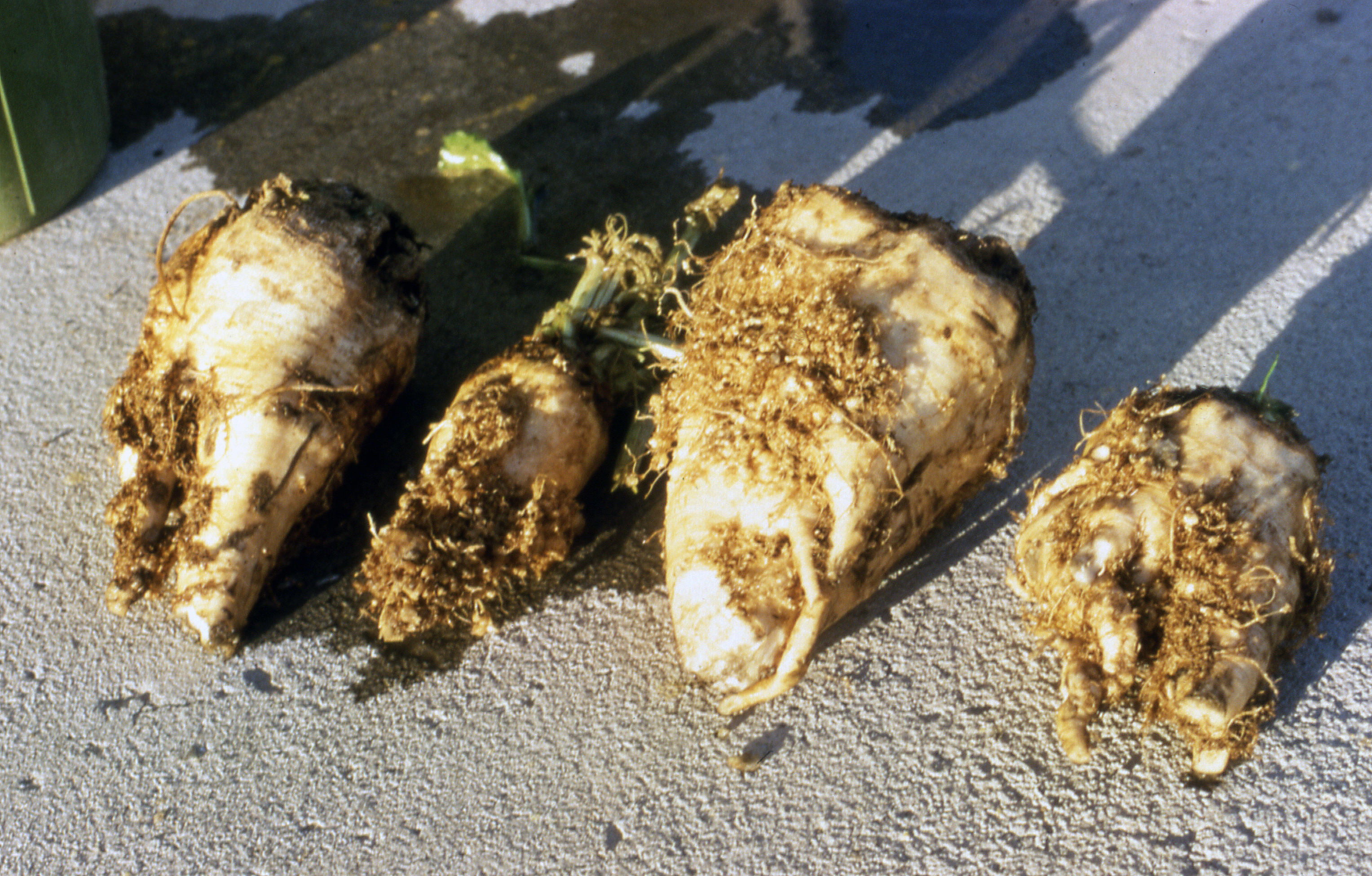
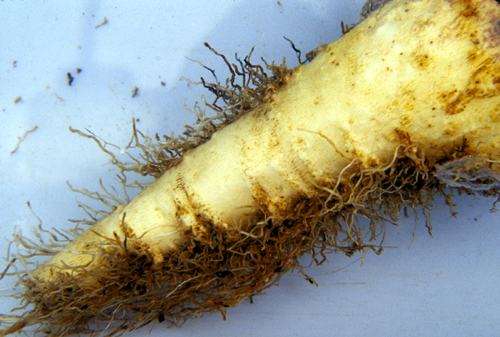
Cause Meloidogyne hapla is a sedentary endoparasite; only second-stage juveniles (the infective stage) and adult males (which may be rare) are in soil.
Later infections occur principally on secondary roots as swellings or knots.
Bill Cobb
By O. Neher and C. M. Ocamb
Cause Heterodera schachtii is a sedentary endoparasite with a relatively small host range. Other crop hosts are mangel-wurzel, table beet, cabbage, cauliflower, Brussels sprouts, broccoli, rape, turnip, rutabaga, and radish. Weed hosts are dock, knotweed, lambsquarters, mustard, nightshade, purslane, saltbush, and red root. Any of these that overwinter may be reservoirs for the pests and may counteract much of the value of crop rotation.
Note the dense secondary rootlets.
Kathy Merrifield.
Cause A deficiency in the minor, nonmobile element boron.
Symptoms A necrotic cross-hatching inside the leaf petiole. Young leaves turn brown and die, resulting in a rosette of small dead leaves at the top of the beet. In the fleshy root, internal and external black spots of necrotic tissue develop.
Cultural control
Cause The soilborne fungus, Fusarium oxysporum f. sp. betae. This pathogen can survive many years as hardy spores (chlamydospores) in soil or can persist as colonized plant debris. It also can survive on many weedy hosts. Periodically, the disease can be severe.
By O. Neher and C. M. Ocamb (Group M1)
Melodie Putnam 2006, Oregon State University
By O. Neher and C. M. Ocamb
By O. Neher and C. M. Ocamb
Photo by Phil Hamm
By O. Neher and C. M. Ocamb
By O. Neher and C. M. Ocamb
Cause The beet curly top virus is spread in North America only by the beet leafhopper (Circulifer tenellus). The virus has an extensive host range. The leafhopper breeds readily on mustards and overwinters in perennial or winter annual weed hosts, carrying the virus to beets and other crops in spring.
By O. Neher and C. M. Ocamb
Cause This disease is caused by a bacterium, Pectobacterium betavasculorum (syn Erwinia carotovora subsp. betavasculorum), present in many native and cultivated soils. This pathogen can survive in some weedy hosts. Plant wounding, excessive nitrogen or moisture, and warm temperatures (optimum is 79°F to 82°F) favor disease development. The disease occasionally is severe in Idaho.