OSU Extension Plant Pathology Slide Set, circa 1950's.
Tomato ringspot virus (TRsV) infection resulting in line pattern symptom on this strawberry leaf.
Melodie Putnam
Cause Verticillium dahliae, a soilborne fungus that can live many years in soil. The fungus grows into the xylem where it colonizes the plant through mycelial growth and conidial production. Fluid movement in the xylem passively transports the conidia. Once in the xylem, this fungus partially blocks water movement and produces toxins that result in wilt symptoms.
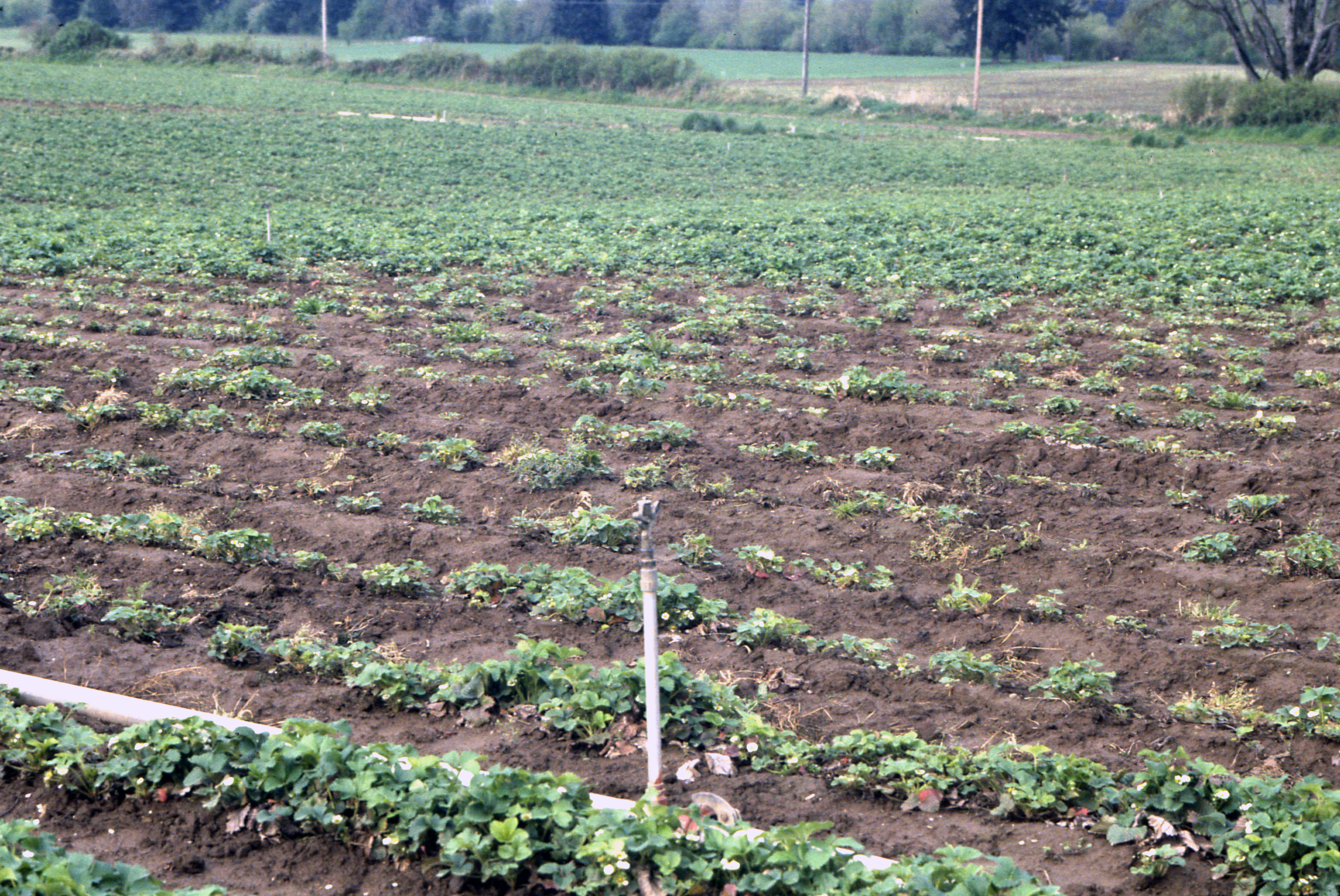
Note the circular damage pattern in this field, where plants are also affected by Verticillium wilt.
Photo by Jay W. Pscheidt, 1992.
Note the stunted, poorly growing plants.
Photo by Jay W. Pscheidt, 1992.
Older leaves wilt and dried out while inner (younger) leaves have remained green although stunted.
Note that a few roots near the center of the picture have been cut in half to show the light color of outer cortex and brick-red central core or stele.
Photo by Jay W. Pscheidt, 1993.
Plants in the valley, draws or lower areas show stunting first. The disease continues to spread to other plants as time goes on.
Heathy root system on the right and high nematode populations affecting the root systems in the middle and left.
Photo by Kathy Merrifield
Note the necrotic areas on these strawberry roots caused by the lesion nematode.
Photo by Kathy Merrifield
Cause Meloidogyne hapla, a nematode that lives in soil and attacks many other kinds of plants. Root-knot nematodes are sedentary endoparasites where only second-stage juveniles (the infective stage) and adult males (which may be rare) are found in the soil. The second-stage juveniles penetrate the tips of young roots.