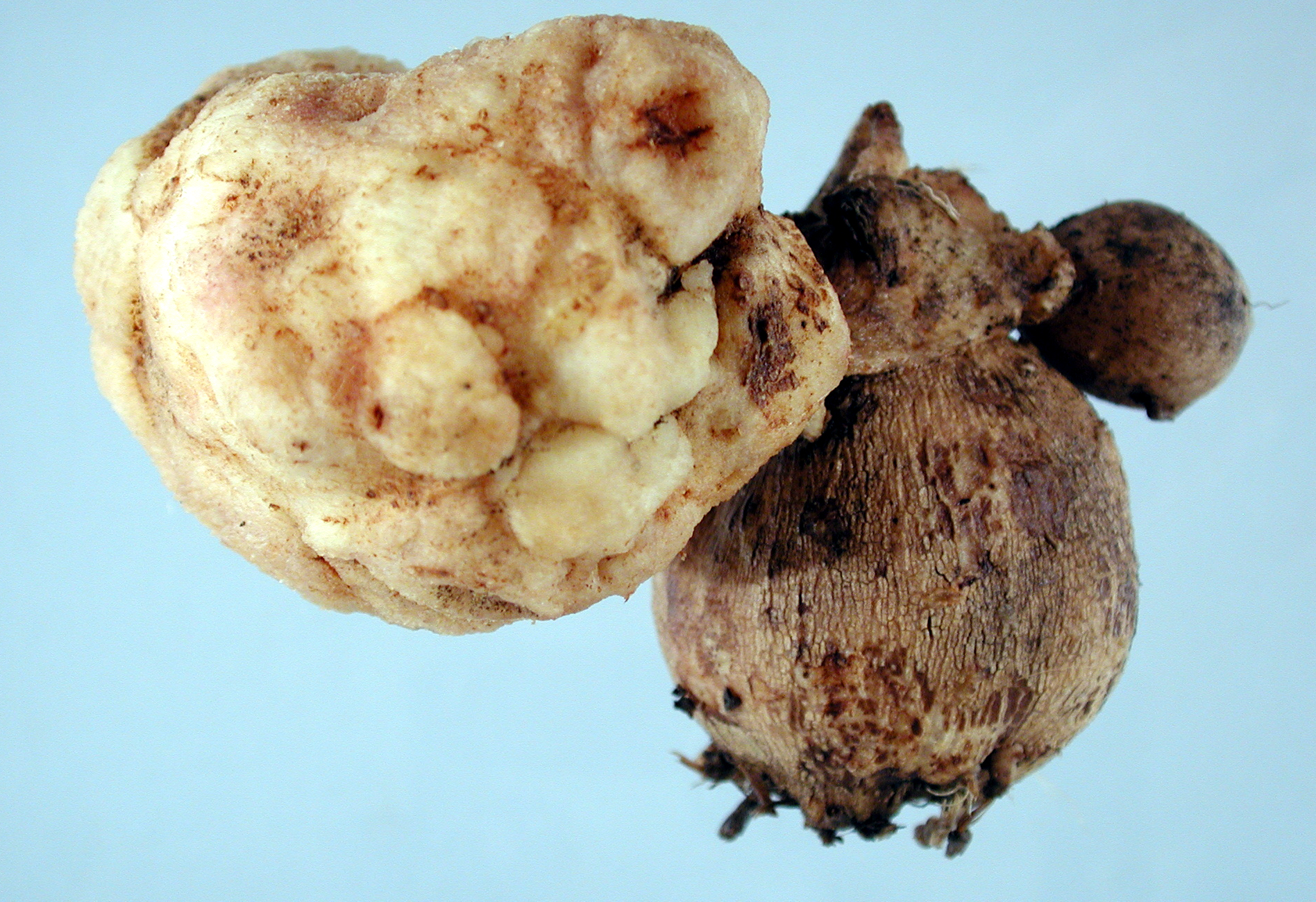
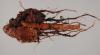
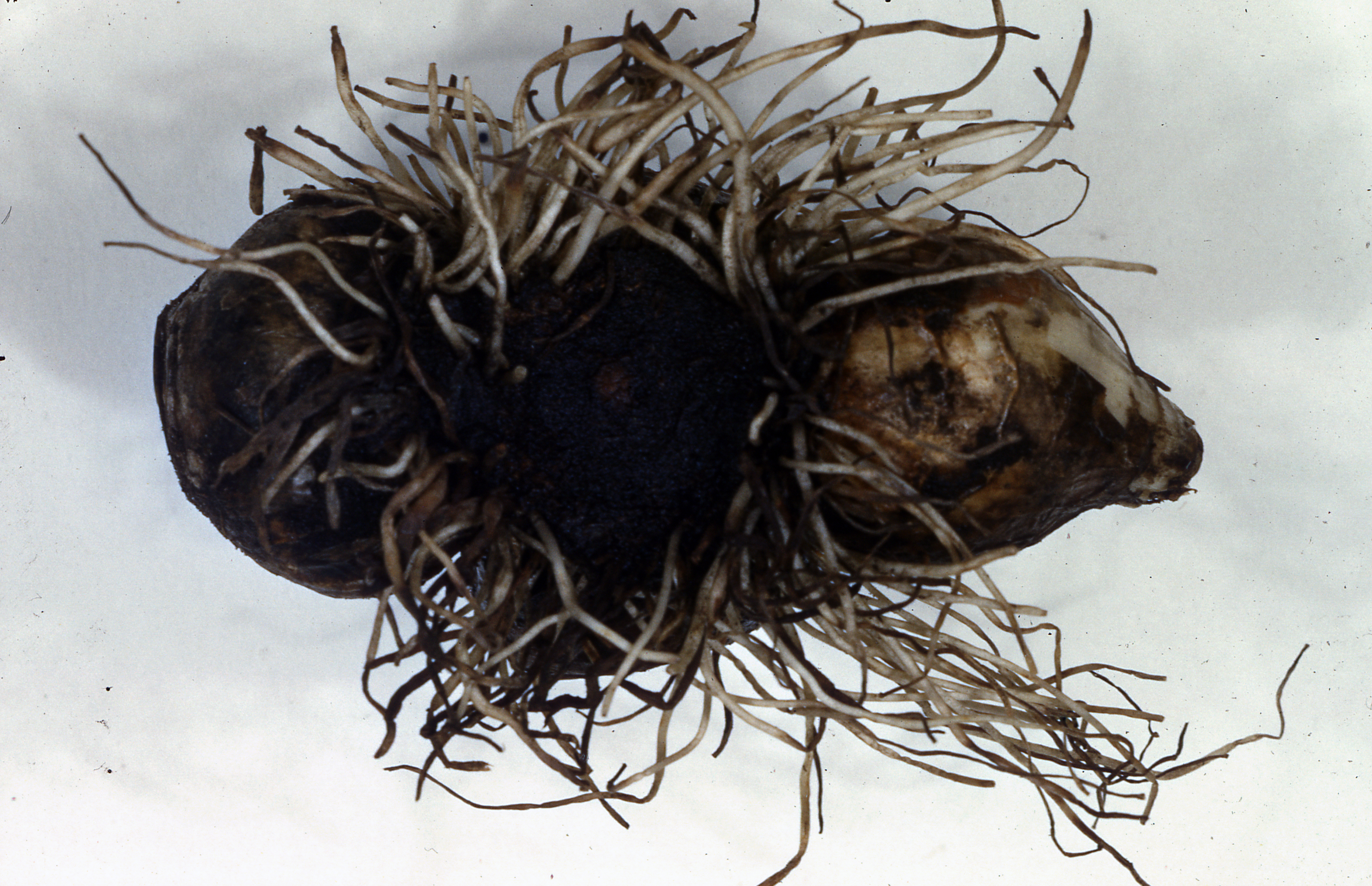
Tuber galls (left side) that tested positive for Agrobacterium.
OSU Plant Clinic image, 2015.
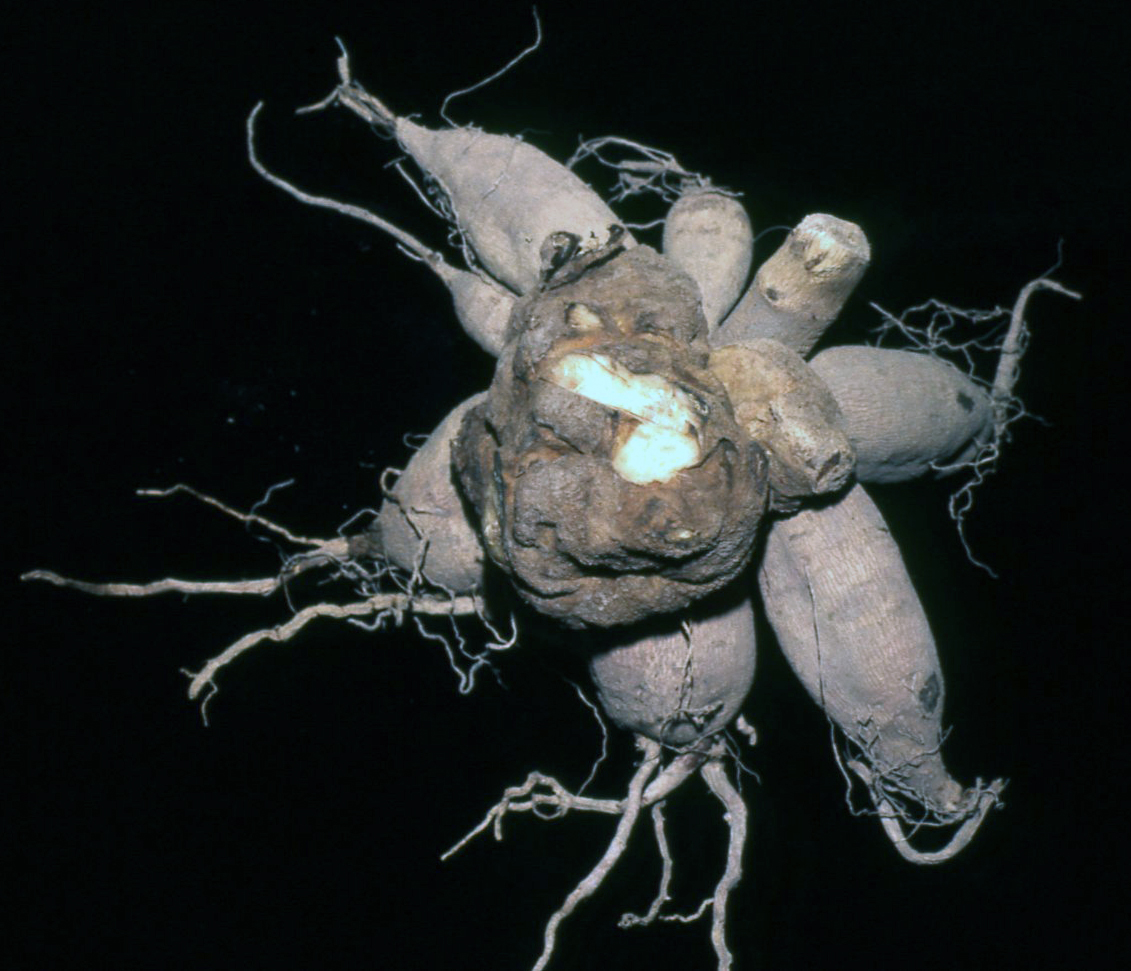
Galls begin as small warts, the tumor also changes surface color from cream to a darker brown as the gall ages.
Larry Moore collection, 1973.
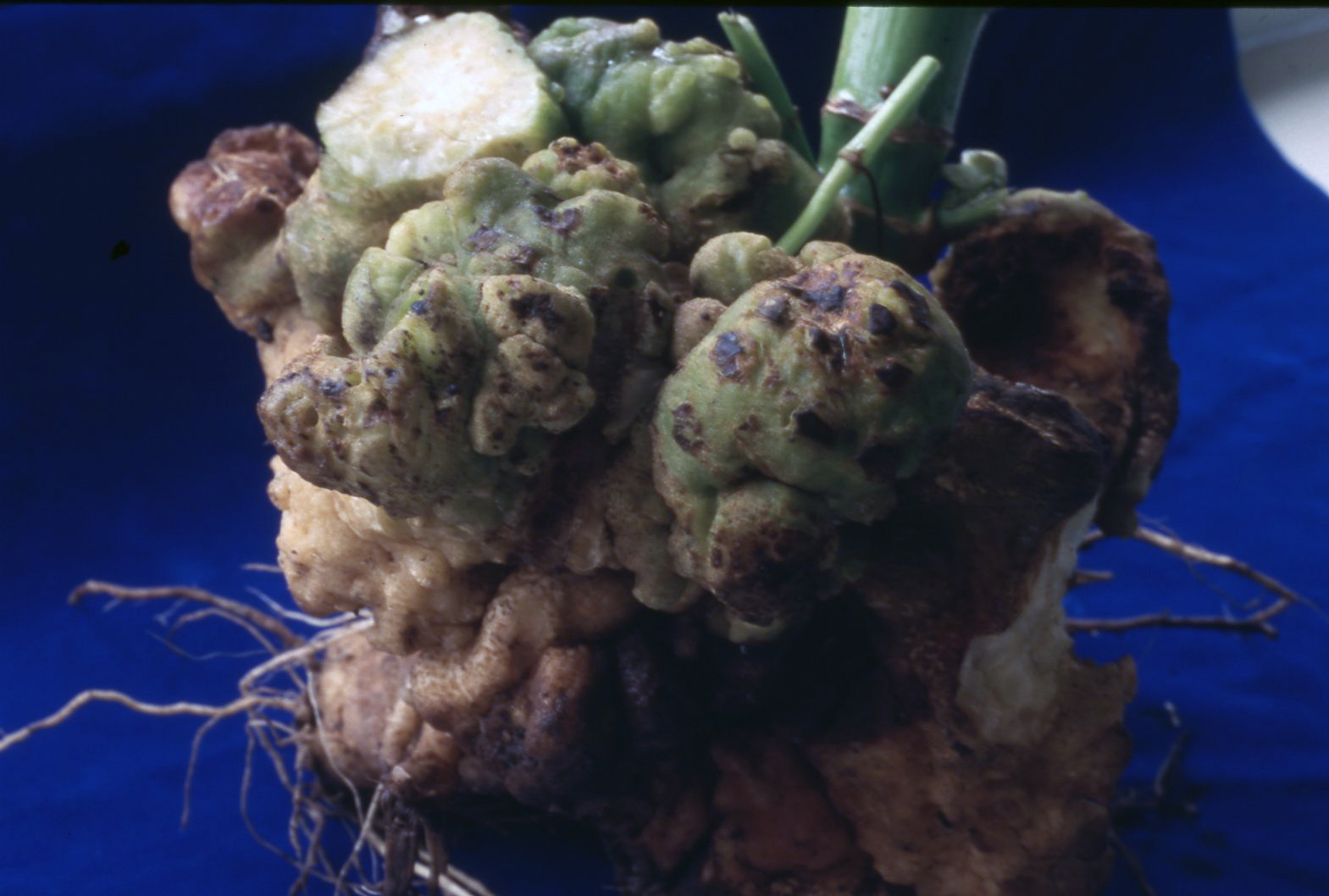
Galls can become larger than the tubers.
Larry Moore collection, 1997.
Cause The fungus Sclerotinia sclerotiorum is frequently encountered, however, several other fungi including Pythium spp. may cause similar symptoms. The fungus produces hard black sclerotia that help it survive from season to season without a host. Isolates from several vegetable and ornamental hosts can attack dahlia with varying degrees of pathogenicity. Potato flowers, which may be similar, are very susceptible to infection and are the main source of stem infection.
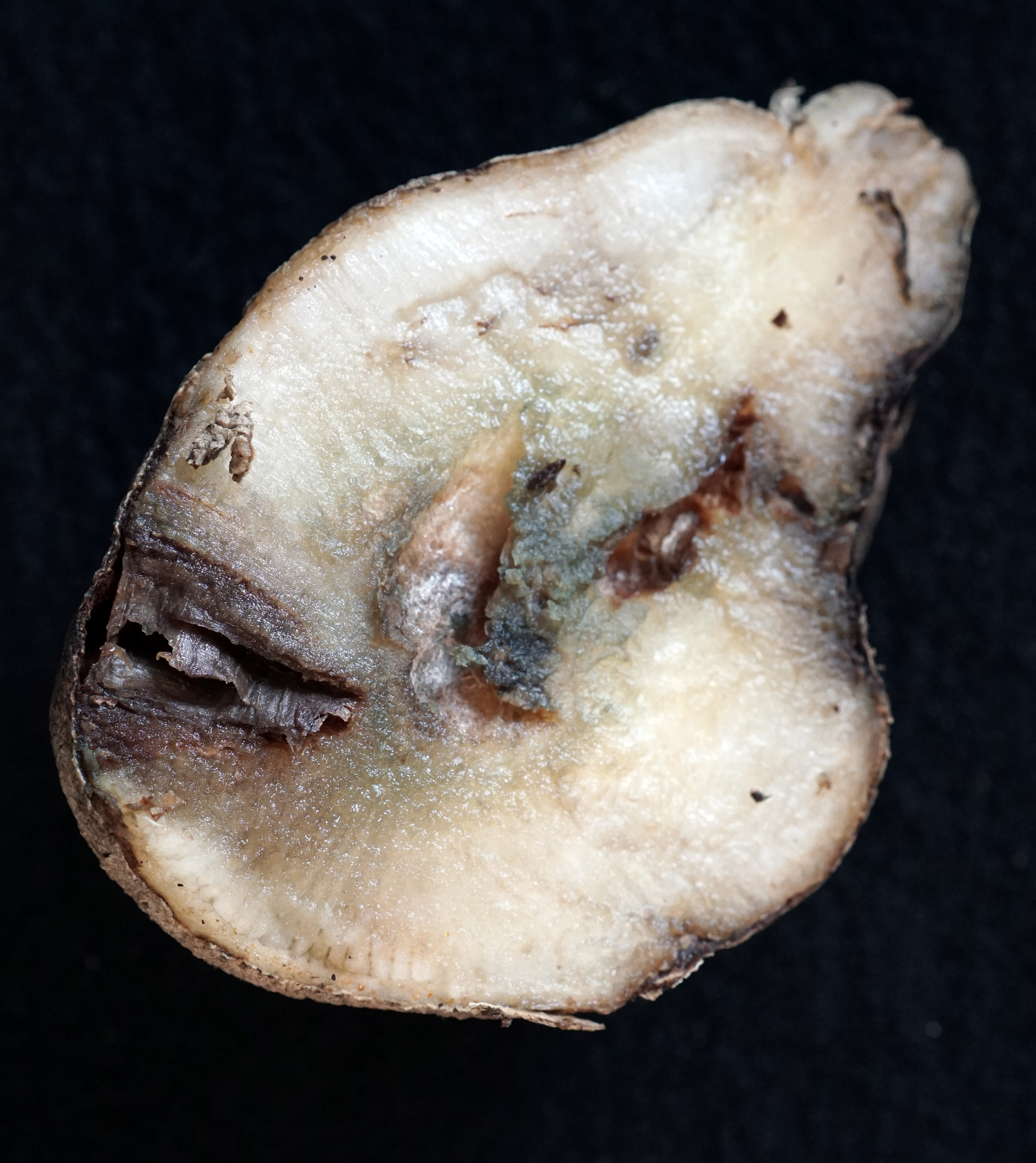
Tuber that was in an intermediate stage of decay where a Pseudomonas sp. was recovered.
OSU Plant Clinic, 2023.
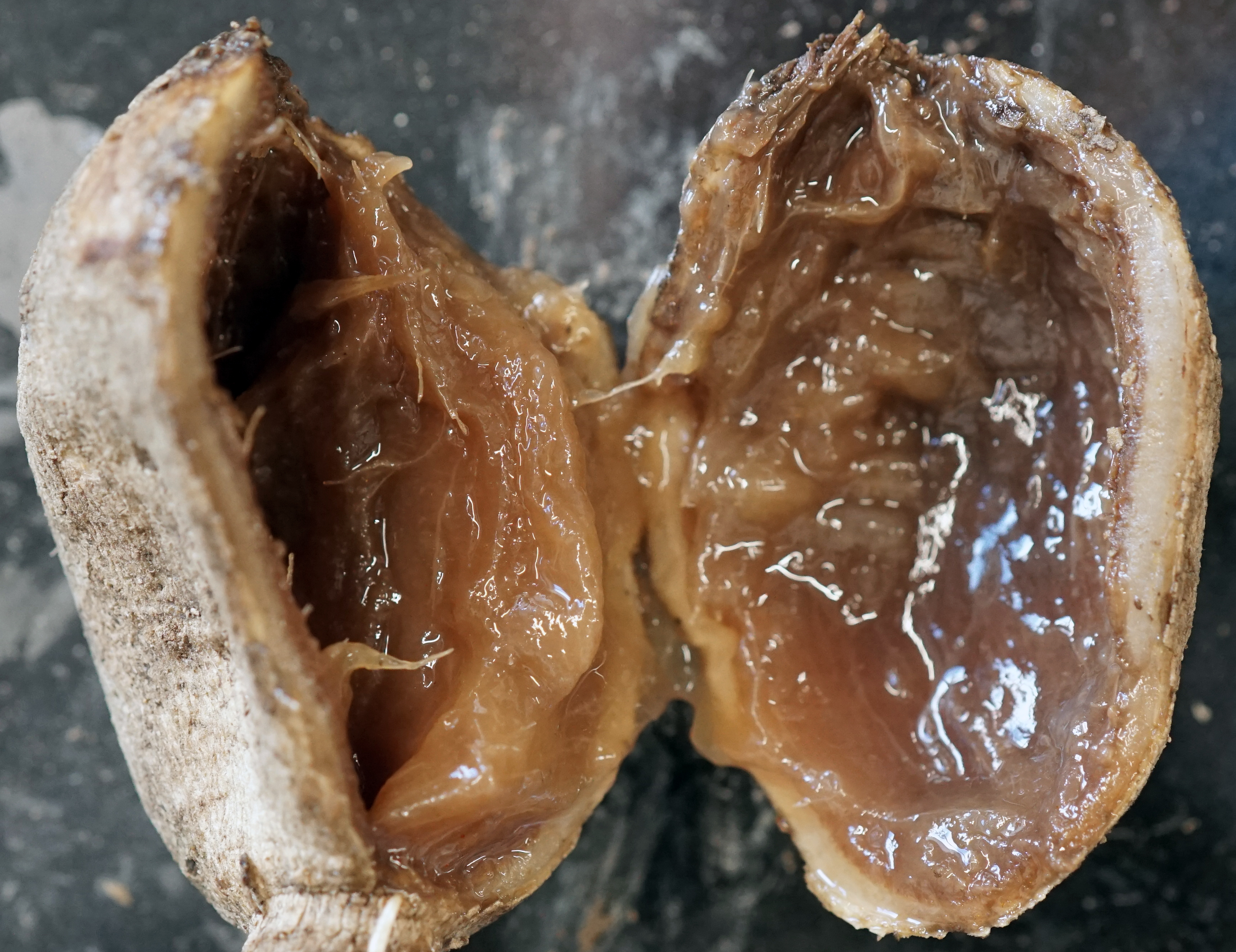
Advanced decay of tuber.
OSU Plant Clinic, 2023.
Cause Periodic episodes of cold weather (including frost events) during flower stem elongation can result in yellow banding of the flower stem and leaves. The alternating temperatures slow or speed up flower stem elongation.
Reference Hanks, G. R. and Chastagner, G. A. 2017. Diseases of Daffodil (Narcissus). In McGovern, R.J. and Elmer, W. H. (eds.) Handbook of Florists' Crops Diseases. Springer Int.
Cause Twenty-one viruses are known to infect daffodil. Two commonly observed are narcissus yellow stripe virus (NYSV) and narcissus white streak virus (NWSV). Both are potyviruses and, after more research, may be found to be the same virus. Aphids are a natural vector for these viruses but spread is slow. These viruses can also be spread by alternately handling healthy and infected plants during flower packing and other operations. They are not seedborne.
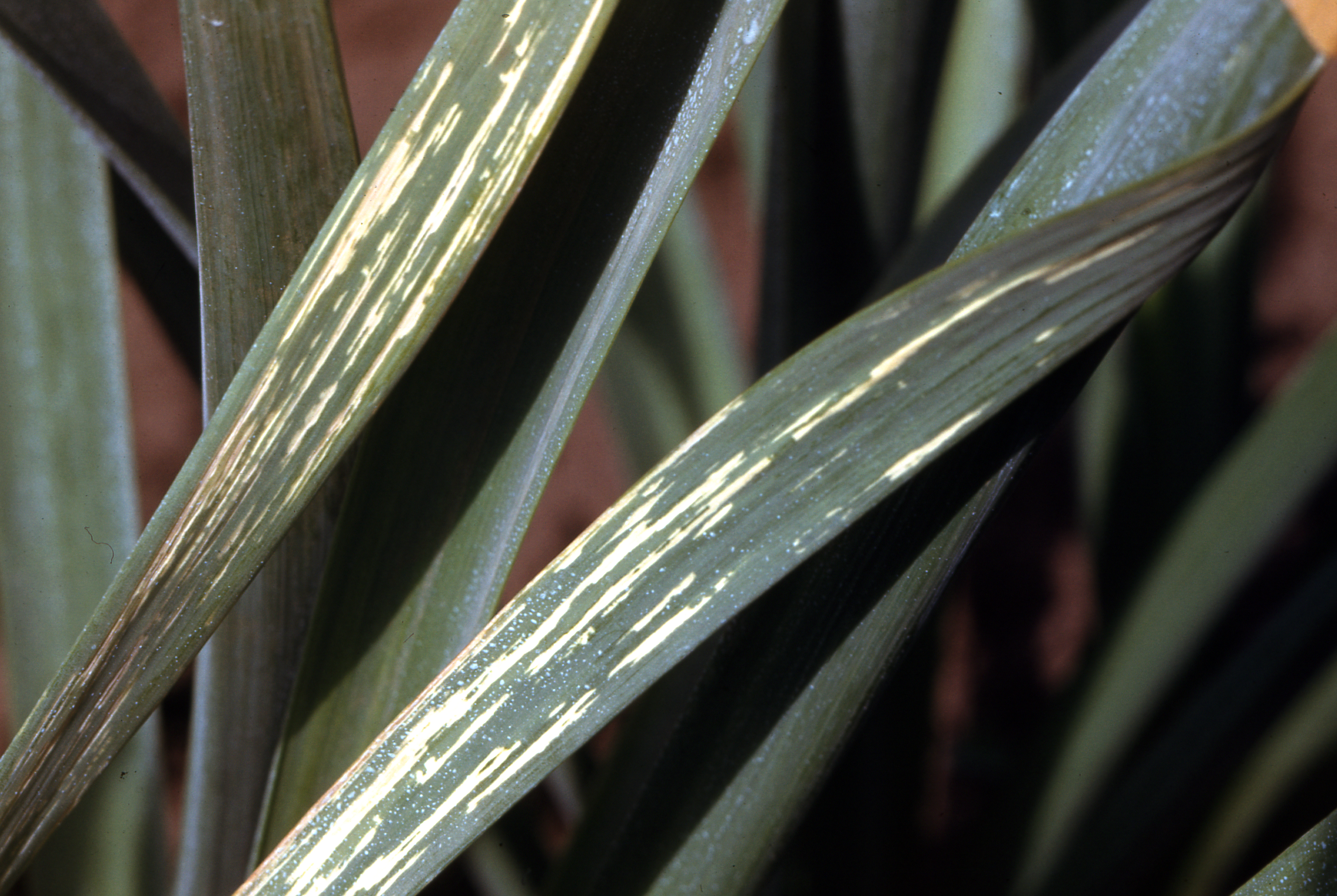
Narcissus Yellow Stripe symptoms occur on the terminal areas of the leaves.
Photo by Ralph S. Byther
This slide is labeled Narcissus White Streak.
OSU Extension Plant Pathology Slide Collection, circa 1950's.
Slide labeled as "Mosaic" on 'King Alfred' daffodil.
Cause Ditylenchus dipsaci. Infected bulbs are mostly responsible for carrying over infestations and establishing new ones. Stem nematodes infect aboveground plant parts and also are in soil. Can destroy a bulb stock in as little as 3 years. Although they can move short distances on their own, they can be spread passively by moving soil or water. Spread down rows in the direction of soil cultivation is common. The life cycle can be completed within the bulb in storage or in the field.
Infected bulbs have poor root development and a dark crater develops between the basal plate and the bulb scales.
Photo by Ralph S. Byther
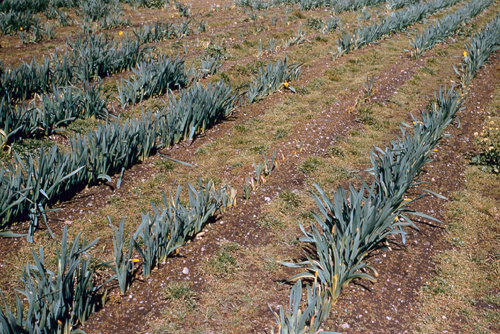
Stunted and missing plants due to this nematode.
OSU Extension Plant Pathology Slide Set, circa 1950's.
Cause Pratylenchus penetrans and P.crenatus. P. penetrans is much more important because of its general distribution and wide host range. Root-lesion nematodes are migratory endoparasites; part of the population is in soil and part in roots at all times.
Note the necrotic roots.
OSU Extension Plant Pathology Slide Collection, circa 1950's.