
See:
Rose (Rosa spp.) and hybrids - Crown Gall
Cause The bacterium Rhizobium radiobacter (formerly Agrobacterium tumefaciens) that causes crown gall was considered a rare problem on dahlia until the early 2020's when it became a problem in the industry. The bacteria enters plants through wounds, either natural or caused by pruning, grafting, mechanical injury from cultivation, heaving of frozen soils, chewing insects, or the emergence of lateral roots. Systemic populations that initiate disease are as important in rose as they are in grape and walnut. After the bacterium enters a wound, a small piece of its DNA is transferred into the plant's DNA. The foreign DNA transforms normal plant cells in the wounded area into tumor cells. Once transformed, tumor cells proliferate automatically. The result is a gall: a disorganized mass of hyperplastic and hypertrophic tissue.
Pruning tools that cut through galls can become contaminated with the bacteria and spread them to cut surfaces of subsequently pruned plants. Galls breaking down in soil release bacteria, which can be transported by moving soil or water. In the absence of plant roots, bacterial populations gradually decrease; however, the pathogen may survive in soil for as long as 3 years. Many plants in 90 families are susceptible but woody perennials such as stone and pome fruit, caneberries (such as blackberry and raspberry), euonymus, Photinia, poplar, rose, walnut, and willow are typically infected.
Leafy gall (Rhodococcus fascians) can also be a problem on dahlia. The dense cluster of growing points should not be used for propagation.
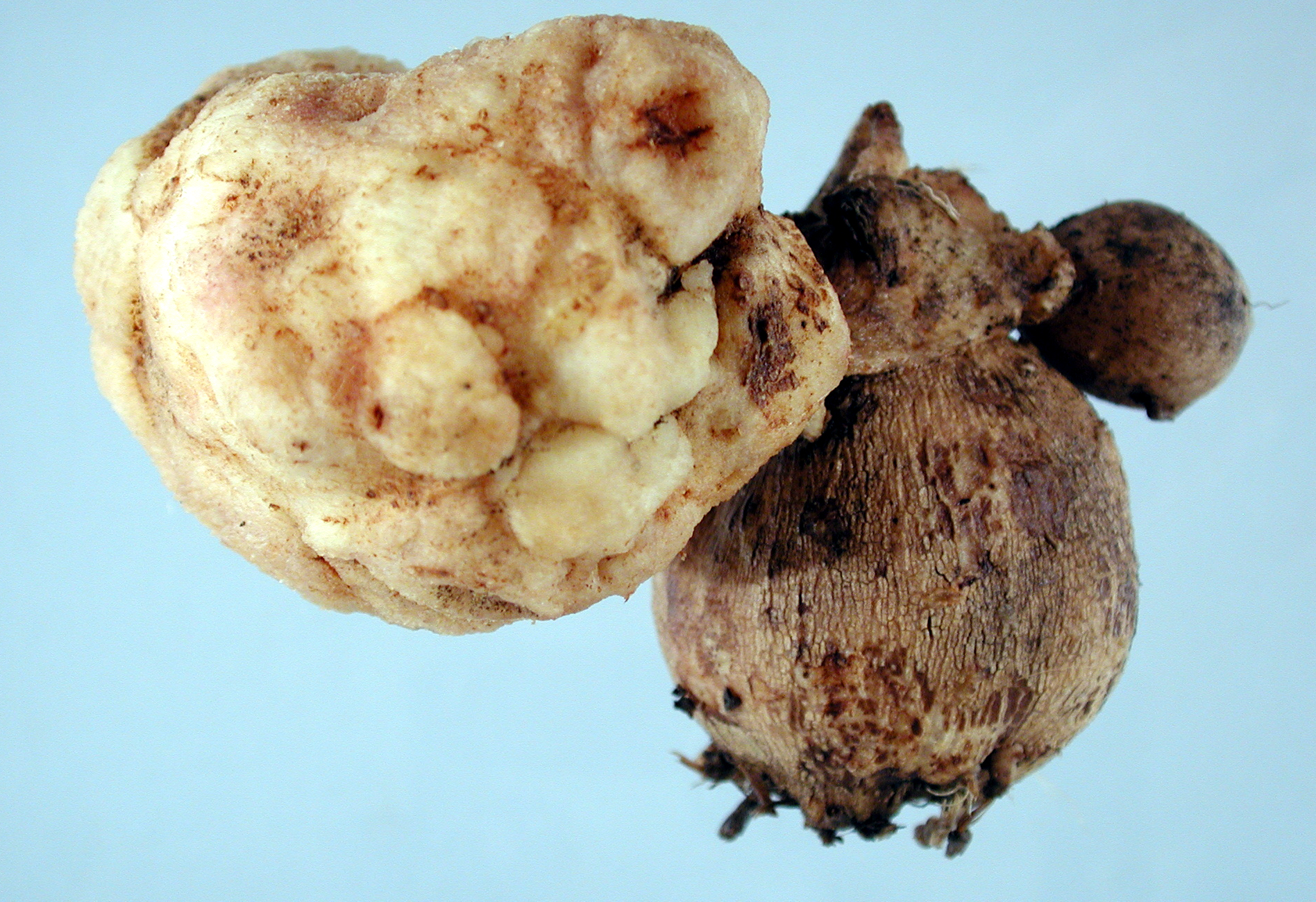
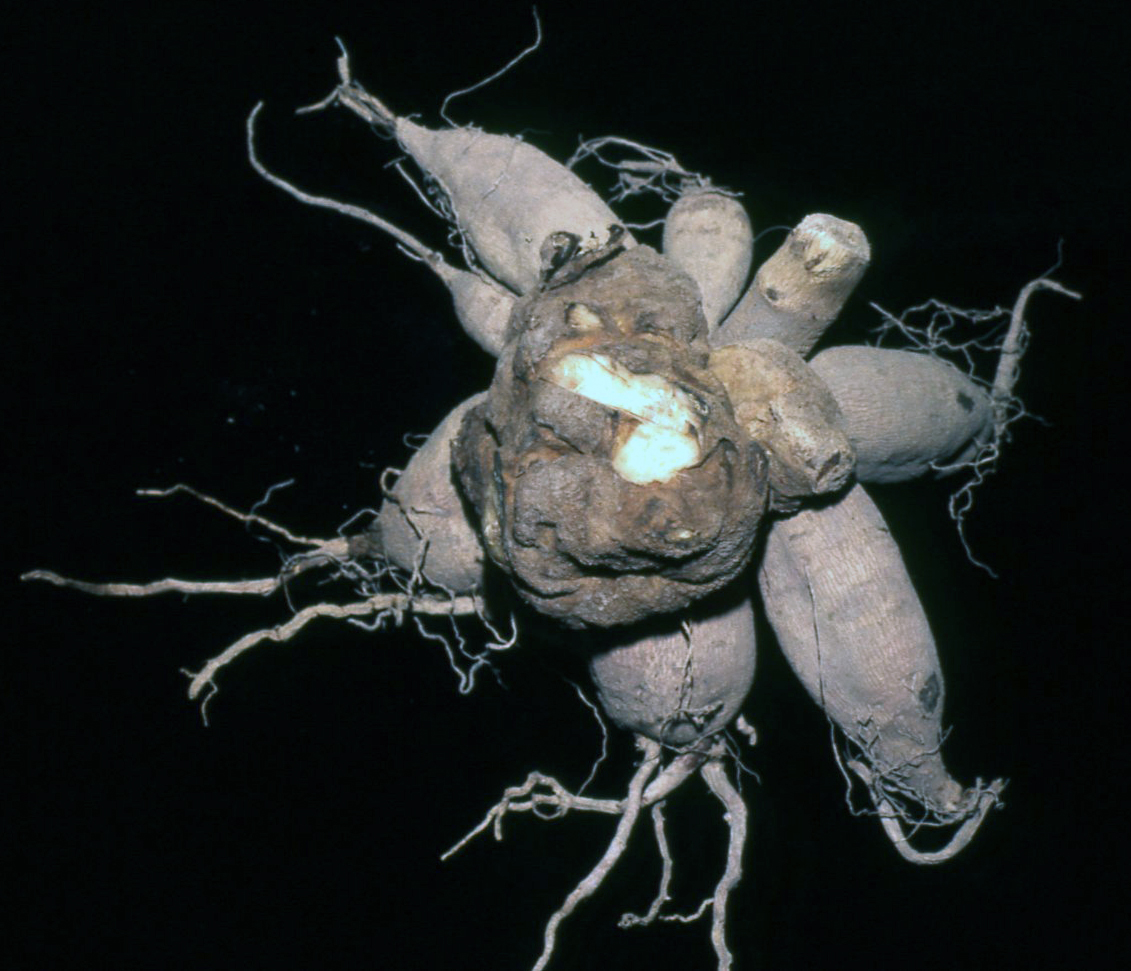
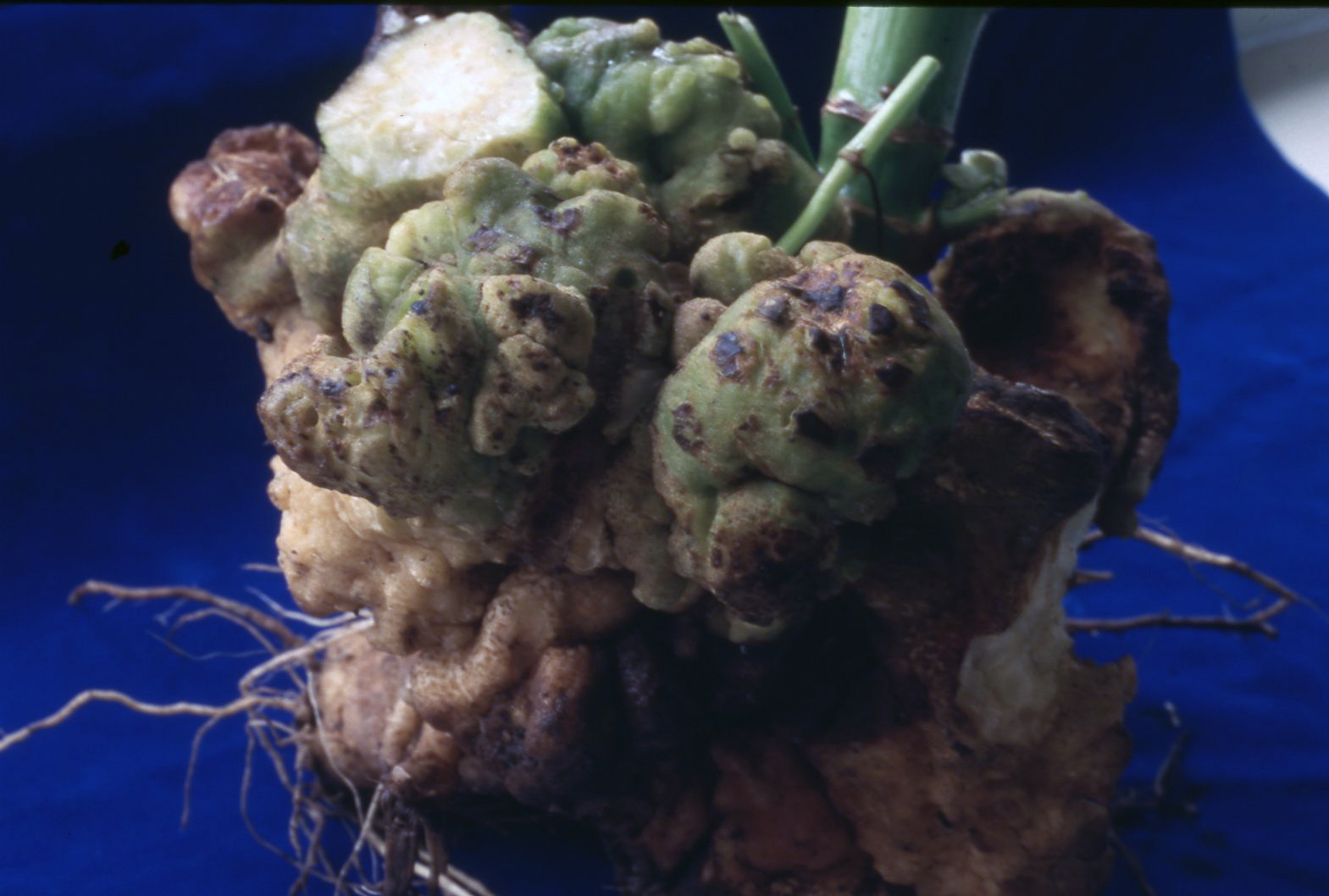
Symptoms Initially beginning as small warts, the tumor also changes surface color from cream to a darker brown as the gall ages. Its shambolic cell structure inhibits water and food-conducting transmission, leading to a decline in plant health. The crown gall bacteria live on amino acid derivatives that the host plant can't use, but which allow the bacterium to prosper. Most notably, a crown gall prevents new shoots from forming from the critical area of the crown zone.
Leafy gall - A mass of shoots, fused at the base, and do not develop into normal growth.
Cultural control
- Use only pathogen-free nursery stock. Inspect new plants and tubers; do not plant any that has galls.
- Avoid wounding plants, especially at planting.
- Disinfect pruning shears frequently. Clean shears and long soak times improve the disinfectant's efficacy. Disinfestants include bleach, peroxides, and quaternary ammonium products.
- Remove and destroy any affected plants.
- Use at least a 2-year rotation.
- Preplant soil solarization has been helpful in reducing populations of certain soilborne pathogens and weeds in western Oregon. Place clear plastic (preferably anti-condensation film) directly on smooth, rototilled ground, which has been irrigated to field capacity and then allowed to drain for 1-2 days. Bury the edges of the plastic to trap the heat. Solarize for 4-6 weeks (or longer) during the hottest part of the summer, beginning in early- to mid-July. The technique may help after removing diseased plants from a bed in which the same crop will be planted again.
Biological control Agrobacterium radiobacter strain 84 has been used successfully with roses in Australia, New Zealand, and Spain but has not been effective in limited trials in the United States. Strain K 84 is preventive only. Latent infections (symptomless) and existing galls are not controlled. A suspension of strain 84 may be used as a soak or spray. To be effective, it must be applied a few hours after wounding.
- Galltrol-A (Agrobacterium radiobacter K84). Not registered in Idaho. 12-hr reentry. O
- NOGALL at 8.8 oz/2.5 gal unchlorinated water per 2,500 nonbearing plants. Apply within 2 hours of lifting and/or damaging plants. Do not use with any pesticides or fertilizers. 4-hr reentry. O
Reference Mehlisch, M. 1933. Crown gall of Dahlias. Ratschlage fur Haus, Garten, Feld, 8:168.