The top branch has leaves that are a much lighter color than leaves on lower branch.
Photo by Jay W. Pscheidt, 1994.
Branch showing silver leaf symptoms on the left and normal branch on the right.
Jay W, Pscheidt.
Branch showing silver leaf symptoms stands out from all the other branches.
Jay W, Pscheidt.
Cause Tranzschelia discolor and T. pruni-spinosae, fungi widespread in prunes and plums. Rust has been considered a curiosity rather than a problem in Oregon; however, rust may be severe some years in prune plantings in western Oregon. The alternate host is Anemone sp.
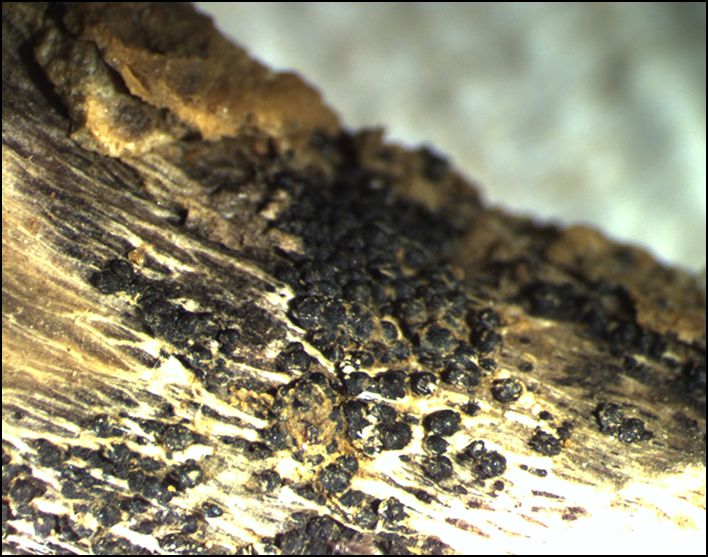
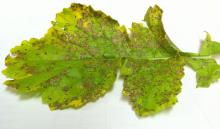
Upper side of leaves show angular chlorotic spots while lower leaves are showing black telia.
Notes Periodic surveys for the virus since 2000 have not found the virus in the Pacific Northwest nursery industry. Diseased plums are deformed with internal browning of the flesh and pale rings or spots on the stones.
Note Although the crown gall bacterium has a wide host range, plants more likely to have crown gall include all stone and pome fruit, caneberries (such as blackberry and raspberry), euonymus, Photinia, poplar, rose, walnut, and willow.
Note the enlarged areas on the roots in the lower portion of the picture.
OSU Extension Plant Pathology Slide Collection.
Flowering plum tree with crown gall in the center of root mass.