Plant Disease Management Handbook

Cause The soilborne fungi or fungus-like microorganisms, Pythium spp. and Rhizoctonia solani, attack before, during, and after germination. In Oregon, Pythium spp. are the major cause of pre- and post-emergence damping-off of young beet seedlings and are favored by cool soil temperatures.

Cause Cercospora beticola, a fungus perpetuated in beet refuse. It can be spread on seed produced in regions where the disease is severe. It is not a major disease in the Pacific Northwest but occasionally causes serious leaf spot. Other hosts include sugar beet, mangel, spinach, and Swiss chard. No resistant varieties of table beet are known.

Cause Beet western yellows virus has a very broad host range including crucifers, (both weedy and cropped). The virus persists in aphid vectors for more than 50 days.

Symptoms Older leaves turn chlorotic, yellowish spots appear between leaf veins, grow larger, and often merge. The leaves become thickened and brittle. Infected leaves are often attacked by secondary fungi.

Cause The beet yellows virus is perpetuated in members of the beet family but is not transmitted by seed. The virus persists in aphid vectors for 1 to 4 days.

Cause Beet mosaic virus (BMV) overwinters in infected members of the beet family (including sugar beets). The virus is spread by many aphid species but persists in the aphid vectors for only a few hours. Therefore, the virus moves fairly short distances from infected plants. The host range for BMV includes the families Chenopodiaceae, Solanaceae, Leguminosae, and others.

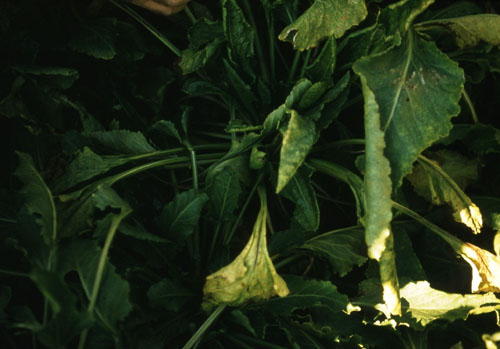
Cause Beet curly top virus is spread in North American only by the beet leafhopper (Circulifer tenellus). The virus has an extensive host range. The leafhopper breeds readily on mustards and overwinters in perennial or winter annual weed hosts, carrying the virus to beets and other crops in spring.

Image related to Beet, Red (Beta vulgaris)-Beet Curly Top

Go to:

By C. M. Ocamb and D. H. Gent

See:

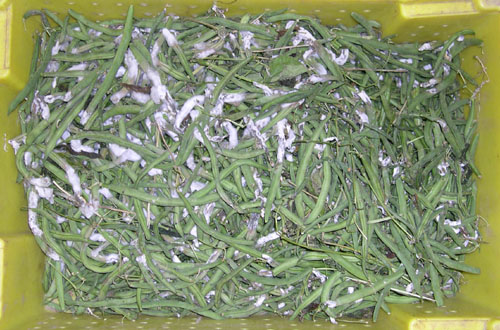
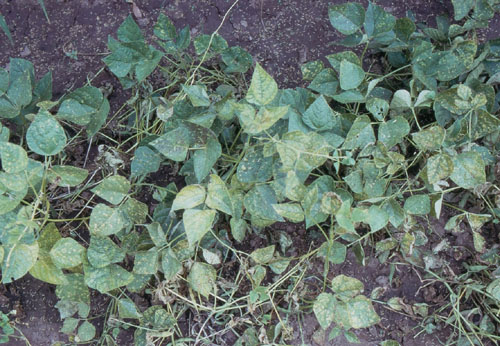
Cause The fungus, Sclerotinia sclerotiorum, causes white mold.

Image related to Bean, Snap (Phaseolus vulgaris)-White Mold (Sclerotinia Rot)

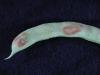
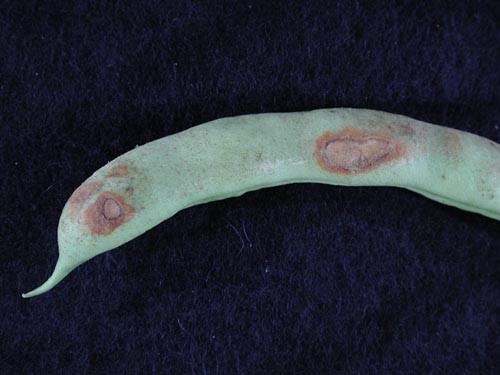
Cause Rhizoctonia solani, a fungus that is in most soils and has a wide host range. It has been observed on pods in the Willamette Valley.

Symptoms Pods have brownish, irregular lesions.

Cultural control

  • Rotate with cereals or corn.

Chemical control

Image related to Bean, Snap (Phaseolus vulgaris)-Web Blight

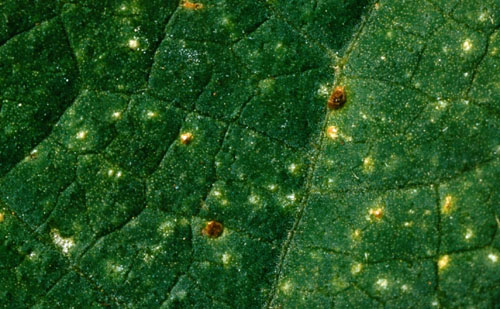
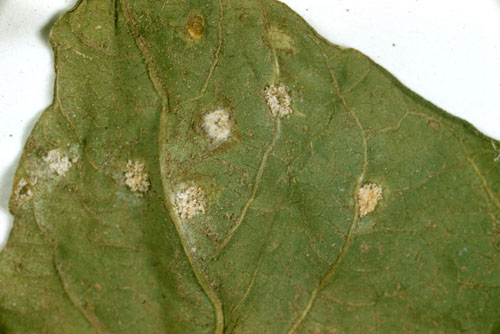
Cause The fungus, Uromyces appendiculatus (formerly Uromyces phaseoli), causes rust. It has had minor importance for many years. When present, the disease is widespread in the major bean-growing areas of the Willamette Valley of Oregon. It is not known to be in Idaho. Disease is favored by moderate temperature and high humidity or moisture.

Image related to Bean, Snap (Phaseolus vulgaris)-Rust