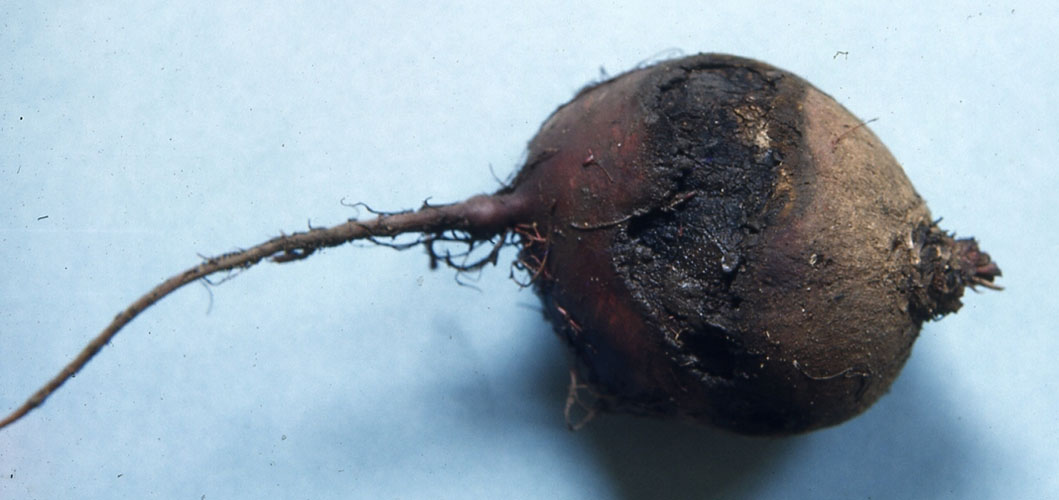
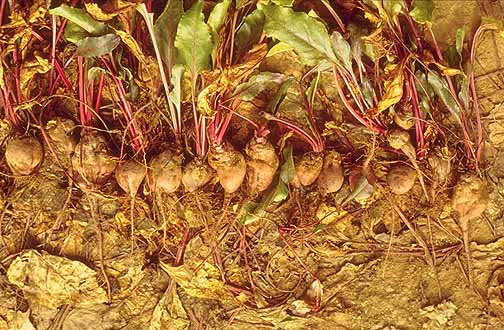
Note Aboveground symptoms include poor vigor with senescent, yellowing leaves. Initially, roots or portions of roots are brown, then develop flat, black root lesions with the formation of chlamydospores on the root surface and in the root cortex.
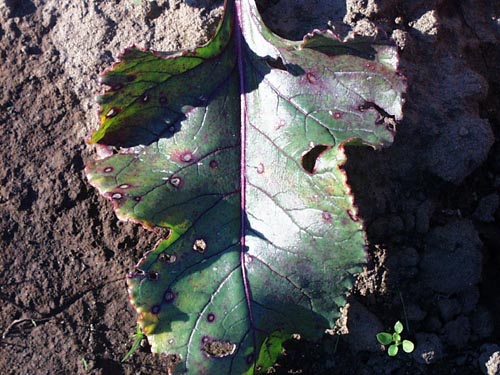
Cause The fungus, Uromyces betae,which does not require an alternate host to complete its lifecycle. It overwinters on volunteer beets and in infected plant debris and may also be seedborne. Disease development is favored by cool (59°F to 70°F), moist weather. The disease commonly occurs late in the season but usually is not destructive enough to reduce yields.
Uredia on beet leaf.
OSU Extension Plant Pathology
Cause Rhizoctonia solani is a fungus that has a broad host range and survives primarily as mycelium or sclerotia in plant debris. Rhizoctonia solani becomes active when soil is 77°F to 91°F, attacking any part of the plant in contact with soil. The fungus is favored by poor soil structure and high soil moisture. Infections can move plant-to-plant, creating diseased "pockets" in a field.
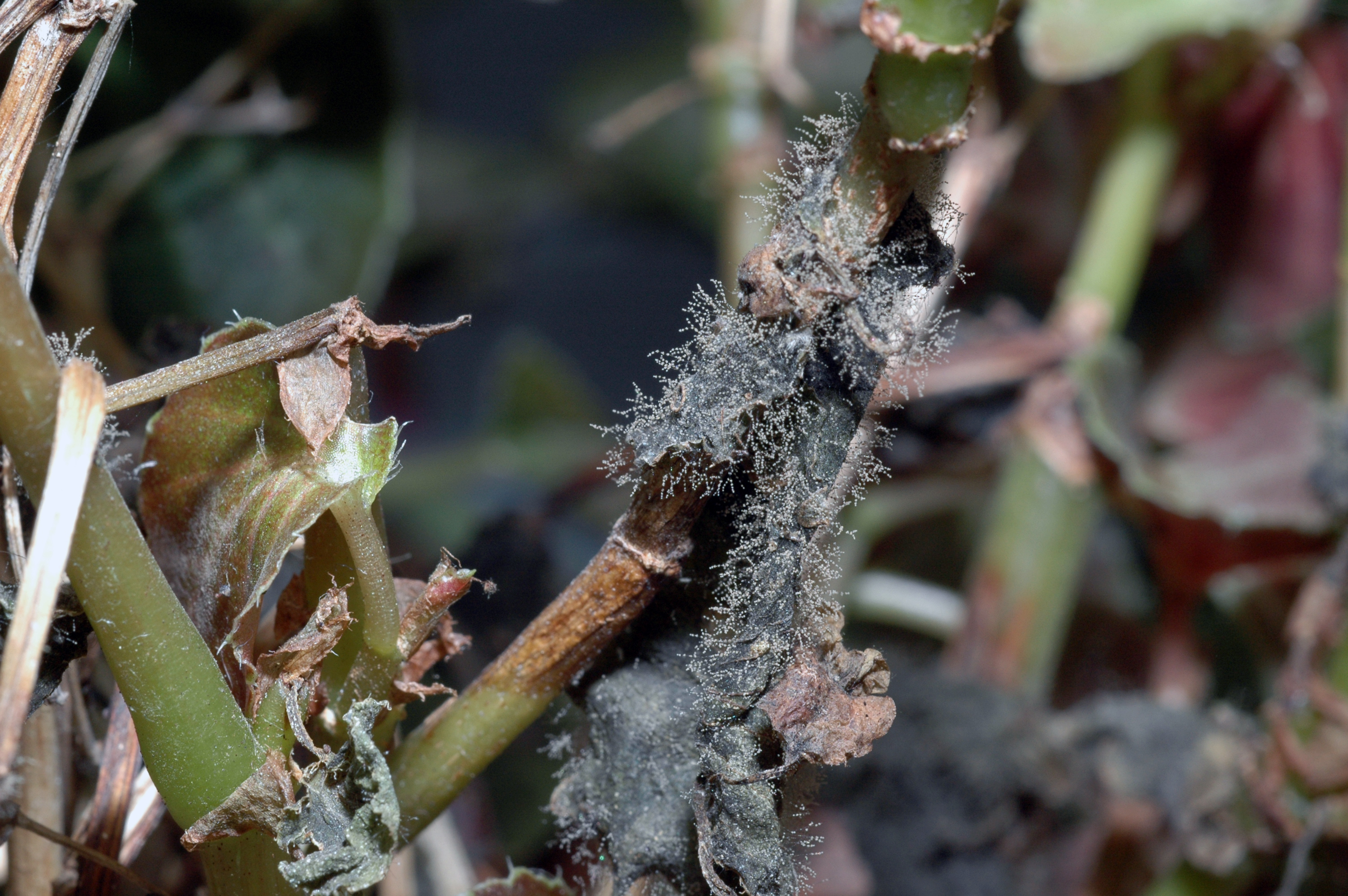
Cause The fungus, Erysiphe betae (= E. polygoni = Microsphaerabetae). The disease has been widespread in several western states. Spores may be blown in from overwintering sources. Overwintered infected seed beets may also be sources of infections. The fungus tolerates a wide range of environmental conditions.
Symptoms On leaves, necrotic crosshatching is on the inside of the petiole. Young leaves turn brown and die, resulting in a rosette of small dead leaves at the top of the beet. In the fleshy root, internal and external black spots of necrotic tissue develop.
Cultural control
Note external black spot of necrotic tissue.
OSU Extension Plant Pathology
Note necrotic tissue.
OSU Extension Plant Pathology
Cause The fungus-like microorganism, Peronospora farinosa (= P.betae = P.schachtii), causes disease mostly west of the Cascade Range. In the Willamette Valley of Oregon, susceptible varieties often are a total loss. The microorganism survives in infected crop residues and in wild or volunteer Beta spp.; the downy mildew on lambsquarters does not affect beet.