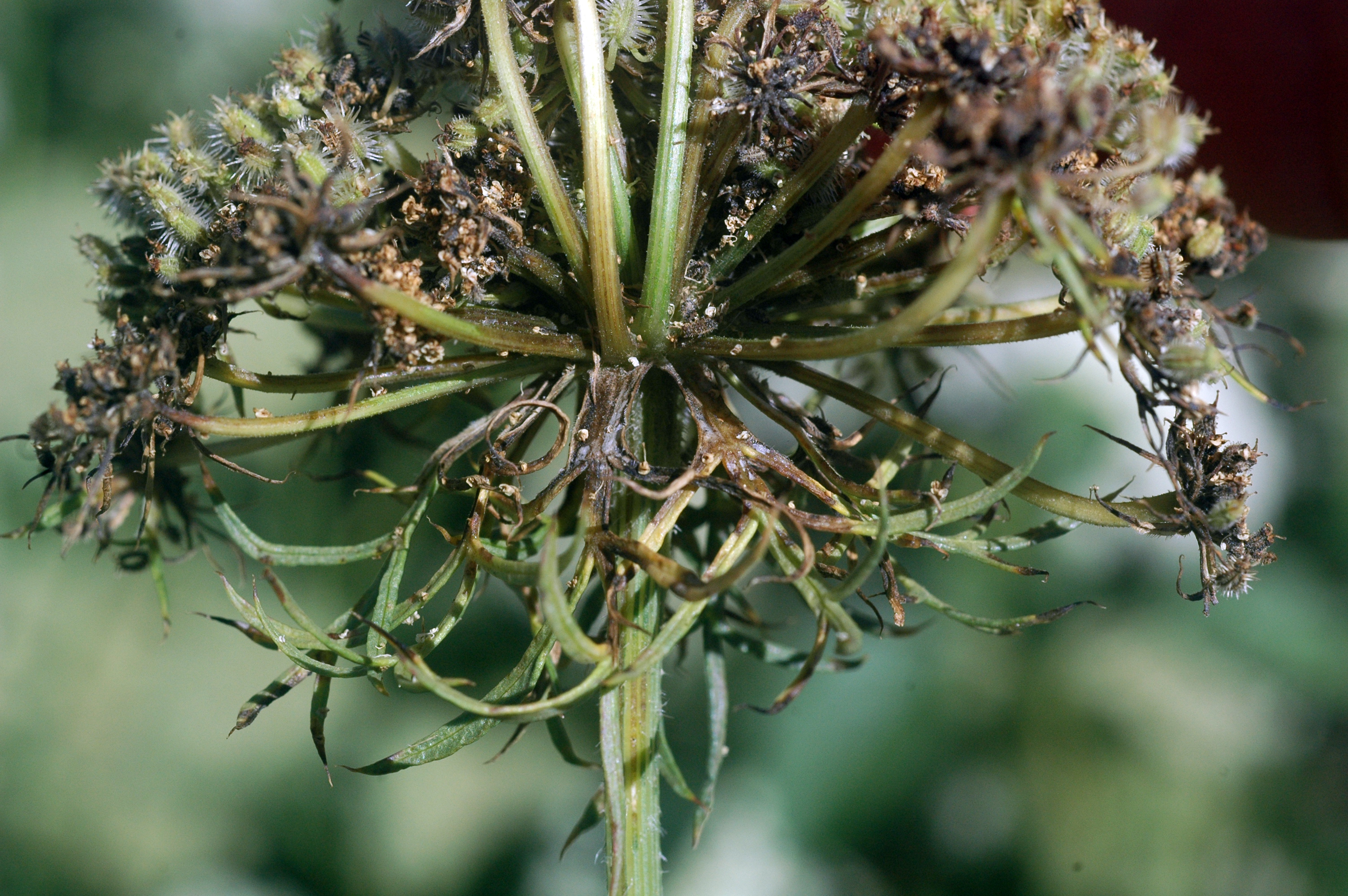
Cause The fungus, Cercosporacarotae, overwinters in infected crop debris or on alternate hosts. Leaf spots are common in carrots grown for seed production in western Idaho and eastern Oregon.
OSU Extension Plant Pathology
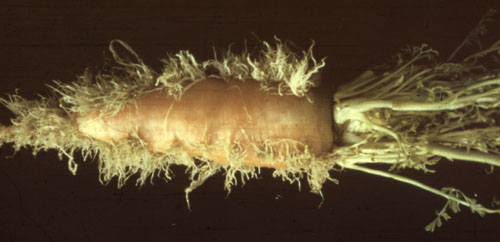
Cause Several species of Pythium, including P. ultimum (syn. Globisporangium ultimum), P. violae (syn. G. ultimum), and P.sulcatum. These are fungus-like microorganisms that live in organic matter in soil.
Cause Erwiniacarotovora subsp. carotovora (syn. = Pectobacteriumcarotovorum subsp. carotovorum), a bacterium that survives in decaying refuse. It enters the root principally through cultivation wounds, harvest bruises, freezing injury, and insect openings. After infection, high humidity is essential for progress of the disease.
Melodie Putnam 2006, Oregon State University
CauseXanthomonas hortorum pv. carotae (syn X. campestris pv. carota) is a bacterium that can be particularly damaging to carrot seed crops. The pathogen can be transmitted in or on seed and can also survive in diseased plant debris. Xanthomonas is spread by wind-blown rain, splashing of irrigation water, or mechanically by insects. Warm, wet conditions favor disease development.
Cause There are 11 viruses reported for carnation. The 1973 WSUPlantDiseaseControlHandbook lists carnation mosaic virus, carnation streak virus, and carnation yellows virus as problems. Carnation vein mottle virus was diagnosed once on carnation by the OSU Plant Clinic.
Carnation vein mottle virus symptoms include chlorotic spotting and mottling of younger leaves as well as flower color break as shown here. Symtoms may be more intense when co-infected with Carnation mottle virus.
Fusarium sp. was found in the roots and crown of this carnation.
OSU Plant Clinic Image, 2013.
Cause Uromycesdianthi, a fungus, has been reported from all three states of the PNW. Does not need the alternate host (Euphorbia spp.) to be a problem. Can be spread by importation of diseased nursery stock. The urediniospores can remain viable for 185 days. They are spread by wind, splashing water, or by infected cuttings. Germination is best at 50°F along with a film of water on the leaf surface that lasts for 9 to 12 hours.
Botrytis is just starting to sporulate on these infected petals. Conidia can be seen in the center of this image as well as necrotic floral tissue on either side.