Plant Disease Management Handbook

Cause Red clover vein mosaic virus. This disease has been reported at low levels in eastern Washington. Red clover is also a host and the virus is spread by aphids.

Symptoms Plants may exhibit a mosaic with bud proliferation and malformation of leaves and branches. A severe stunting can also occur as well a severe reduction in flower and pod numbers.

Cultural control

Cause Several fungi or fungus-like microorganisms including Aphanomyces euteiches, Fusarium solani, Thielaviopsis basicola, and Pythium spp. Each survives in soil a long time and produces resistant survival structures. F. solani is favored by lighter soils and soil temperatures above 75°F.

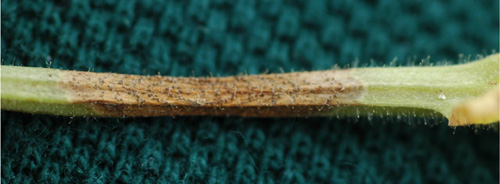
Cause Ascochyta rabiei (syn. Phoma rabiei; teleomorph stage: Didymella rabiei, syn. Mycosphaerella rabiei), a fungus that can be carried in and on seed and in infested crop residue.

Image related to Chickpea (Garbanzo Bean) (Cicer sp.)-Ascochyta Blight

See:

Note Out of a dozen samples there was only one diagnosed with Verticillium wilt by the OSU Plant Clinic.

Cause Cryphonectria parasitica (formerly Endothia parasitica), a fungus. Chestnut blight has been reported from all Pacific Coast States and provinces but is not commonly found. Latest report for Oregon was in 1934 in an orchard near Gunter. Oregon continues to quarantine all Castanea (Chestnut) and Castanopsis (Chinquapins) spp.

Cause Pseudomonas sp., a bacterium. There are few descriptions of this disease. It has been reported in Japan and found in Oregon. The bacterium in Japan was named Pseudomonas syringae pv. castaneae.