Plant Disease Management Handbook

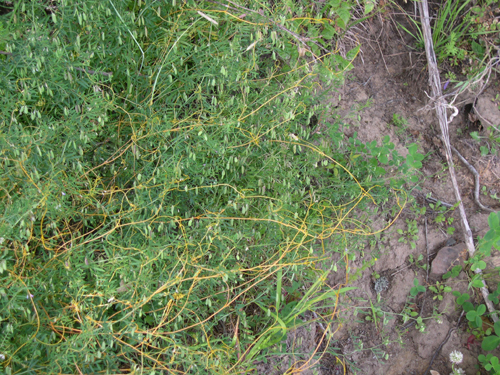
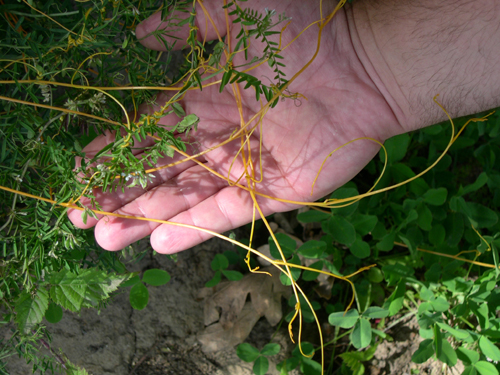
Cause Annual, parasitic seed plants belonging to the genus Cuscuta, which live on clover and other plants including commercial crops and weeds. Dodder plants consist of rootless, leafless stems that encircle and penetrate clover stems, diverting host nutrients. Dodder is favored by high temperatures and full sunlight. Dodder seed can remain viable in the soil for 20 years.

Image related to Clover (Trifolium spp.)-Dodder

Cause The soilborne fungi or fungus-like microorganisms, Fusarium spp., Pythium spp. and Rhizoctonia solani, may attack before, during, and after germination. In the Pacific Northwest, Pythium spp. are the major cause of pre- and post-emergence damping-off of young clover seedlings. Pythium is favored by cool, wet soils.

Cause Orobanche minor (clover broom-rape) is a federally listed noxious weed that has quarantine significance to many of Oregon's trading partners.

From 1923 to 1997, there have been 6 reports of clover broom-rape in Oregon. In 1998, clover broom-rape was identified in a single field. In 2000, clover broom-rape was found in 15 fields in northwestern Oregon. Native species of broom-rape can be found in all parts of Oregon.

Image related to Clover (Trifolium spp.)-Black Stem

Cause Erysiphe aquilegiae (formerly Erysiphe polygoni), a fungus that is frequently on plants growing in shaded areas. Has been reported from Washington and observed in Oregon. The disease can reduce both plant quality and vigor. The time between infection and symptom development ranges from 4 to 11 days at temperatures from 50°F to 85°F, respectively.

Cause Calophoma clematidina (formerly Ascochyta clematidina), a fungus that overwinters in leaf and stem debris. Spores shed from pycnidia that form on old infected stems. After germination, the fungus enters leaves and stems by direct penetration of the cuticle, often, but not always, following the formation of infection structures.

Image related to Clematis-Leaf and Stem Spot
Image related to Chrysanthemum-White Rust