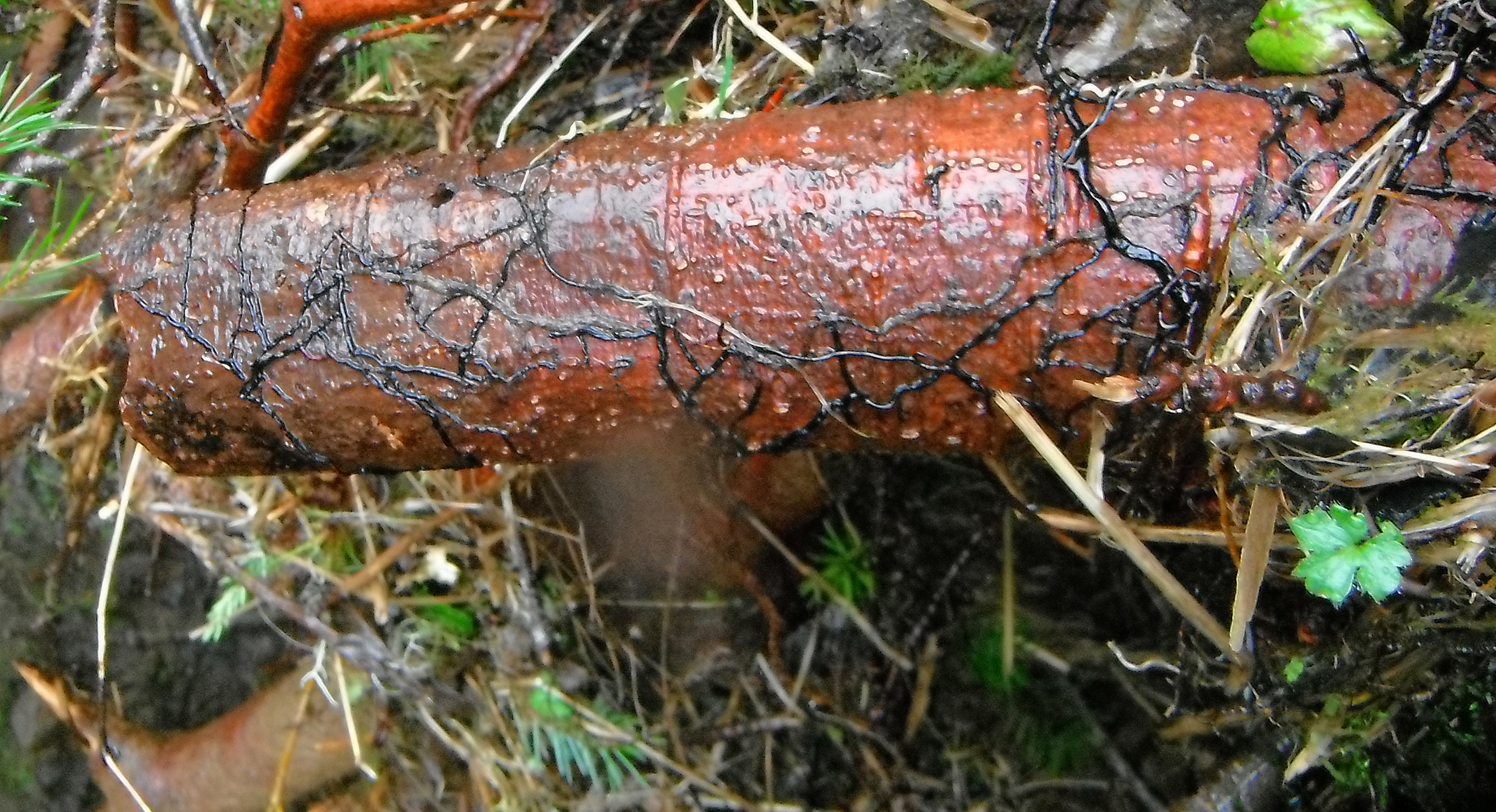
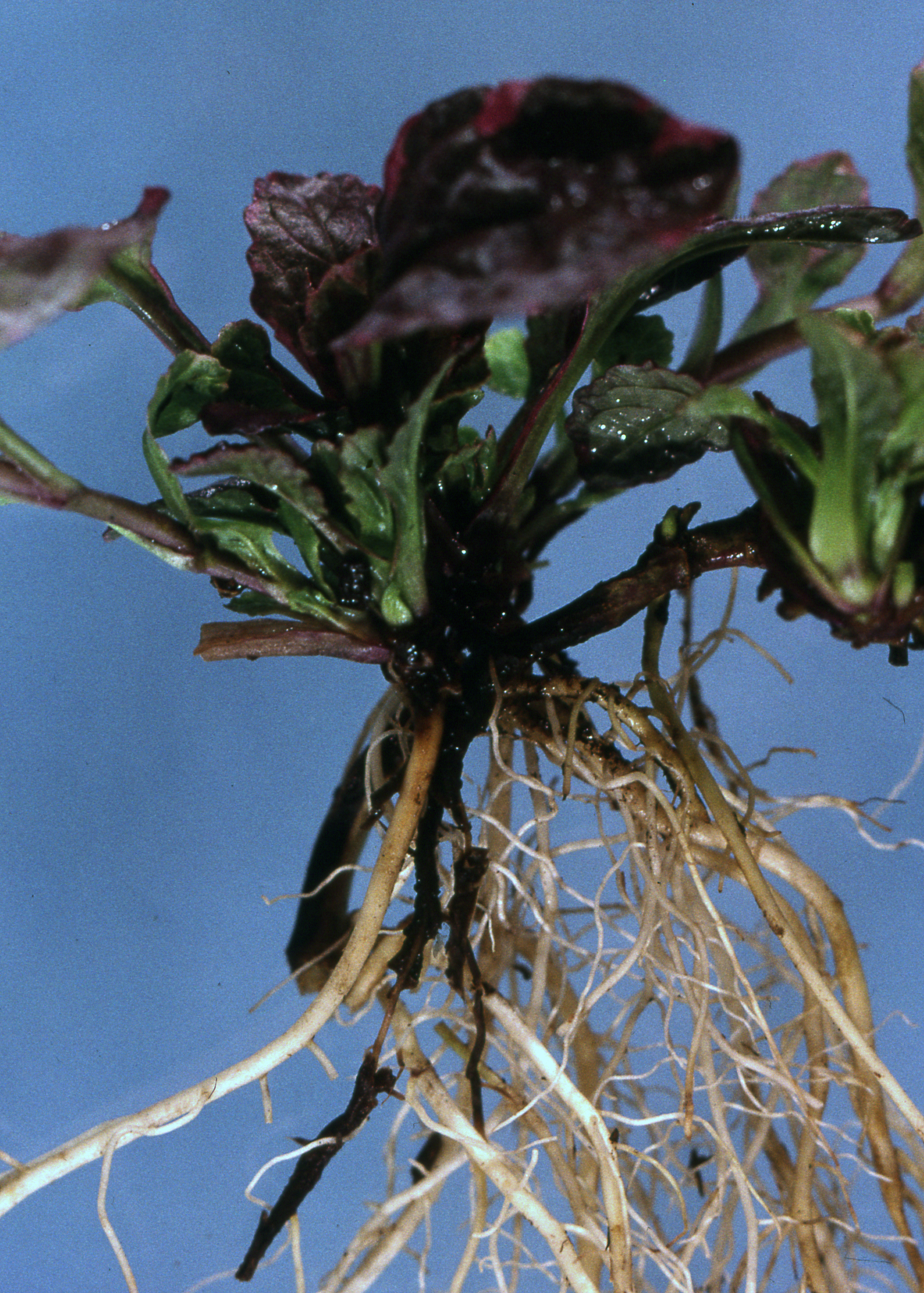
What look like little black roots on this root piece are rhizomorphs of the fungus.
Laura Sims, 2012.
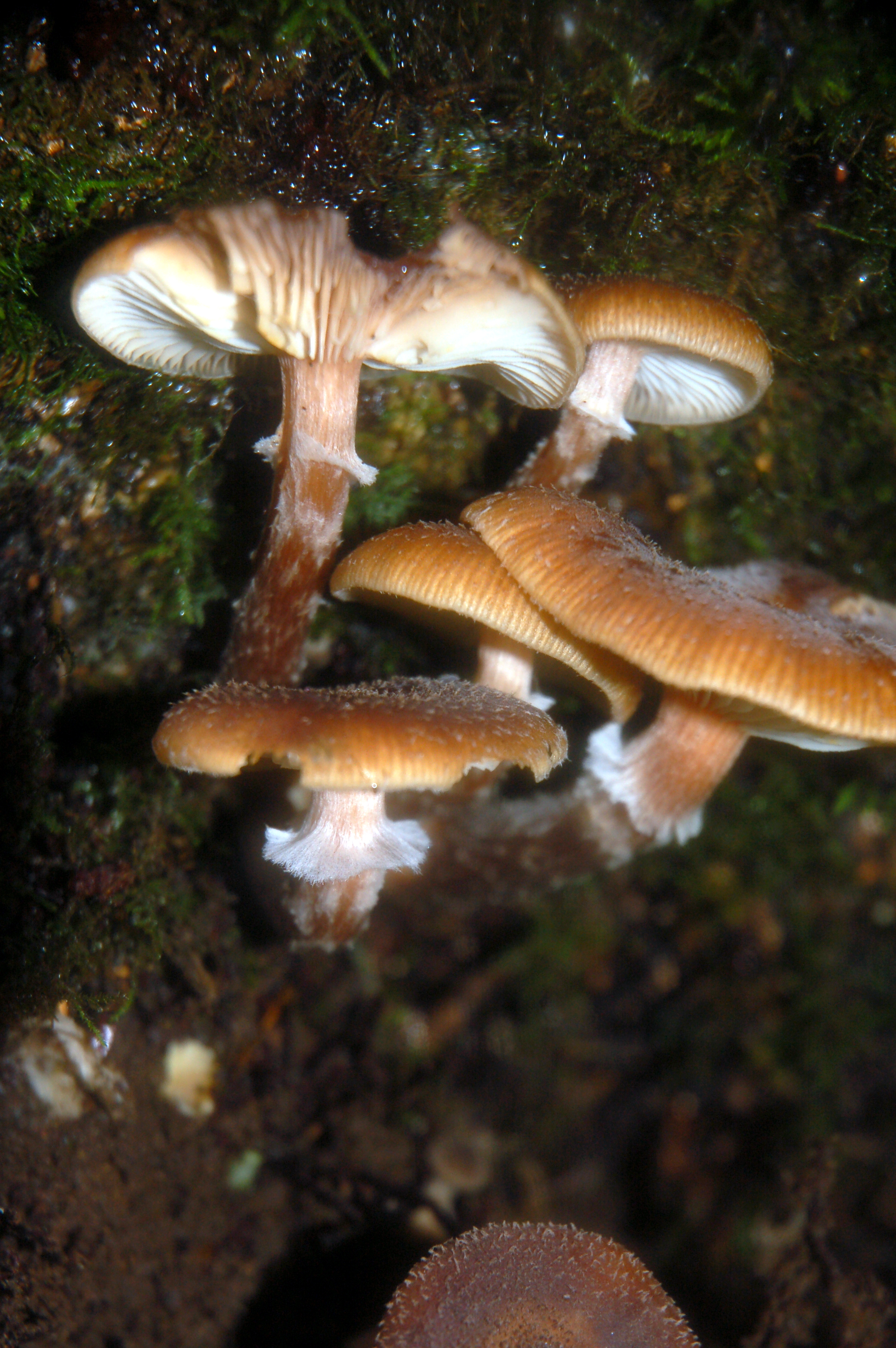
Armillaria fruiting bodies.
Laura Sims, 2012.
Cause Both Golovinomyces biocellatus and Neoerysiphe galeopsidis have been reported on Ajuga from North America. Powdery mildew has not been reported formally for the Pacific Northwest, but it is a common problem. This fungus is favored by conditions that produce high humidity but dry leaves. It is a highly specialized pathogen that forms a close association with the host. Conditions that favor the host also favor the pathogen.
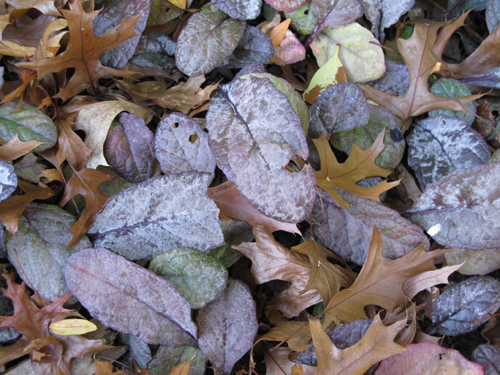
Focus on the purple colored oval leaves with a slight white stringy coating (ignore the fallen brown oak leaves).
Melodie Putnam, 2008.
Cause The fungus Phoma sp. has been found in greenhouse grown plants by the OSU Plant Clinic and reported from Georgia. The problem in Georgia was attributed to infected plants coming in from plug production facilities in Central America. Plants die quickly.
Sclerotium rolfsii can also infect crowns and causes a sudden wilting and death but is rarely seen in the PNW.
Stem rot due to Phoma sp.
Photo by Melodie Putnam, 1999.
Note the discoloration at the base of the stems due to a Sclerotium sp.
Chemical control Best when used on Ajuga along with cultural controls. Tank-mix and/or alternate products from different groups with different modes of action to prevent the build-up of resistant fungi.
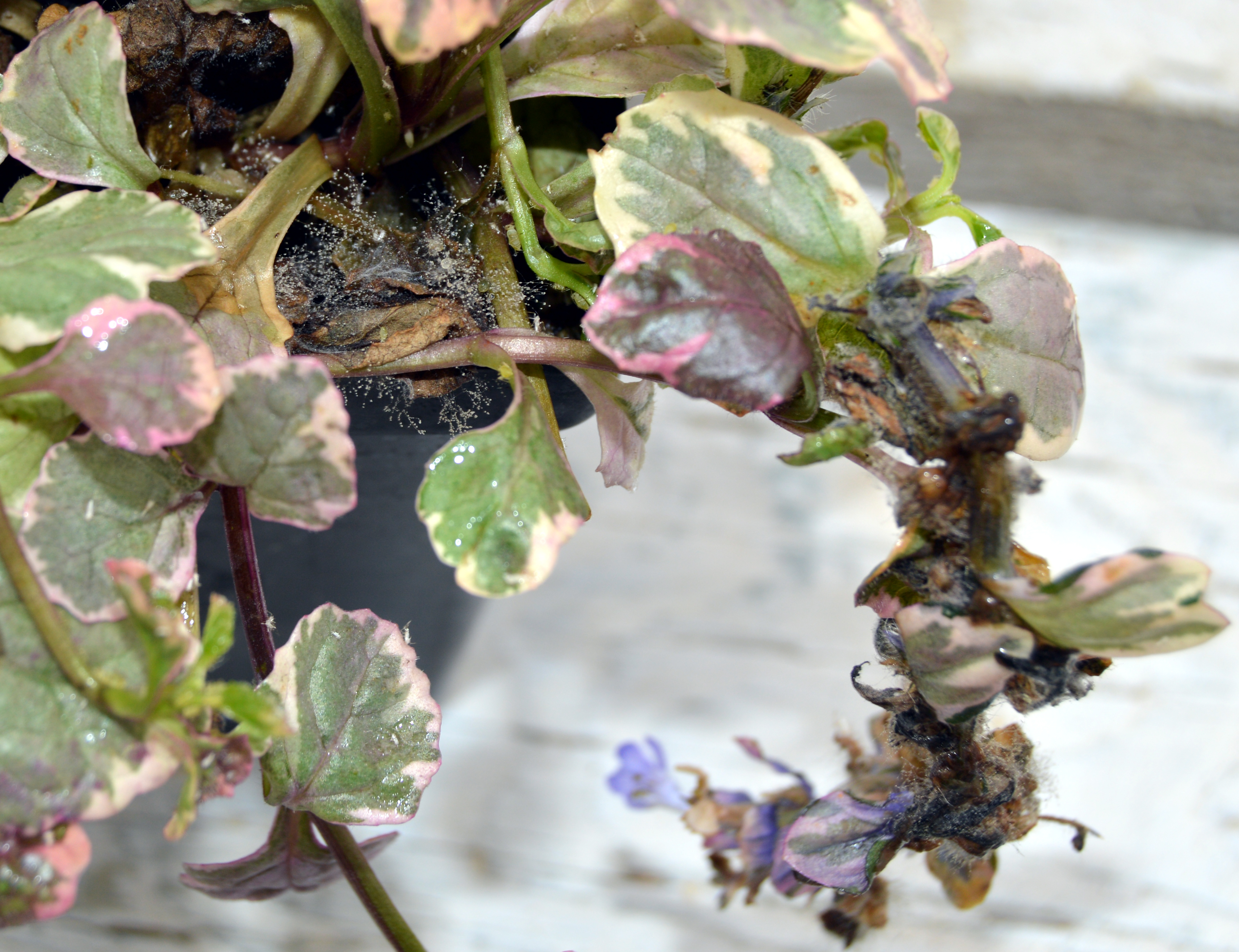
Gray moldy growth can be seen on these stems, leaves and flowers.
Cause A rapid drop in leaf temperature for a few seconds drastically decreases photosynthetic activity and irreversibly destroys the ultrastructural composition of leaf palisade cells. Generally occurs in the home when African violets are watered from the top with cold water or when cold water splashes onto leaves. This injury, however, can be caused by immersion in 77°F water if the leaf temperature before the immersion was higher than 95°F.
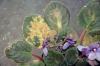
African Violet with necrotic areas on leaves due to watering from the top. Note the new green leaves at the bottom of the picture that have not been water from the top.
Jay W. Pscheidt, 2021.
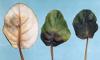
The necrotic areas on this Streptocarpus are due to cold water injury and are very similar to those on African violet.