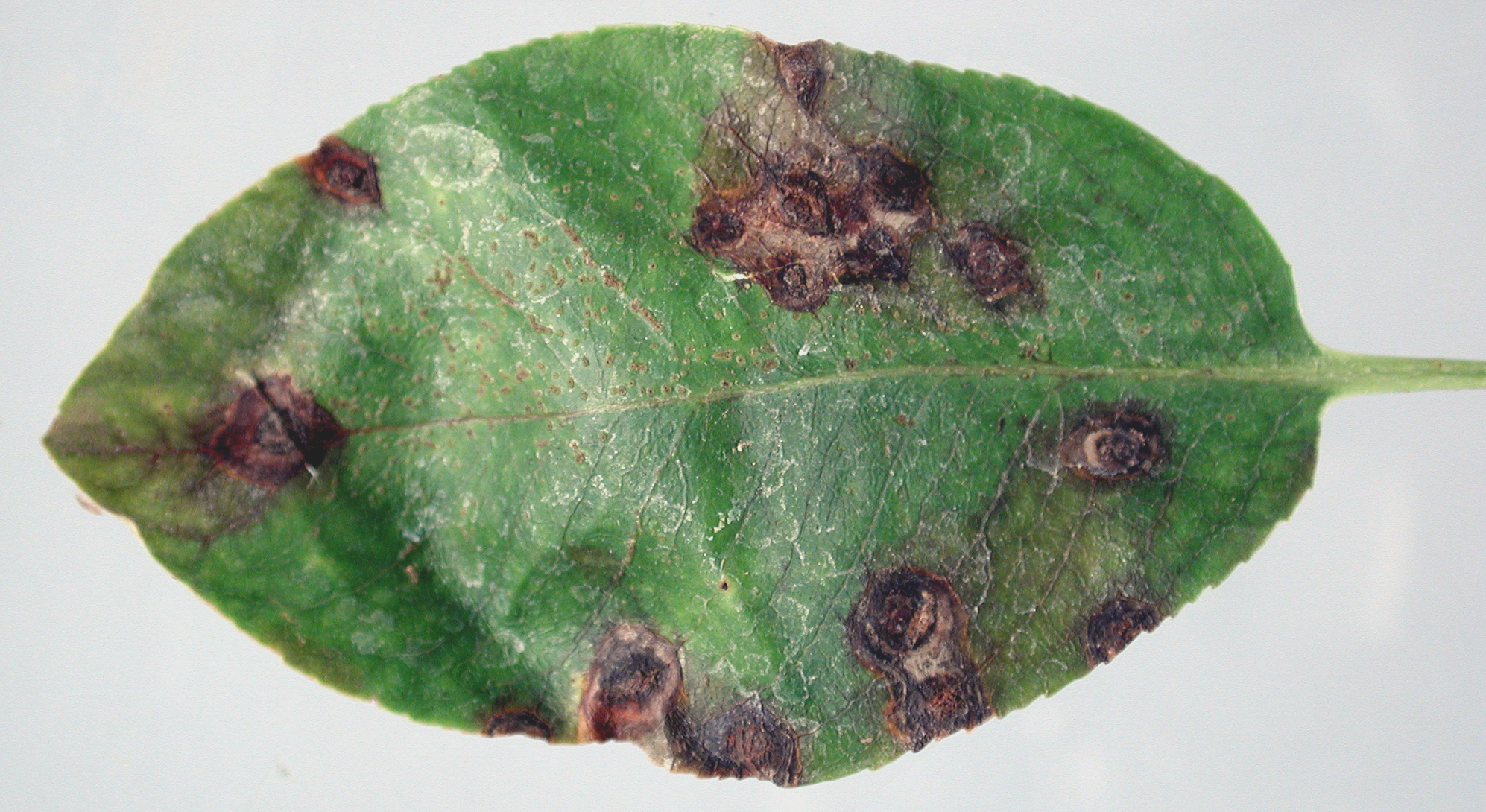
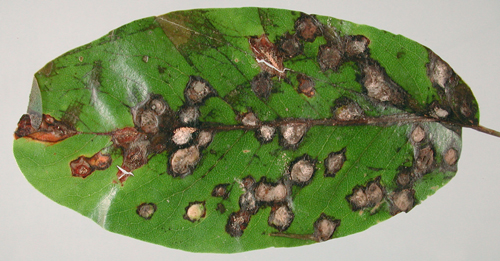
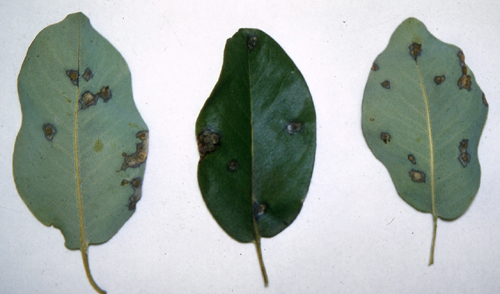
Madrone trees in the Willamette Valley always seem to look like crap in early spring. The leaf spots take over on leaves that are about to be shed when the new leaves appear. In time, the trees will look better.
Jay W. Pscheidt, 2015.
Madrone leaf spots due to Mycosphaerella arbuticola.
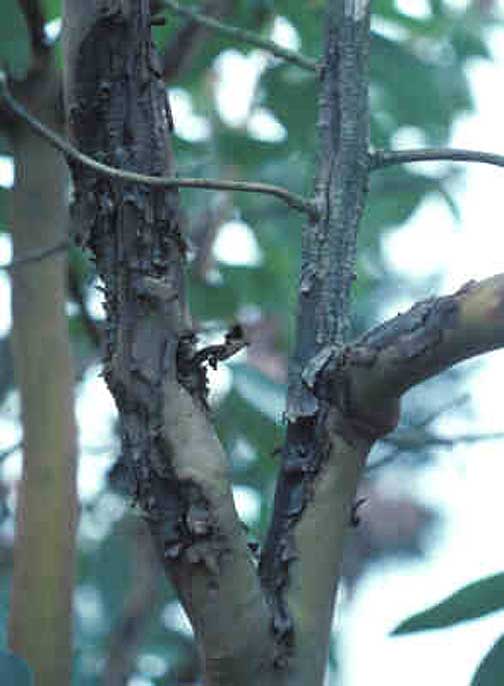
Irregular, sunken cankers develop and are surrounded by callous tissue.
Photo by Ralph S. Byther
Cause Although the fungus Erysiphe polygoni has been reported from all PNW states, molecular evidence indicates the presence of E. lupine and E. intermedia in Washington and likely the rest of the PNW. Can be prevalent in garden situations. It is favored by conditions that produce high humidity but dry leaves such as heavily-shaded growing sites. The fungus is a highly specialized pathogen that forms a close association with the host.
Some leaves are heavily coated while others have only a colony or two.
Jay W. Pscheidt, 2012.
Note the white colonies on this leaf.
Photo by Jay W. Pscheidt, 1996.
Cause Many fungi have been reported causing leaf spots on species of lupine in the Pacific Northwest.
Anthracnose is characterized by yellow spots forming on young leaves that develop into leaf blights.
OSU Plant Clinic Image, 2014.
Not all leaf spots are due to fungus as these are due to Impatiens necrotic spot virus.
OSU Plant Clinic image, 2014.
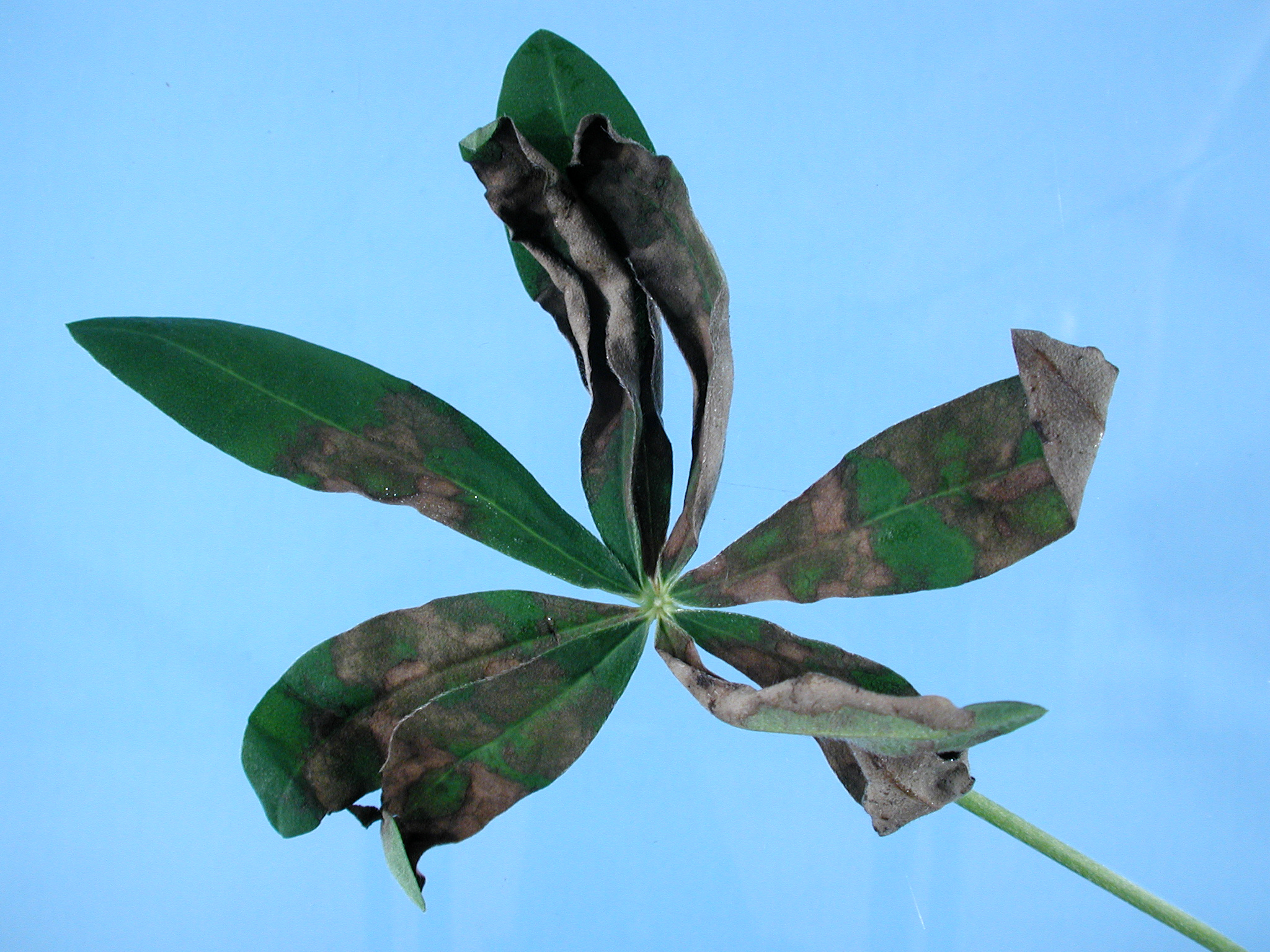
Cause The fungus-like organism Peronospora trifoliorum has been reported in all PNW states. Although downy mildew of alfalfa is attributed to the same organism, it is unlikely that an alfalfa isolate will infect lupine. This organism is favored by wet, rainy conditions in spring and generally is a problem only in gardens.
Note the twisted leaves with purple and gray patches.
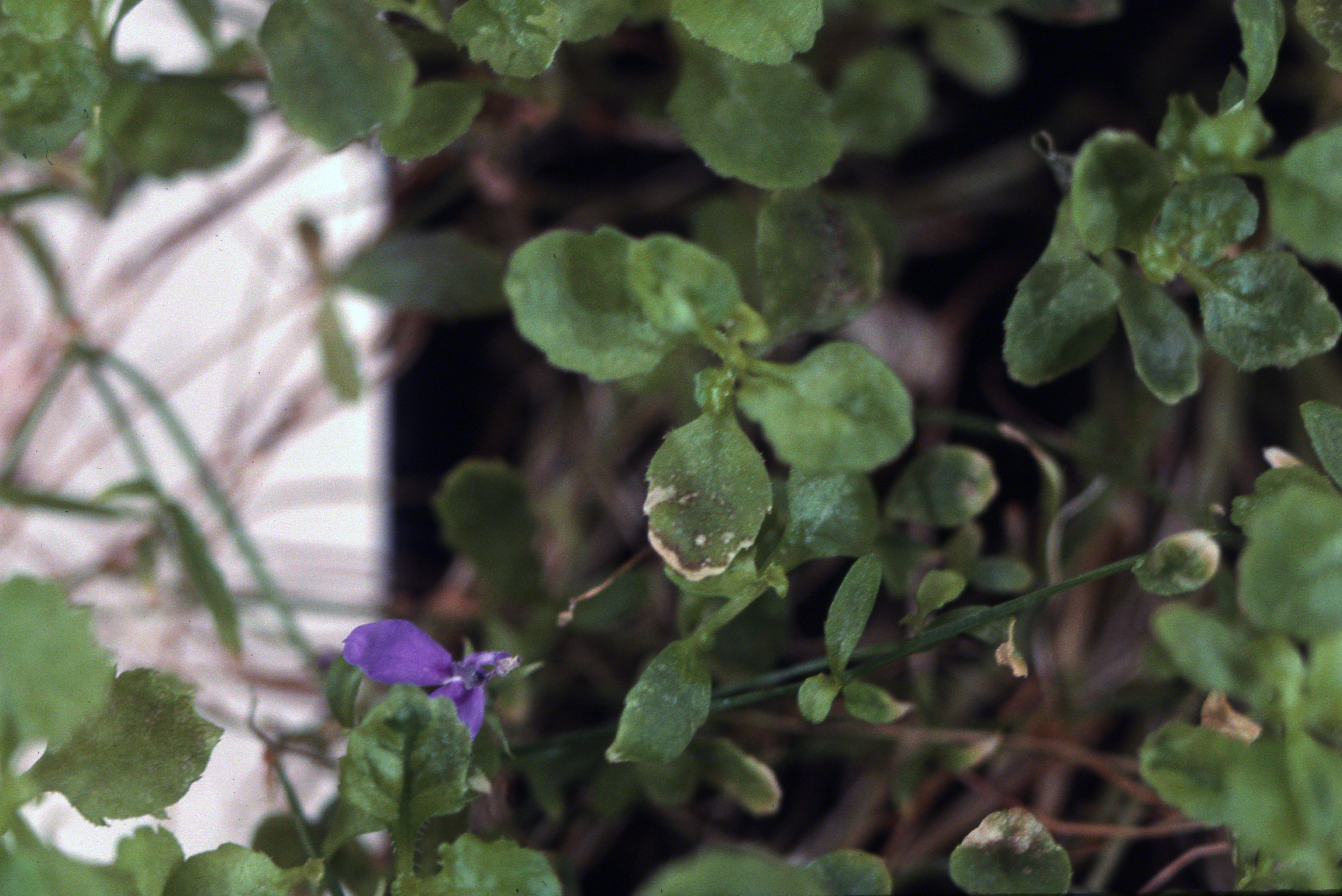
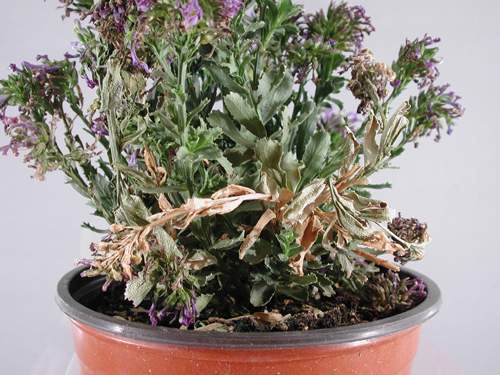
Symptoms Leaves may develop chlorotic flecks that can look like symptoms of chemical phytotoxicity. The plant also generally dies back. Both Tomato spotted wilt virus (TSWV) and Impatiens necrotic spot virus (INSV) can infect Lobelia.
Note the necrotic leaf margin and spots on the center leaf due to INSV.
Photo by Stacey Fischer, 1990.
Dieback due to Impatiens Necrotic Spot Virus.
Melodie Putnam, 2008.
Cause Pythium spp. can cause damping-off and has been found on Lobelia by the OSU Plant Clinic. Pythium is favored by cool and overly moist soil conditions. It survives unfavorable periods in soil and infected plant debris. Under favorable conditions, spores germinate and infect roots. After infection, the fungus-like microorganism spreads mainly in the inner bark tissues of the root and stems.
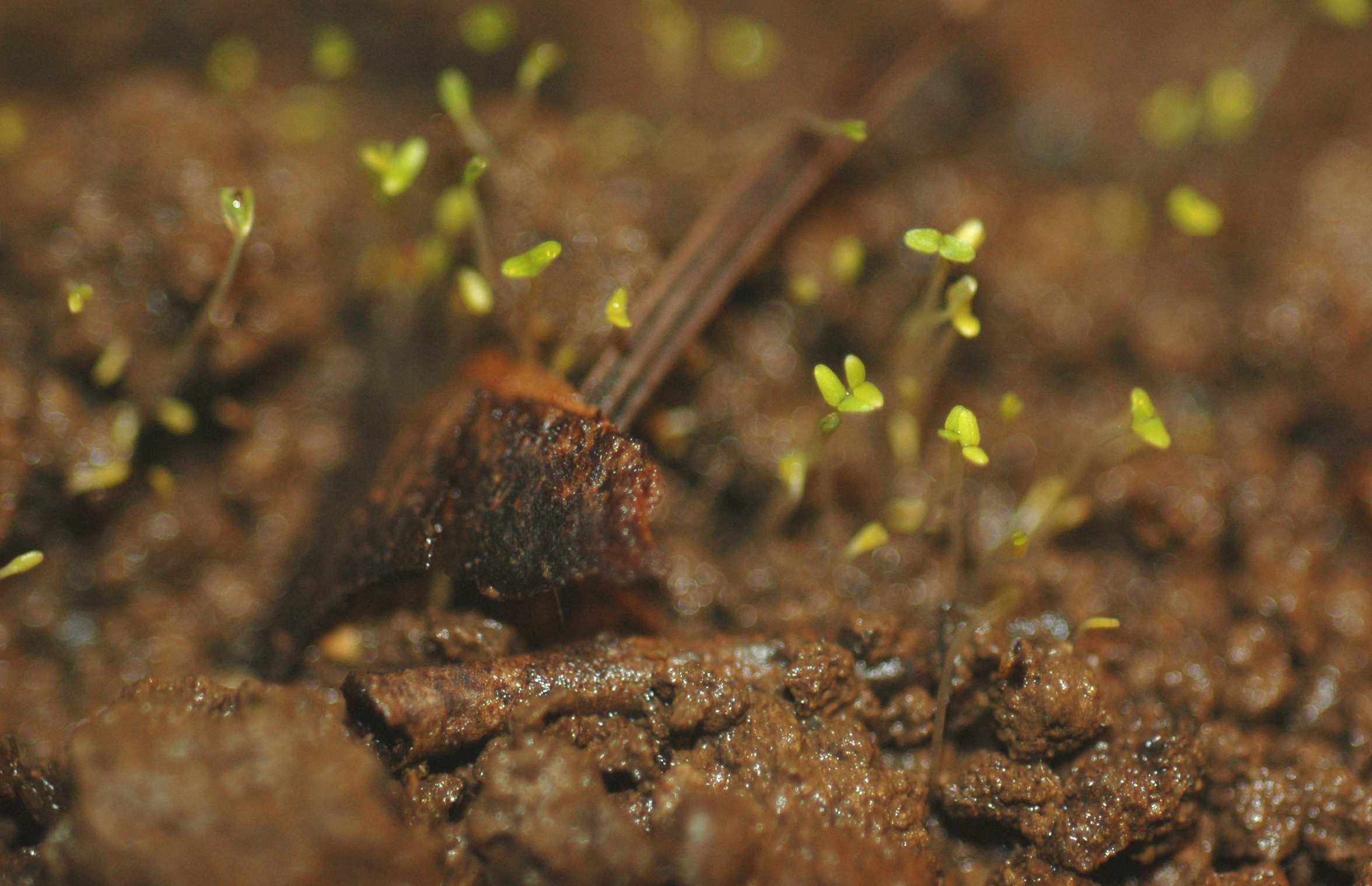
Slide is labeled Lobelia damping-off.
Melodie Putnam, 1997.
Poor germination or stand development can indicate pre-emergence damping-off where seeds rot in the media prior to emergence above ground.