
See:
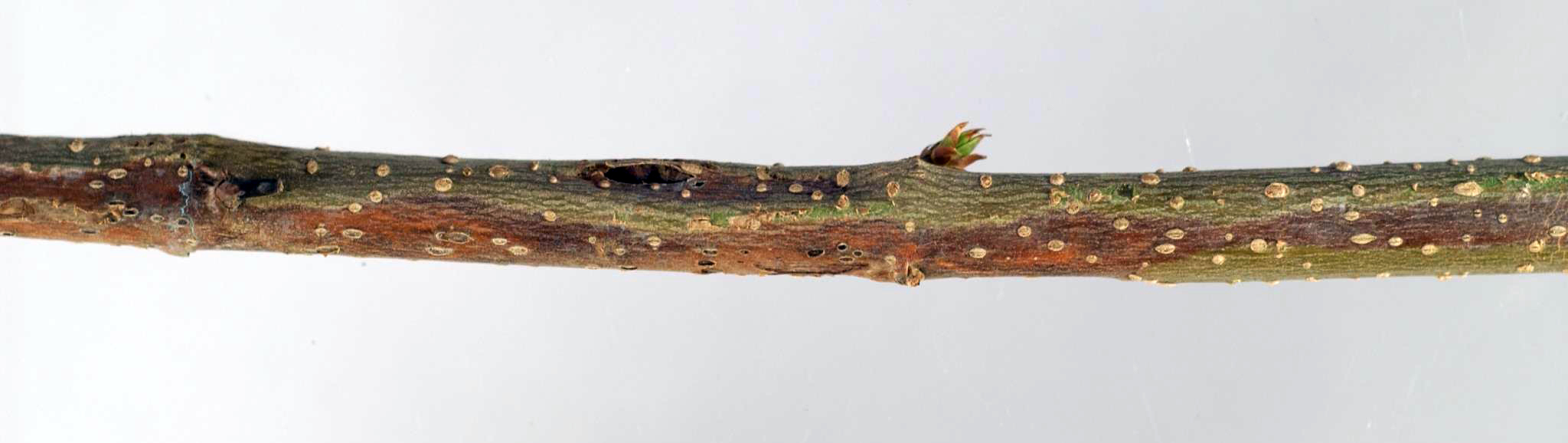
Crabapple (Malus spp.) - Stem Rot
Cause Phytophthora cactorum and P. syringae, fungal-like organisms. Canker is a problem when plants are "heeled in" (placed in sawdust piles) after bare-root stock has been dug prior to shipping to market. Shoot blight also can occur in the spring on plants in production. P. syringae is mostly a problem on crabapple and pear stock during the winter in the Pacific Northwest. On the other hand, P. cactorum has a wide host range and is active during much warmer weather.
Symptoms Canker may occur anywhere on the stem of young plants but primarily on the lower stems and base of main trunk. In young nursery stock, cankers may appear slightly sunken and darker than normal. May be difficult to find when dry. Wetting cankers can make them more noticeable. Cankers may girdle the plant producing a general lack of vigor, which may result in smaller leaves, reduced shoot growth, sparse, chlorotic foliage and premature autumn color.
Shoot blight, like bacterial blight, causes shoot dieback in the spring; however, it also affects older wood. Shoots are often killed back to the ground. Infected shoots have been described as darker brown or very black when compared with shoots affected by bacterial blight. Root sprouts that form under bushes may also be killed back to the ground.
Cultural control
- Prevent mechanical injury to trees, especially late in the season.
- Avoid leaving plants on the ground during rainy winter weather.
- Plant on well-drained sites.
- Avoid mounding soil around the trunks. Also, do not "heel-in" higher than the collar.
- Harvest highly susceptible nursery plants during dry weather.
- Remove and destroy all infected plants and plant debris.
Chemical control To minimize the development of resistant fungi, alternate or tank-mix fungicides from different groups that have different modes of action.
- Aliette at 2.5 to 5 lb/100 gal water may be useful for Phytophthora management. Do not use with adjuvants. Group P7 fungicide. 24-hr reentry.
- Empress at 1 to 3 fl oz/100 gal water can be used for cuttings or seedlings. May be useful for Phytophthora management. Group 11 fungicide. 12-hr reentry.
- Phospho-Jet is registered as a basal bark spray at 62.4 fl oz in 62.4 fl oz water plus 3 fl oz of Pentra-Bark. Group P7 fungicide. 4-hr reentry.
Reference Chester, K. S. 1932. A comparative study of three Phytophthora diseases of lilac and of their pathogens. Journal of the Arnold Arboretum, 13:232-269.
Pscheidt, J. W., and Moorman, G. W. 2001. Chapter 56. Lilac Diseases p. 221-224 in Diseases of Woody Ornamentals and Trees in Nurseries, R. Jones, and M. Benson (eds.). St. Paul, MN: APS Press