Cause A fungus, Puccinia menthae, which overwinters on mint stubble and on wild and escaped mint. It completes its complex life cycle on one host (autoecious) and is macrocyclic (five spore stages), of which the aecial stage can be systemic in plants. Eleven races have been identified in the Pacific Northwest. Isolates from native spearmint are unable to infect peppermint, and peppermint isolates are unable to infect native spearmint.
Note the lesions of peppermint rust on the underside of this leaf.
Photo by Kathy Merrifield.
Cause A fungus, Golovinomyces biocellatus (syn = Erysiphebiocellata, formerly Erysiphe cichoracearum; anamorph Oidium erysiphoides), which overwinters on mint, stubble, and many wild hosts.It is seldom serious enough on peppermint to warrant control measures; however, it is very destructive on Scotch spearmint.
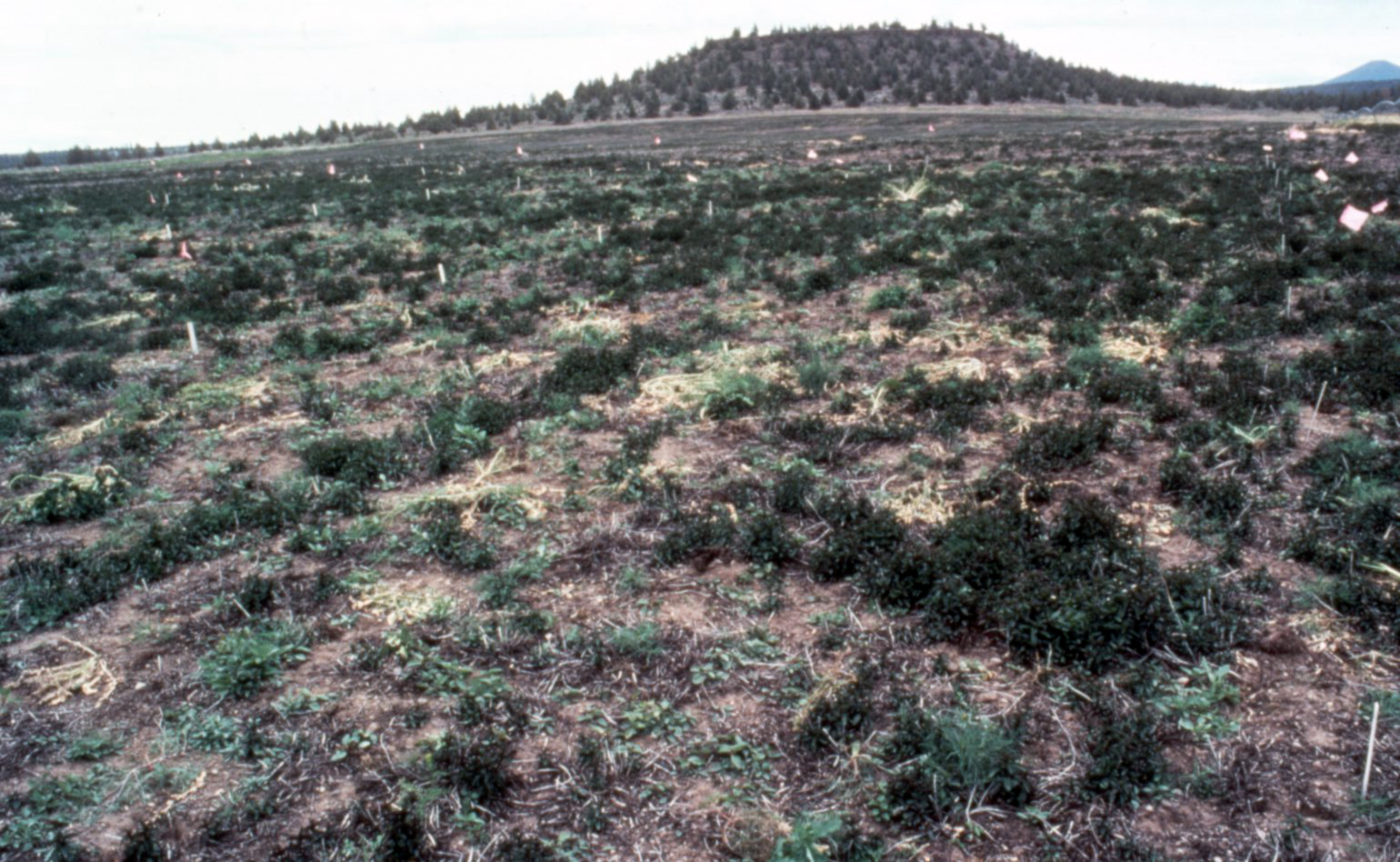
Open patches in a field with severely depressed, red-green plants.
Kathy Merrifield.
Roots near center the of the plant (picture) are dark-brown to black.
Photo by Kathy Merrifield, 1995.
Cause Meloidogyne hapla. It lives in soil and causes plant decline by affecting the root system. The pest is important because it severely injures potential rotation crops such as carrots and potatoes.
Symptoms Galls form on roots; however, infection does not appear to cause yield loss under field conditions.
Cultural control
Cause Longidorus elongatus is one of several nematodes that live in soil and cause plant decline by affecting the root system. They are frequently found in the Willamette Valley of Oregon, though seldom in high numbers. Needle nematodes are migratory ectoparasites found only in soil.
Cause A fungus, Cephalosporium sp. It infects leaves through wounds such as those from rust pustules, insects, or machinery.
Symptoms Irregularly shaped black spots on leaves rapidly coalesce and kill them. Infection may move down the leaf petiole into the stem. It develops rapidly in cool, wet weather and causes severe leaf drop, especially if hot, dry weather follows cool, wet weather.
Cause A fungus, Phoma strasseri, which is most active during cool, wet weather.
Symptoms Dark-brown or black cankers on stems or rhizomes, usually at the junction of lateral branches. Cankers may girdle the stem, causing plant parts above the infection to wilt and die.
Bell pepper field with plants exhibiting wilting due to white mold.
Cynthia M. Ocamb, 2011.
Bell pepper plant with white mold infections on fruit as well as the base of the main stem. Note both the water-soaking appearance as well as signs of the fungus, white fluffy mold.
Cynthia M. Ocamb, 2011.
Bell pepper fruit split open, showing the abundance of sclerotia forming inside the fruit.
Cynthia M. Ocamb, 2011.
Cause Pepper is susceptible to at least 70 different viral pathogens. The more important viruses affecting pepper in the PNW include alfalfa mosaic virus, beet curly top virus, cucumber mosaic virus, pepper mild mottle virus, pepper mottle virus, potato virus Y, tobacco etch virus, and tomato spotted wilt virus. Many of these viruses overwinter in perennial legumes such as alfalfa and various clovers. Several weeds common in the PNW are hosts of some of these viruses.
Note the yellow to green mottles and spots on the fruit.