Plant Disease Management Handbook

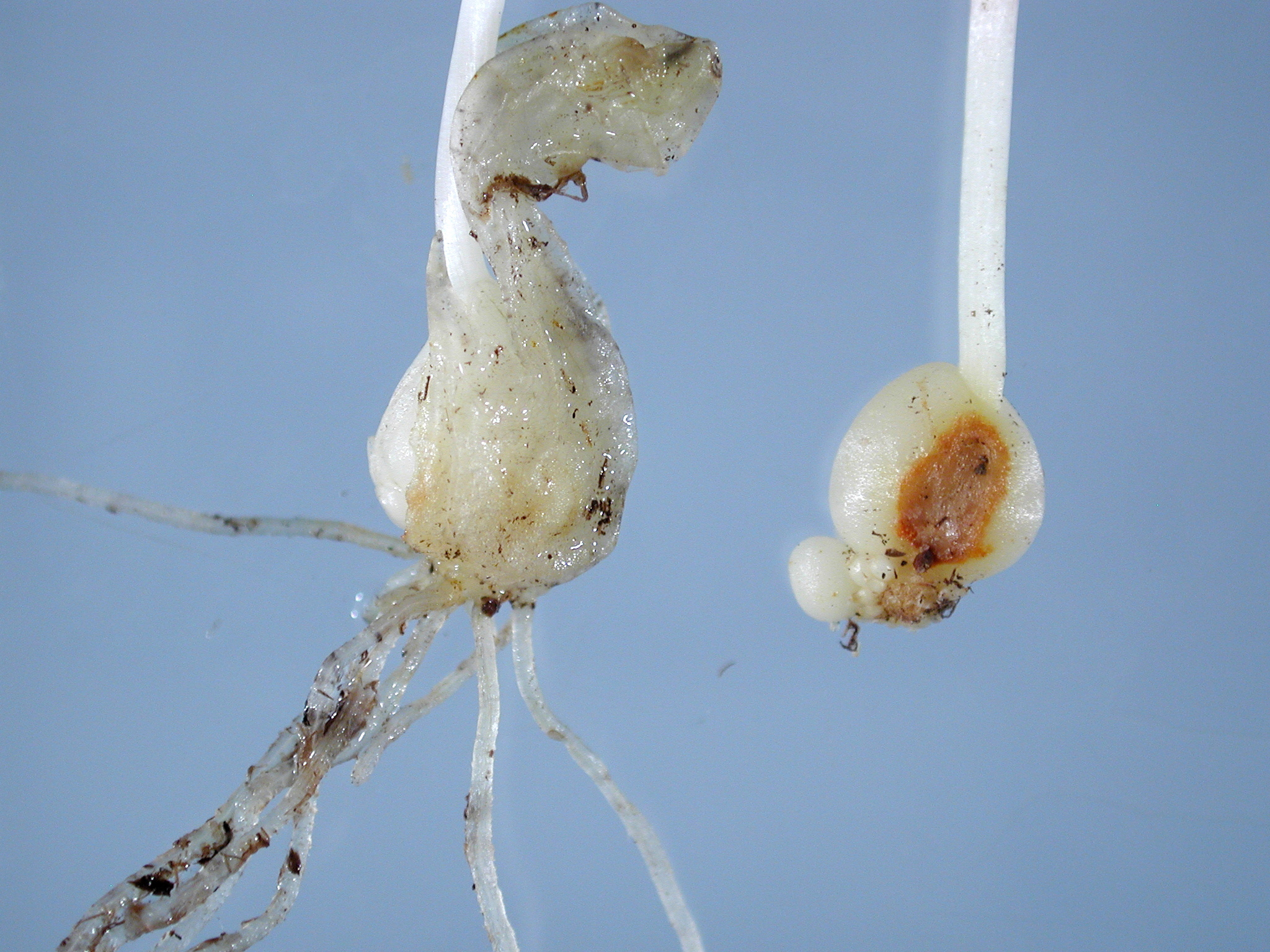
Cause A fungus-like microorganism, Aphanomyces euteiches, that overwinters as thick-walled oospores, which can be spread by water, wind, infected plant debris, soil movement, or tillage equipment. Oospores are produced within infected root tissue, which decomposes, releasing the oospores into surrounding soil. The fungus can infect and multiply in other legume roots, such as clover, pea, lentil, Cava bean, and common bean.

Pertaining to the absence of life; abiotic diseases are not caused by living organisms (biotic pathogens), but by chemical and/or physical factors.

The curved, apical portion of a blighted stem typical from bacterial infections.

A crop plowed under while still green and growing to improve the soil; sometimes used to enhance populations of antagonistic microorganisms for biological control.

A distinct form of an organism or virus within a species, differs from other forms of the species biologically, physically, or chemically.

A pathologic condition in stone fruits characterized by excessive formation of gums exuding from buds, twigs, branches, or trunks.

The tightly intertwined layer of plant litter (lawns and turf) from accumulations of undecomposed or partially decomposed plant residues.

A structure developed within a plant cell as a result of infection by a virus, often useful in identifying the virus.

a cylinder of meristematic cells (lateral meristem) that produces secondary phloem to the outside and secondary xylem (wood) to the inside of a branch or trunk of a woody plant.

A natural opening in the surface of a fruit, root, stem, or tuber for gas exchange.