Insect Management Handbook

Diuraphis noxia

Pest description and crop damage The Russian wheat aphid is relatively easy to identify. The aphid is light green, elongated, and spindle-shaped. Antennae are very short. It has a wart-like projection above the tail that gives it a two-tail appearance. Dorsal tubes (cornicles) are very short and not obvious.
Includes

Bird-cherry oat aphid (Rhopalosiphum padi)
Cereal grass aphid (Metopolophium festucae cerealium)
Corn leaf aphid (Rhopalosiphum maidis)
English grain aphid (Sitobion avenae)
Greenbug (Schizaphis graminum)
Rose-grass aphid (Metopolophium dirhodum)

Image related to Small grain-Aphid

Limonius spp.

Pest description and crop damage Brown, jointed, wiry, yellow to brown larvae of click beetles that feed on roots and underground stems of mint plants. Adults are brown elongate beetles from 0.33 to 0.75 inch long. Wireworms are a problem mainly when mint is planted into soil that is already infested. They do not become a problem in well managed and watered established mint.

Management-chemical control

Image related to Mint-Wireworm

Frankliniella spp.

Pest description and crop damage Small yellowish insects < 1 mm long. Feeding on undersides of leaves injures cells. Damage appears as stippling, silvering, and/or yellowing of leaves. Generally, thrips are a localized problem in drought-stressed areas of fields or portions of fields adjacent to a crop just harvested. Seldom a problem requiring insecticide.

Management-cultural control

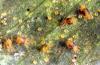
Includes spider mite (Tetranychus urticae)

Pest description and crop damage Spider mite adults are small, eight-legged, spiderlike animals associated with webbing and round eggs on the underside of leaves. They are pale green, yellowish to reddish, with two large, dark spots on each side of their bodies. They suck plant juices, causing leaves to yellow, dry, and fall under heavy infestations. They reduce oil yield and probably quality.

Image related to Mint-Spider mite

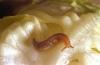
Includes

European black slug (Arion ater)
Gray garden slug (Deroceras reticulatum)
Great gray garden slug (Limax maximus)
Marsh slug (Deroceras laeve)

See also:

Image related to Mint-Slug

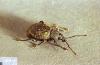
Black vine weevil (Otiorhynchus sulcatus)
Strawberry root weevil (O. ovatus)

Pest description and crop damage Larvae are legless white grubs with tan heads. They overwinter 2 to 8 inches deep in the soil. Adults generally are black but may be brown or chocolate brown. Larvae feed on mint roots, and adults feed on foliage.

Image related to Mint-Root weevil

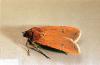
Euxoa ochrogaster

Image related to Mint-Redbacked cutworm

Vanessa cardui

Pest description and crop damage Spiny, dark caterpillars with pale yellow stripes on sides. Larvae feed communally, associated with webbing and black frass.

Image related to Mint-Painted lady or thistle butterfly

Pseudobaris nigrina