Insect Management Handbook

Pogonomyrmex spp.

Pest description and crop damage Large reddish ants found east of the Cascades. They build soil and pebble mounds and destroy vegetation around the mounds. May sting viciously when disturbed.

Management-chemical control

Insecticide control is not recommended
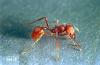
Image related to Small grain-Harvester ant

Trionymus haancheni

Includes

Clear-winged grasshopper (Camnula pellucida)
Migratory grasshopper (Melanoplus sanguinipes)

Pest description and crop damage Both young and adults do damage. They feed on foliage, heads, or often on stems just beneath the heads, causing them to drop. They may attack any of the cereal crops.

Management-chemical control

Image related to Small grain-Grasshopper

Cerodontha dorsalis and C. occidentalis

Pest description and crop damage Adult is a tiny fly, approximately 0.18 inch long, dark with yellow on the head, body, and legs. Adults make feeding punctures on leaves. Larvae mine in leaves.

This insect has been found in wheat and barley and is reported to feed on a wide variety of grasses. This insect is not known to cause injury to wheat or barley.

Includes

Black grass bug (Labops hesperius)
Pacific grass bug (Irbisia pacifica)

Pest description and crop damage This true bug is grayish black, about 0.25 inch long, and somewhat pear-shaped. Feeding causes pale spots on the leaves of cereals and, when severe, gives leaves a general yellowish, stippled appearance.

Image related to Small grain-Grass bug

Includes

Army cutworm (Chorizagrotis auxiliaris)
Black cutworm (Agrotis ipsilon)
Fall Armyworm (Spodoptera frugipedra)
Variegated cutworm (Peridroma saucia and Euxoa spp.)
Wheat head armyworm (Faronta diffusa)

Blissus spp.

Pest description and crop damage A small black insect (a true bug), approximately 0.18 inch long, with a conspicuous black triangle on the outer margin of their white forewings. The nymphs have a white band that transverses the body. As the nymphs mature, their reddish bodies become darker.

Image related to Small grain-Chinch bug

Oulema melanopus

Pest description and crop damage Adults are small beetles about 0.25 to 0.375 inch, with a metallic-blue head and wing covers, red pronotum, and yellow-orange legs. Larvae are yellow to yellow-brown with a dark mass of slimy fecal material on their backs, which makes them look like dark, shiny, and round objects on the leaves.

Both adults and larvae feed on leaves. Feeding causes a characteristic stripping of the leaves.

Petrobia latens

Pest description and crop damage Young mites are red-orange; later, they become dark brown with lighter colored legs. The front legs are usually held straight in front, elongated and almost twice as long as the other legs. Feeding gives foliage a mottled appearance and stunts plants. It has been a problem primarily in barley, but it could also attack wheat and other small grains, ryegrass, some legumes, onions, and carrots.

Limothrips denticornis

Pest description and crop damage Black or brownish, winged or wingless, small slender insects between 0.03 and 0.0625 inch long. Thrips feed on the cell contents of the plant foliage, which results in whitish/silverish look of the infested plants and fields. When abundant, they may injure flowers and reduce yields. Because of their small size, they are hard to locate. Gently unroll leaves or tap plants on a white background to inspect for their presence.