Insect Management Handbook

Labops hesperius and other Labops spp.
Irbisia pacifica and other Irbisia spp.

Image related to Pasture and grass hay-Black grass bug

Various species, including:

Armyworm (Pseudaletia unipuncta)
Army cutworm (Chorizagrotis auxillaris)
Black cutworm (Agrotis ipsilon)
Glassy cutworm (Apamea devastator)
[No common name] (Protagrotis obscura)

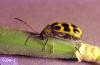
Diabrotica undecimpunctata

Pest description and crop damage Yellowish green, black-spotted beetle, common in western Oregon and Washington. Adults feed on seedlings and can kill plants and reduce stands.

Management-chemical control

Image related to Clover hay-Western spotted cucumber beetle

Includes beet webworm (Loxostege sticticalis)

Pest description and crop damage Caterpillars vary from light to dark with three white longitudinal stripes and many black and white tubercles.

Management-chemical control

Image related to Clover hay-Webworm

Pest description and crop damage Primarily a problem in western Oregon and Washington. Slugs can damage seedling stands during critical establishment phases, reducing plant density.

Management-chemical control

Sitona lineata

Pest description and crop damage Adults are small, grayish brown, faintly striped weevils about 0.2 inch long. They can appear in large numbers in spring and sometimes in late summer. Adult feeding may kill seedling plants and seriously defoliate older stands. These insects migrate into fields from border areas.

Management-chemical control

Image related to Clover hay-Pea leaf weevil

Philaenus spumarius

Pest description and crop damage Nymphs are easily recognized by spittle mass they produce. Moderate populations can stunt plants reducing overall growth and yield.

Management-chemical control

Image related to Clover hay-Meadow spittlebug

Includes alfalfa looper (Autographa californica)

Pest description and crop damage The adult moth is grayish to light brown, with front wings displaying a characteristic teardrop mark. Mature larvae are about 1 inch long, light green, and have pale heads. They move in a looping fashion.

Management-chemical control

Image related to Clover hay-Looper

Hypera nigrirostris

Pest description and crop damage Green or brown weevils are about 0.125 inch long. Larvae feed under the basal leaf sheath, tunnel in the stem, and feed on florets in developing flowers. This pest typically prefers red clover. It is seldom a severe problem.

Management-chemical control

Image related to Clover hay-Lesser clover leaf weevil

Includes several species, especially Melanoplus spp.

Pest description and crop damage Both young (nymphs) and adult grasshoppers feed on clover leaves, resulting in reduced leaf area and potential crop loss. Severe infestations cause stunting and affect hay quality.

Management-chemical control

Image related to Clover hay-Grasshopper