Insect Management Handbook

Bibio xanthopus

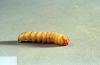
Pest description and crop damage Adults are dark brown to black flies around 0.45 inch in length with reddish legs; smallish, dirty-looking, light brown to gray larvae (0.5 inch in length when mature in February or March) are quite common in western Oregon fields high in organic matter. They feed primarily on decaying organic matter and only incidentally on grass seedlings.
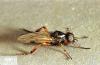
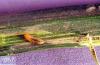
Image related to Grass seed-March fly

Phytomyza nigra

Pest description and crop damage This pest is most commonly in young stands. Visually, damage looks like pale-yellow lines moving vertically up the leaf. Very localized damage within a field may result in some seedling die-out. Larvae (small, white maggots) mine between the epidermal layers of grass blades. Moisture stress coupled with the chlorotic symptoms produced by the miner can kill seedling grasses.

Management-biological control

Image related to Grass seed-Leafminer

Many species

Pest description and crop damage Small, 0.25 inch in length, pale to bright green, wedge or torpedo-shaped insects whose wings fold roof-like when resting. Similar in appearance to sharpshooters, though half the size. Large numbers cause stippling and a bleached look on leaf blades and chlorosis. They also excrete honeydew indicated by a black sooty mold on the leaf. The damage often looks like that of mites or aphids.

Includes

Clear-winged grasshopper (Camnula pellucida)
Migratory grasshopper (Melanoplus sanguinipes)
Red-legged grasshopper (Melanoplus femurrubrum)

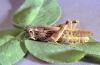
Image related to Grass seed-Grasshopper

Phenacoccus graminum (western OR) and other species east of the Cascade Range

Chionodes psiloptera

Crymodes devastator and an identical species east of the Cascades
Protagrotis obscura (no common name)

Pest description and crop damage The adults of glassy cutworm are heavy grayish moths with a wingspan of about 1.25 inches.

Image related to Grass seed-Glassy cutworm

Scutigerella immaculata

Pest description and crop damage Adult symphylans are about 0.12 to 0.33 inch in length, white, with prominent antennae 12 pairs of legs. Juveniles look similar to adults only with less legs and smaller body. Their bodies are creamy white. They resemble centipedes, but centipedes usually are larger, yellowish to brown, and when mature have more than 12 pair of legs.

Image related to Grass seed-Garden symphylan

European crane fly (Tipula paludosa)
Common or marsh crane fly (Tipula oleracea)

Pest description and crop damage Adults are large (wing span of 1 to 1.5 inches), grayish brown, and resemble large, long-legged mosquitoes. They do not bite! The wings of these pest species are long, slightly milky-brown along the fore-edges, and folded in roof-like when the adults are at rest.

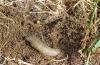
Image related to Grass seed-Cranefly

Oulema melanopus

Pest description and crop damage Adults are slender, about 0.33 inch in length, and have metallic, bluish-black elytra. They have a black head, orange thorax, and orange legs. They are known to fall to the ground when disturbed. A single, yellow, cylindrical egg usually is laid parallel to the mid-vein. Sometimes eggs may be in groups of two or three. Eggs are about 0.04 inch in length and darken before they are about to hatch.