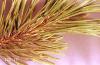
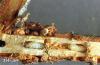
Pest description and crop damage White scale flock needles. Hosts: Douglas-fir and pines. Eggs hatch May or June, perhaps July.
Management-chemical control
Apply to crawler stage.
Contarinia spp.
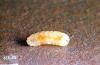
Pest description and crop damage Adult is a small midge (fly). Larvae mine needles; they often appear as a purple node above which the needles are distorted. Degree day models and traps are available to monitor pest emergence.
Management-chemical control
Time applications based on adult needle midge trap catch. Time to coincide with adult emergence.
Adelges cooleyi
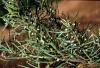
Pest description and crop damage Adelgids appear as small cottony tufts on underside of needles. May cause yellowing, distortion, and premature needle drop. Aphids may distort stems.
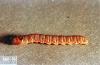
Pest description and crop damage Small creamy-brown moth larvae bore into stems, especially around wounds.
Management-chemical control
Applications must be made before eggs hatch and larvae tunnel into stem. Using pyrethroid insecticides is associated with subsequent spider mite outbreaks.
Nuculaspis californica
Pest description and crop damage Gray-black scale. Hosts: Douglas-fir and pine.
Management-chemical control
Includes Ten-lined June beetle (Polyphylla decemlineata) Rain beetle (Plecoma spp.) Aphodius spp.
Pest description and crop damage Small to large C-shaped, white scarab beetle larva with six legs and a brown head. Grubs feed on roots, often killing young trees. Many follow the soil moisture and may appear absent in summer.
Cylindrocopturus furnissi
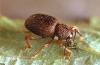
Pest description and crop damage Small gray-black weevil with white mottling, sometimes with pink or orange spots. It may kill small branches and sometimes small trees. Traditionally thought to infest only Douglas-fir yet has been found on various true firs as well in recent years including Nordmann, noble and Turkish firs.
Management-cultural control
Choristoneura fumiferana
Pest description and crop damage Green-brown larvae up to 1 inch long feed on foliage and buds of fir, spruce, and Douglas-fir.
Management-chemical control
Apply May-June or when bud flush is at 90 to 95% and new growth is 0.75 to 1 inch. Pay particular attention to areas adjacent to infested forest. Two applications may be necessary.
Oligonychus ununguis and others
Pest description and crop damage Dark green mite stipples and bronzes needles, beginning at the base. Overwinters as red-orange eggs.
Management-chemical control
Strawberry root weevil (Otiorhynchus ovatus) and others
Pest description and crop damage Larvae are cream-colored, C-shaped grubs that feed on roots, sometimes girdling them. Adults feed on Douglas-fir and true fir needles, resulting in characteristic notching.
Management-cultural control
Site preparation with fallow period prior to planting will reduce habitat for weevils.