To remove and destroy undesired individual plants from a planting on the basis of disease infection, not being true-to-type, insect infestation, or other reason.
Produced outside.
Nongrowing (inactive, quiescent) state of a plant.
Nematodes that feed inside roots, tunneling inside and moving back into soil and to new roots at will. (Examples: root-lesion nematodes, Pratylenchus spp.)
A singlecelled, wallless, spiral, filamentous organism associated with corn stunt and citrus stubborn disease.
Microscopic one-celled organism. Cell type lacks a distinct nucleus, sexual recombination, and chlorophyll. It does have cell walls and DNA.
To circle and cut through; to destroy vascular tissue, as in a canker or knife cut that encircles the stem.
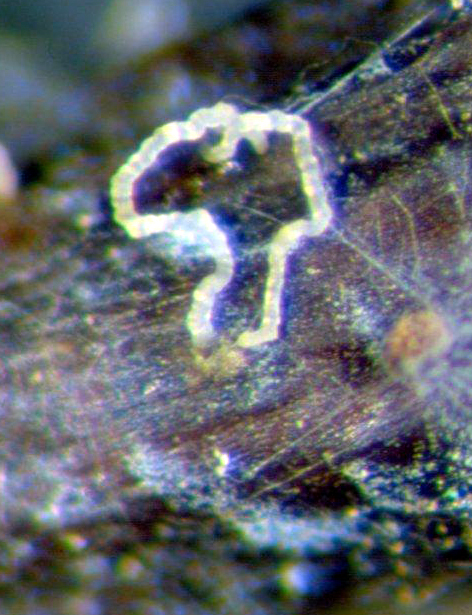
A curl-like tuft; a tendril-like mass or "spore horn" of forced-out spores.
When wet, pycnidia of a fungus may ooze spores out of a small hole in the top and the spores may form a cirrus (it is kind of like a Play-dough fun factory).
Jay W. Pscheidt.
Determining presence of disease in a plant by removing buds or other parts for inoculation of a susceptible indicator plant that exhibits specific symptoms of a transmissible disease.