A group of fungi characterized by the production of sexual spores within an oval or tubular membranous sac called an ascus.
A chemical or physical agent that prevents fungi from developing but does not kill them.
Fungicides in the FRAC group 4 are considered fungistatic.
Jay W. Pscheidt, 2008.
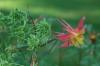
Change from a normal flower to leafy structures. Characteristic of certain phytoplasma infections.
Columbine sp. with phyllody where the petals of the plant on the left side are more leaf-like than flower-like.
Jay W. Pscheidt, 2007.
Submicroscopic, infectious agent, too small to be seen with a compound microscope, that multiplies only in living cells. A virus consists of nucleic acid (DNA or RNA) surrounded by a protein coat.
The sum of the qualities of a plant and causal agent that allows the development of the causal agent.
Treatment of disease by chemicals (chemotherapeutants) working internally. Chemical agent has toxic effect directly or indirectly on the pathogens without injury to the host plant.
A single filament of a fungus mycelium.
One fungal strand is a hypa while a group of them together is a mycelium.
Jay W. Pscheidt, 2014.
A single-celled animal and human disease- causing organism with a partial cell wall that has not been grown in culture.
The description of the cause of disease.
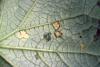
Describing plants or lesions that appear wet and dark and are usually sunken and translucent.
The first symptom with pepper leaf spot is water-soaking which gives it a darker green coloration.