Any chemical or physical agent that destroys pests (e.g., fungicide, insecticide, miticide).
Slender, tubular mouthparts in plant-parasitic nematodes or aphids.
A plant or animal that carries a virus or other infective agent without showing symptoms.
The abnormal increase in the number of cells without their enlargement.
Intercellular thallus branch that absorbs food and provides anchorage.
Plants in a given population that remain free of disease where it is prevalent, although they possess no natural inherent resistance to the disease. (See Klendusity).
The death or disintegration of cells and tissue accompanied by darkening to black or brown.
The sum of the deviations of the vital functions beyond the latitude of health. (This is just one of many definitions of disease.)
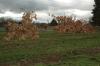
The retention of dead plant organs, such as leaves, which normally are shed. Several trees, including certain oaks, normally have marcescent leaves.
These Quercus alba trees are marcescent as they hold on to their leaves all dormant season.
Jay W. Pscheidt, 2014.
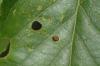
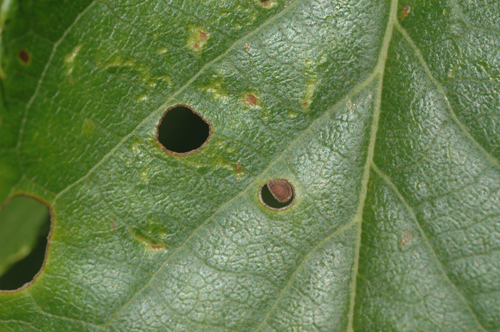
Disease symptom characterized by the dropping out of small, round fragments of leaves, making them look as if riddled by shot.
An abscission layer forms around the necrotic spot allowing the diseased tissue to drop out.