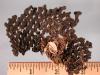
A dried and shriveled fruit partially or completely replaced with fungal structures
Jay W. Pscheidt, 2014.
Within the cells.
A small, compact, hardened mass of hyphae that may bear fruiting bodies. Can help fungus survive adverse environments.
Signs of Sclerotinia from sunflower; note the large size of the sclerotium (survival structure).
Melodie Putnam, 2015.
Disease caused by acervuli-forming fungi (order Melanconzales) and characterized by sunken lesions and necrosis.
Many diseases called anthracnose produce similar necrotic lesions and shoot diebacks as seen with sycamore anthracnose. There are some diseases called anthrancose that produce cankers (apple anthracnose) or fruit rots (blueberry ripe rot).
Jay W. Pscheidt, 1994.
A small, white to translucent lesion (spot) visible through a leaf.
An entity's capacity for producing a disease.
An agent, such as an insect, nematode, or fungus, that may transmit a pathogen.
A cultivated plant variety or cultural selection. Used synonymously with variety.
Any agent or chemical that destroys all living organisms in a substance such as soil.
The mass of interwoven threads (hyphae) making up the vegetative body of a fungus.
One fungal strand is a hypa while a group of them together is a mycelium.