One of two kinds of plants on which a parasitic fungus (e.g., rust) must develop to complete its life cycle.
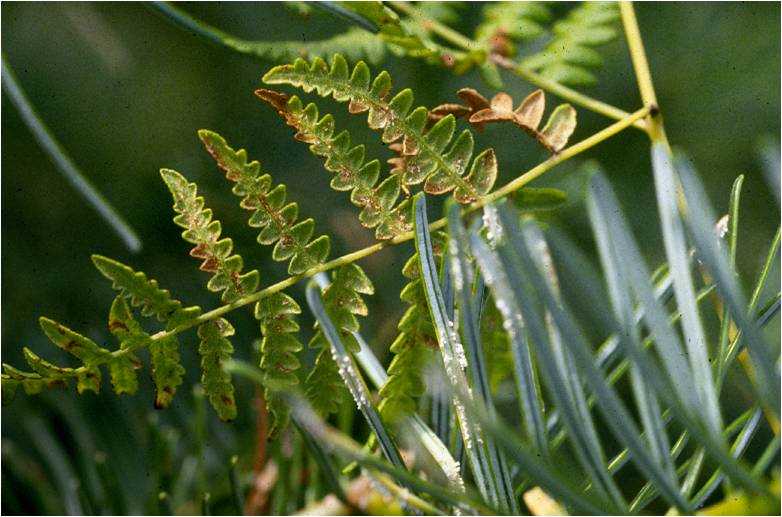
Uredinopsis pteridis is a rust fungus that alternates between true firs and bracken fern.
Jay W. Pscheidt, 1994.
A long hairlike or whiplike contractile filament protruding from certain bacterial cells and spores of fungi and that enable movement.
The phenomenon of the growth of one organism, the parasite, at the expense of another, the host.
A bladderlike intrusion of the protoplasm from a parenchymatous cell through a pit into the lumen of a xylem cell.
Asexual spore formed by abstriction and detachment of part of a hyphal cell at the end of a conidiophore and germinating by a germ tube.
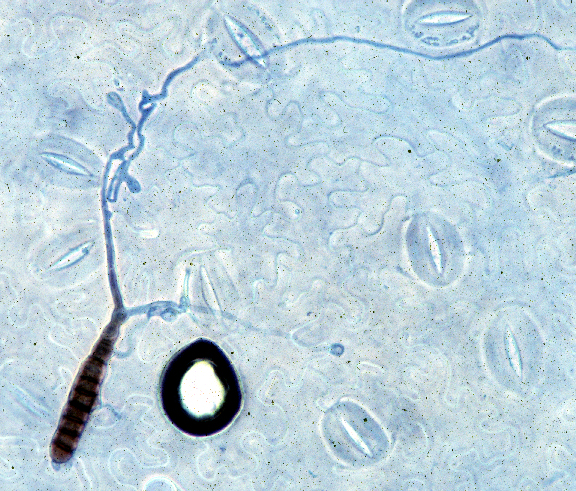
Conidium of Alternaria solani that has germinated on the surface of a potato leaf and formed several appressoria. (Dark elongate structure is the conidium while the dark circular object is an air bubble.)
Jay W. Pscheidt, 1980's.
Capable of forming spores.
Any sudden, severe, and extensive spotting, discoloration, or destruction of leaves, flowers, stems, or entire plants, usually attacking young, growing tissues. (In disease names, often coupled with the name of the affected part of the host; e.g., leaf blight, blossom blight, shoot blight).
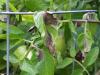
Tomato late blight will blight the leaves as seen here.
Photo by Cynthia M. Ocamb, 1998
Requiring two or more unrelated hosts for completing the life cycle of a rust.
A chemical applied to a plant surface in advance of the pathogen to prevent infection.
Plant disease that causes about the same amount of injury each year.