Plant Disease Management Handbook

See:

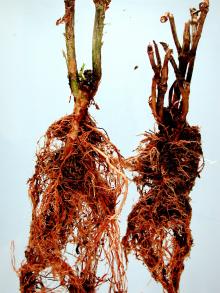
Note: Phytophthora spp. have been identified on rose samples with root rot from the PNW several times by the OSU Plant Clinic.

photo of Rose (Rosa spp.) and hybrids-Phytophthora Root Rot
PNW Plant Disease Image

Cause Lilac ring mottle virus can be mechanically transmitted from one plant to another.

Symptoms Leaf deformation, reduction in leaf size, ring spots, and line patterns were observed on cultivars President Grevy and Krasavitsa Moskvy. Symptom expression was influenced by environmental conditions and may be erratic, thus infections may remain undetected for years.

Photo showing Lilac (Syringa spp.)-Lilac Ring Mottle

Cause The fungus, Erysiphe cruciferarum (syn. E. polygoni), can infect most crucifer crops and cruciferous weeds, but strains exist that have specificity and will infected only a subset of the crucifers. Stressed plants will be more susceptible to disease. The fungus survives on infected hosts or as chasmothecia (formerly cleistothecia), sexually-produced survival structures on infected crop debris.

By N. K. Osterbauer and C. M. Ocamb

A young hemp plant dying due to Pythium root rot.

By C. M. Ocamb and N. K. Osterbauer

Hemp plant with gray mold symptoms on flower buds. Note the dead tissues that have turned brown.  Photo by Cynthia M. Ocamb, 2020

By N. K. Osterbauer and C. M. Ocamb

Cause The fungi, Cercospora cannabis and Pseudocercospora cannabina, which overwinter on infected crop residues on the soil surface. More commonly observed in field-grown hemp. In greenhouses, most commonly observed in plants near open greenhouse doors or near vents.