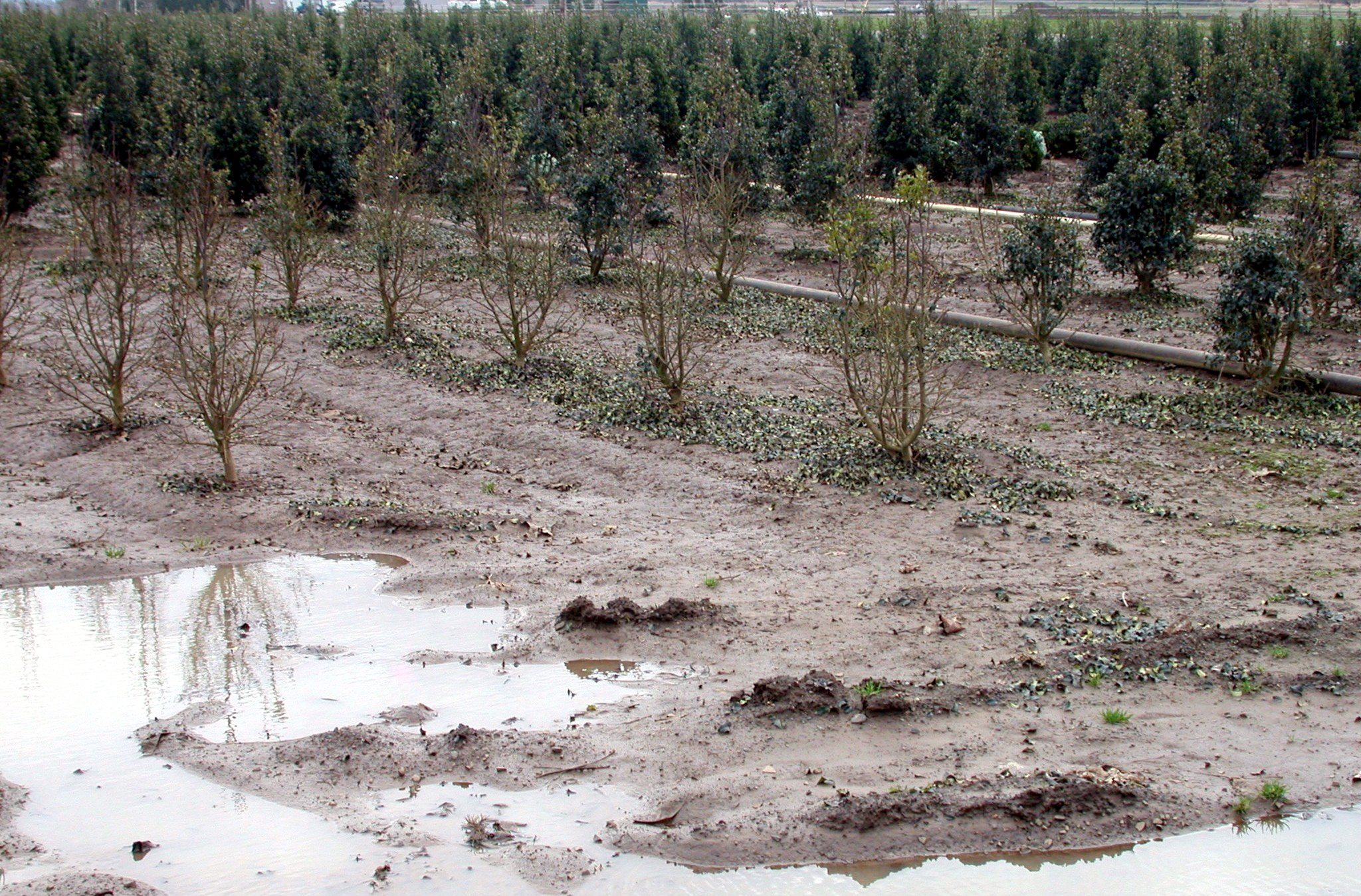
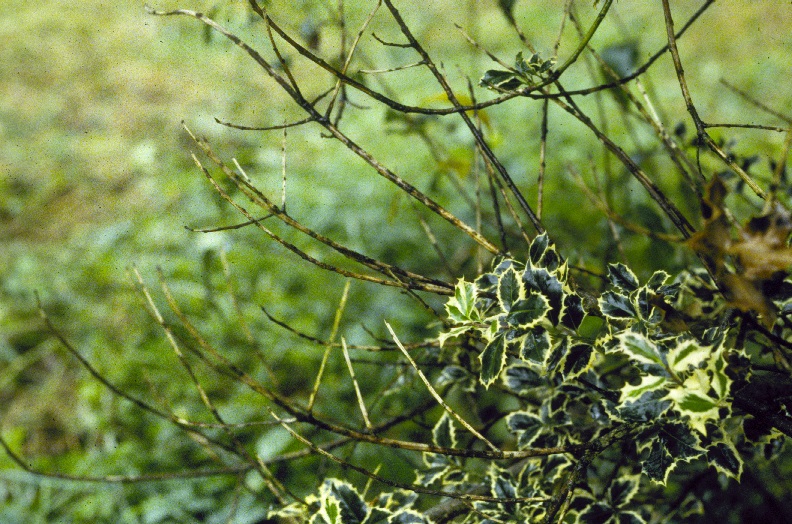
Note Heterobasidion root rot is mostly a butt or trunk rot in hemlock that becomes important when trees are 60 to 80 years old.
Note the staining of the wood. The wet looking outer area was 'wetwood' where no decay fungi were present. The blackish central area and dark stain within the wetwood is where the fungus was cultured.
Dave Shaw
Cause Coniothyrium hellebori, a fungus that is favored by wet weather and factors that stress plants. The disease may spread rapidly during wet springs or falls. Found frequently in Oregon and Washington.
Spots often run together and show a concentric zonation pattern.
Photo by Lindsey du Toit, 2003
Leaf spot on Helleborus argutifolius caused by Coniothyrium hellebori from a home garden in Skagit Co., WA.
Photo by Lindsey du Toit, 2003
Note Helleborus may be evergreen but can have a rough time when PNW winters are extreme. Secondary organisms, such as bacteria or fungi, may colonize brown, dead areas caused by cold temperature injury.
No pathogens detected and cold injury was suspected.
Melodie Putnam, 2010.
Cause 'Black death' has been reported in a number of states in the Western and Eastern United States as well as other countries. Although the cause of 'black death' has not been determined definitively, evidence points to a virus as the probable causal agent, specifically a Carlavirus tentatively assigned the name Hellebores net necrosis virus (HeNNV).
The most common symptom is blackened leaf veins.
OSU Plant Clinic image, 2015.
Black streaks may occur as lines and, when severe, are associated with distortion and stunting of affected plant parts.
OSU Plant Clinic image, 2015.
Symptoms include blackened leaf veins, dark brown to black streaks on petioles and black streaks on flower bracts.
OSU Plant Clinic image, 2015.
Cause Septoria exotica is a fungus that is favored by conditions that keep leaves wet. Pseudophaeophleospora atkinsonii (formerly Kirramyces hebes) has been described, which has similar symptoms but larger sized leaf spots. It is not known which might occur in the PNW.
The first symptoms are small black spots on the leaves, which enlarge and form an ash-colored center.
Photo by Neil Bell, 2004
Small spots are Septoria sp. but the larger necrotic areas and leaf deformation are due to downy mildew.
Photo by Neil Bell, 2004
Cause There have been several organisms associated with root rots and resulting branch diebacks in Oregon including Phytophthora sp., Macrophomina phaseolina (Charcoal rot) and Fusarium oxysporum. Both Phytophthora and Fusarium are favored by excessively wet soils but Phytophthora is favored by cool soils conditions while
Phytophthora sp. on the cultivar 'Red Edge'.
Photo by Neil Bell, 2005
This Hebe 'McKeanii' had dieback and black root rot (Berkeleyomyces sp. (formerly Thielaviopsis basicola)).
Powdery mildew may start out as widely scattered individual colonies.
Jay W. Pscheidt, 2012.
Entire shoots may be covered with the sporulation of this fungus.
Jay W. Pscheidt, 2012.
Many shoots may be covered with this disease.
Jay W. Pscheidt, 2012.
Cause Mosaic symptoms may be due to any of 3 viruses including cucumber mosaic virus (CMV), plantago asiatica mosaic virus (formerly nandina mosaic virus) and/or nandina stem pitting virus (NSPV). All of these viruses are easily transmitted through vegetative propagation of the host. CMV can also be vectored by a wide variety of aphids. None are seed transmitted.
'Tuscan Flame' with CMV.
OSU Plant Clinic Image, 2013.
Cause The fungus-like microorganism Phytophthora cinnamomi has been reported frequently in Oregon. Waterlogged soils and warm temperatures favor the disease. It survives unfavorable periods in soil and within plant debris. Under favorable conditions, spores germinate and infect roots. After infection, the fungus-like microorganism spreads mainly in the inner bark tissues of the root and stems. They survive as various spores in the soil, container media, or infected roots.
Dieback of 'Darleyesis Kramer Red' heather due to root rot from Phytophthora sp.
OSU Plant Clinic Collection, 2011.
Crown rot of 'Svenja' heather due to Phytophthora sp.
OSU Plant Clinic Image, 2014.
Shoot dieback due to Phytophthora sp. on this Calluna vulgaris 'Svenja'.