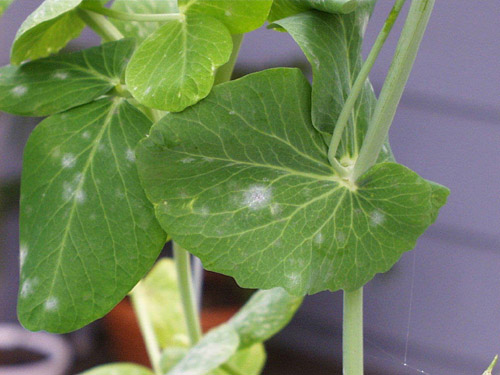
Note the white powdery mildew colonies on the lower leaves.
Photo by Jay W. Pscheidt, 2002.
White powdery mildew colonies are sporulating heavily.
Photo by Jay W. Pscheidt, 2002.
Cause Several fungal leaf spots have been reported from the Pacific Northwest including Ramularia agrestis, R. lactea, and Cercospora violae. Other fungi such as Alternaria sp. and Colletotrichum sp. (anthracnose) are also common leaf spot problems. Leaf spots are favored by warm, humid conditions especially later in the growing season during fall.
Senescent plant debris often becomes quickly colonized by Botrytis.
Jay W. Pscheidt, 2013.
Cause Two fungal-like organisms are reported to cause downy mildew on pansy: Plasmopara megasperma (formerly Bremiella megasperma) common in North America and Peronospora violae common in Europe and Asia. The disease has not been reported in the Pacific Northwest but has been observed in both Oregon and Washington. Wet, humid environments favor disease development.
Chemical control Best when used on palm along with cultural controls. Tank-mix and/or alternate products with different modes of action to prevent building up resistant fungi. Limit the use of any one group during crop production.
Cause Volutella pachysandrae and Coccinonectria pachysandricola (formerly Volutella pachysandricola), fungi. Much more severe on stressed plants such as those growing in full sun, wounded or weakened by scale insects or winter injury. Infection of wounds occurred for several days after the wounding event early in the growing season. Wounds occurring in the summer are much more resistant to infection.
Volutella sp. found in these leaf spots.
OSU Plant Clinic image, 2009.
Volutella sp. can be seen sporulating in these leaf lesions.