Insect Management Handbook

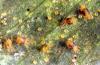
Tetranychus spp., Bryobia rubrioculus, and Panonychus citri

See:

Image related to Skimmia (Skimmia)-Spider mite

Carulaspis juniperi

See:

Pest description and crop damage Scale covering is circular, white, and about 0.06 inch in diameter. Causes foliage to turn brown and twigs to die back.

Management-chemical control

See:

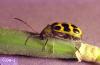
Diabrotica undecimpunctata

Pest description and crop damage Yellowish green beetles with black spots. Feed on blossoms.

Management-chemical control

See:

For more information

Image related to Rose (Rosa)-Western spotted cucumber beetle

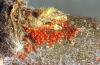
Tetranychus spp. and Panonychus ulmi

See:

Image related to Rose (Rosa)-Spider mite

Ceratina spp.

Pest description and crop damage Small bees, 0.37 inch long and metallic blue or blue-green, burrow into the pith of cut stems and make cells for young. Cells are provisioned with pollen and nectar. Damage is not serious and is only in pruned stems.

Management-cultural control

Cover cut stems with wax to prevent burrowing and egg laying.

Prune out damaged canes.

Frankliniella spp.

Pest description and crop damage Slender, tiny, straw-color insects in buds and blooms cause distortion of leaves and flowers.

Management-chemical control

See:

For more information

Marmara spp.

Pest description and crop damage Adult is a small moth. Larvae make winding mines beneath the epidermis. Seldom a serious problem.

Management-cultural control

If mines detract from the plant's appearance, prune and destroy infested canes.

Management-chemical control

No control measures have been developed.

Endelomyia aethiops

Pest description and crop damage Larvae are slug-like and light green. They skeletonize leaves or make holes in leaves.

Management-chemical control

See:

For more information

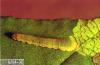
Image related to Rose (Rosa)-Rose sawfly

Dasineura rhodophaga

Pest description and crop damage The adult midge lays its eggs inside the sepals of new flower and leaf buds. The tiny maggot that hatches feeds in these areas causing blackened tissue, tip abortion, and distorted flower buds. There are two peaks of damage: in late June/early July and late August/early September.

Management-cultural control

Edwardsiana rosae

Pest description and crop damage Adult insect is greenish white; immature stages are the same color, flat, and elongate. Leaves look stippled. Heavy infestations result in defoliation.

Management-chemical control

See:

For more information

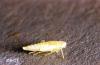
Image related to Rose (Rosa)-Rose leafhopper