Insect Management Handbook

Merhynchites bicolor

Pest description and crop damage Bright red beetle, 0.25 inch long, with black undersurface, head, and legs, and long snout. One form is entirely black. Adults make egg punctures in buds, which may fail to open. Usually not a serious pest.

Management-chemical control

See:
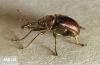
Image related to Rose (Rosa)-Rose curculio

Macrosiphum rosae

See:

For more information

Johnson, W.T. and H.H. Lyon (1991), Insects That Feed on Trees and Shrubs, 2nd ed., Cornell University Press (p. 308).

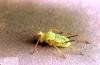
Image related to Rose (Rosa)-Rose aphid

Schizura concinna

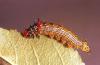
Pest description and crop damage Mature larvae are reddish or yellow and have several spines on each segment. The entire body is lined with white, dark reddish brown, and black lines. The head is red, and the fourth segment is humped. This insect has been a problem on cherry and other hosts east of the Cascade Mountains.

Management-chemical control

See:

Image related to Rose (Rosa)-Redhumped caterpillar

Pegomya rubivora

Pest description and crop damage New shoots wilt from a few inches to a foot from the tip. Damage is caused by a small white maggot that girdles the cane. This usually is not a serious pest. It is more often a pest of blackcaps and other cane fruits.

Management-cultural control

Cut off infested canes several inches below the wilted portion.

Many species

Pest description and crop damage Variously colored caterpillars about 0.75 inch long when mature.

Management-chemical control

See:

Megachile spp.

Pest description and crop damage Smooth, circular, or crescent-shape areas are cut from leaves. Bees use pieces of leaves to form cells for young.

Management-chemical control

No controls are registered.

For more information

Dialeurodes chittendeni

Pest description and crop damage Small white insects with wings held roof-like over their heads. The eggs are small and white and laid on the underside of the leaf. Once the eggs hatch, the small oval nymphs settle and remain stationary, feeding at that site. Honeydew can be present with the associated black sooty mold fungus. The insect overwinters in the nymph stage. There is one generation a year.

Management-chemical control

Stephanitis rhododendri

Pest description and crop damage Overwinters in egg stage. Eggs are laid in the midrib on the underside of leaves. Eggs hatch in late May or early June, although they have been noted as early as mid-April. Probably one generation a year in Oregon. Leaves are yellow and stippled. Undersides of leaves are dirty.

Management-chemical control

See:

Image related to Rhododendron (Rhododendron)-Rhododendron lace bug

Coleotechnites huntella

Pest description and crop damage Pink larvae overwinter in the larger buds. They pupate in buds or twigs in the spring. Adults are gray moths, about 0.5 inch long, appearing in July. New larvae make blotch mines covered with silk and debris on the underside of host leaves. Later, they mine the midrib and then bore into twigs and bud bases in the fall.

Management-chemical control

See:

Sciopithes obscurus, Otiorhynchus sulcatus

See: