



Includes
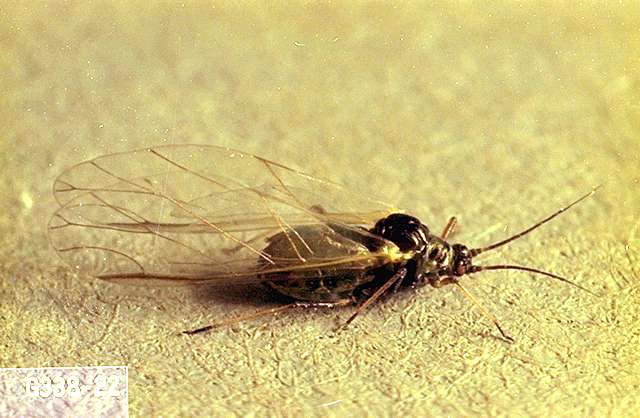
Bird-cherry oat aphid (Rhopalosiphum padi)
Corn leaf aphid (Rhopalosiphum maidis)
Pest description and crop damage
Bird-cherry oat aphid - This aphid varies in color from orange-green to olive-green, dark olive-green and sometimes greenish-black. It features long antennae and elongated, tube-shaped cornicles positioned at the rear of its abdomen. Wingless individuals frequently have a reddish-orange patch around the base of the cornicles. Bird cherry-oat aphids may be found any time after seedling emergence. The bird cherry-oat aphid, often confused with the corn leaf aphid; however, the former has a rounded, bulblike body shape, while the latter appears almost rectangular.
Corn leaf aphid - These small aphids that are olive-green, bluish-green to dark olive, with a purplish patch around the base of the cornicles. Due to their small size and short antennae, they can be mistaken for Russian wheat aphids. However, corn leaf aphids have prominent black cornicles and do not possess a supracaudal process-a tail-like appendage found on certain aphids that gives them the appearance of having two tails. This appendage is located directly above the aphid's cauda (tail-like structure).
Damage - Heavy populations of both aphids can cause a golden yellow streaking on leaves. It is important not to confuse this yellowing with the white streaks caused by Russian wheat aphids. The curl caused by bird-cherry oat aphids resembles a corkscrew, while the curl caused by Russian wheat aphids looks like an upright soda straw. Damage from these aphids is typically minor. Nonetheless, they serve as vectors for the barley yellow dwarf virus. Large populations of these aphids may lead to a reduction in kernel number and size.
Management-chemical control
Seed treatments
- abamectin/azoxystrobin/fludioxonil/mefenoxam/thiabendazole/thiamethoxam (Avicta Complete Corn 250 Nematicide/Insecticide/Fungicide) Group 4A 6 insecticide, Group 1,4,11,12 fungicide-Only to be treated directly to seed, in Syngenta-certified facilities.
- clothianidin (Lumisure, Nipsit Inside, Poncho 600 Seed Treatment) at 0.044 to 0.88 lb ai per 100 lb of seed. Seed treated with Lumisure must be colored with EPA approved dye. All seed require minimum depth of 0.5 inch. Do not plant non-listed crops in same area less than 4 months after planting treated seed. Group 4A
Foliar application
- alpha-cypermethrin (Fastac CS Insecticide) at 0.018 to 0.025 lb ai/A (2.7 to 3.8 fl oz). REI 12 hr. PHI 30 days grain and stover; 60 days forage. Retreatment interval 3 days. Do not exceed 0.075 lb ai/A per season. Group 3A.
- Beauveria bassiana GHA (Bioceres WP, Mycotrol ESO, BotaniGard, several variations of each) at 4 oz/A. REI 4 hr. PHI 0 day. OMRI-listed for organic use.
- bifenthrin (Brigade 2EC, Capture LFR, Sniper LFR and several other formulations) at 0.033 to 0.1 lb ai/A. PHI 30 days for harvest, grazing, or cutting for feed. REI 12 hr. Do not apply more than 0.3 lb ai/A per season. Group 3A
- bifenthrin/chlorantraniliprole (Elevest) at 0.084 to 0.167 lb ai/A. REI 12 hr. PHI 30 days. No more than three applications per year. Do not apply more than a total of 0.2 lb ai/A of chlorantraniliprole and 0.3 lb ai/A of bifenthrin per year. Group 3A and 28.
- bifenthrin/zeta-cypermethrin (Hero EW insecticide, Hero insecticide, Steed insecticide) at 0.04 to 0.1 lb ai/A. PHI 30 days grain and stover; 60 days forage. REI 12 hr. Do not graze for 30 days after treatment. Do not apply more than 0.099 lb/A zeta-cypermethrin and 0.398 lb/A bifenthrin per year. Group 3A insecticide.
- Burkholderia spp. strain A396 (Venerate XC) at 1 to 4 quarts/A. For suppression only. REI 4 hr. PHI 0 days. Bioinsecticide. OMRI listed.
- chlorantraniliprole/lambda-cyhalothrin (Besiege Insecticide) at lambda-cyhalothorin 0.02 to 0.03 lb ai/A and chlorantraniliprole 0.04 to 0.065 lb ai/A. Suppression only. PHI 21 days. REI 24 hr. Do not exceed 0.12 lb ai of lambda-cyhalothrin or 0.2 lb ai of chlorantraniliprole per acre per growing season. Retreatment interval 7 days. For use in WA only. Group 3 & 28 insecticide.
- Chromobacterium subtsugae strain PRAA4-1 (Grandevo WDG) at 0.6 to 0.9 lb ai/A per 100 gal. PHI 0 days (2 to 3 lb/A). REI 4 hr. OMRI-listed for organic use.
- deltamethrin (Delta gold 1.5EC) at 0.018 to 0.022 lb ai/A. Suppression only. Do not apply more than 0.095 lb ai/A per growing season. REI 12 hr, PHI 21 days. Group 3
- dimethoate (Dimethoate 400 EC, Drexel Dimethoate 4EC) Group 1B insecticide/miticide at 0.33 to 0.5 lb ai/A (0.6 to 1.0 pint/A). PHI 14 days forage; 28 days grain. REI 48 hr. Do not exceed 0.5 lb ai/A per season. Do not apply during pollen shed if bees are foraging actively.
- esfenvalerate (Asana XL, S-Fenvalostar) at 0.03 to 0.05 lb ai/A. For optimum results, direct the spray at the aphid population so as to achieve maximum coverage of the exposed insects. Aphids not contacted by the spray, such as in whorls and leaf axils, may not be adequately controlled. PHI 21 days. REI 12 hr. Do not exceed 0.25 lb ai/A per season. Group 3 insecticide.
- fluoxastrobin/bifenthrin (Tepara Plus) at 0.033 to 0.10 lb ai/A (fluoxastrobin) 0.033 to 0.10 lb ai/A (bifenthrin). Continue foliar application as needed on 7- to 10-day interval on field corn. Do not apply more than 0.3 lb active ingredient bifenthrin and 0.36 lb active ingredient fluoxastrobin per acre per year. REI 12 hr. PHI 30 days. Use of this product on corn is prohibited in all coastal counties. Group 11 fungicide and Group 3 insecticide
- flupyradifurone (Sivanto 200SL, Sivanto HL, Sivanto Prime) at 0.09 to 0.14 lb ai/A (7.0 to 14.0 fl oz/A). PHI 7 days forage; 21 days grain, stover or straw. REI 4 hr. Retreatment interval 7 days. Do not exceed 0.365 lb ai/A per calendar year. Registered in WA only.
- gamma-cyhalothrin (Declare Insecticide, Announce) at 0.01 to 0.015 lb ai/A. For suppression only. PHI 21 days. REI 24 hr. Do not apply more than 0.06 lb ai/A from planting to foliar applications per year. IRAC Group 3A
- malathion (Drexel 5EC, Malathion 5, Fyfanon 57EC, Fyfanon 8 lb Emulsion and several other formulations) at 0.6 to 1 lb ai/A (1 pint/A). Limit 2 treatments per year. Retreatment interval 7 days. PHI 7 days. REI 72 hr for detasseling, 12 hr for other activities. Group 1 insecticide
- methomyl (Lannate SP) at 0.23 to 0.45 lb ai/A. PHI 21 days for ears, 3 days for forage, or 21 days for fodder. REI 2 days. Initial application when corn is at 1-2 leaf stage for early control with second application 5 to 7 days later if needed. Do not exceed 2.25 lb ai/A or 5 treatments per season. Retreatment interval 5 to 7 days. Restricted use pesticide. Group 1A insecticide.
- sulfoxaflor (Transform WG) at 0.023 to 0.047 lb ai/A. PHI 7 days for grazing, forage, fodder or hay harvest. Minimum retreatment interval 7 days. Do not apply more than 0.09 lb ai of sulfoxaflor per acre per year. Group 4C insecticide
- zeta-cypermethrin (Mustang, Mustang MAXX) at 0.034 to 0.05 lb ai/A. PHI 7 days for grain, stover and forage. REI 12 hr. Do not exceed 0.2 lb ai/A per season. Do not make consecutive applications less than 7 days apart. Group 3A insecticide.