Plant Disease Management Handbook

Cause The OSU Plant Clinic has diagnosed root rot on rockrose a few times by the oomycetes Pythium or Phytophthora. The primary cause is overwatering. These plants are well adapted to growing in hot, dry situations, and in relatively poor soils.

Symptoms Leaf chlorosis, defoliation, and wilt associated with root and collar rot. Note: they may drop leaves during prolonged periods of drought.

Cause Streptomyces scabies (syn: Streptomyces scabiei), a filamentous bacterium that lives in soil and can infect storage root and tuber portions of beets, potatoes, parsnips, carrots, radish, and potentially other root and tuber crops. Neutral or alkaline soils favor common scab development, it survives a short period of time in acidic soils. Soils containing high levels of organic matter which is not fully-decomposed, can have more severe disease.

By C. M. Ocamb and D.A. Johnson

See:

Cause Several fungi that live in soil. Stolon decay is associated with Fusarium solani. Stem and stolon canker are caused by Rhizoctonia solani.

Symptoms Roots, runners, and rhizomes have brown or black progressively rotting areas. Stands may be greatly reduced, frequently in spots.

Cultural control

Cause The impatiens necrotic spot virus (INSV) and the tomato spotted wilt virus (TSWV) infect many economically important plants, including both dicots and monocots, and have been found in mint.

Cause Streptomyces scabies (syn: Streptomyces scabiei), a filamentous bacterium that lives in soil and can infect belowground portions of beets, potatoes, parsnips, carrots, radish, and potentially other root and tuber crops. Neutral or alkaline soils favor common scab development, it survives a short period of time in acidic soils. Soils containing high levels of organic matter which is not fully-decomposed, can have more severe disease.

Cause The fungus, Golovinomyces cichoracearum (syn. Erysiphe cichoracearum) can infect lettuce as well as wild lettuces (Lactuca serriola, L. canadensis, L. pulchella, L. serriola, etc.). It has been reported on lettuce in Washington.

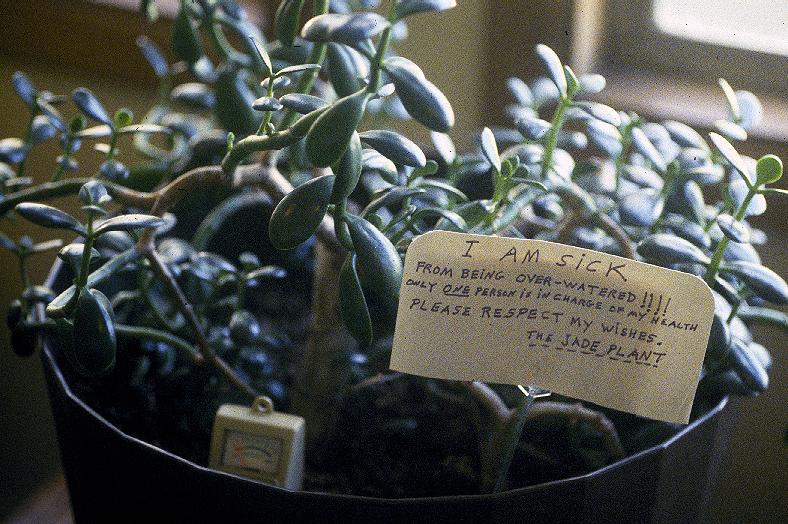
Cause The primary cause of rotting jade plants is overwatering. The OSU Plant Clinic has diagnosed overwatering several times. Sometime this results in oedema or colonization by the oomycetes Pythium or Phytophthora.

Symptoms Yellowing of leaves and defoliation may be the first symptom seen. Roots and/or stems become mushy and brown.