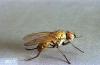
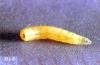
Pest description and crop damage Adult is a fly with a gray body and black legs, less than 0.25 inch long. Larvae are legless, blunt, white maggots that feed on seeds and reduce onion stands. They sometimes damage bulbs of mature plants.
Pest description and damage Sapygid wasps are tiny and black with yellow markings along the body. The first instar larvae of this wasp-like parasite is only about one tenth the size of the bee egg, but it is able to puncture the bee egg, either parasitizing the host or causing the host egg to collapse.
Management-emergence traps
Trichodes ornatus
Ascosphaera spp.
Wood-boring wasp ("horntail")
Siricidae
Adult female wasps are large and thick-waisted, with a hornlike ovipositor at the end of the abdomen. They sometimes emerge from recently milled dimension lumber in newly constructed homes. Emerging wasps damage walls (sheetrock, plaster, wallpaper, etc.) but do not re-infest.
Termites are among the most important structural insectpests in the PNW, rivaled only in certain areas by carpenter ants. They feed on wood, paper, cardboard, and other cellulose-containing material. Experts have estimated that termites cause as much property damage each year in the U.S. as fire (over $5 billion according to the National Pest Management Association).
Beetles are the most diverse group of insects on earth and yet, only a few species are important as structural pests. Given the long duration that beetle larvae feed within wooden timbers, they can cause extensive damage to houses and commercial buildings.
Ambrosia beetle
Platypodidae
Ants are found everywhere and, like termites, bees, and wasps, are social insects that live in colonies consisting of thousands of individuals. Because they are so numerous, pest management companies rate ants as the number one insect problem they encounter in residences.