Rate 0.5 to 1 lb ai/A (0.8 to 1.6 pints/A Basagran 5L)
Time Apply to small, rapidly growing annual broadleaf weeds after first trifoliate bean leaf is fully expanded. Not effective if temperature drops below 50°F at night and in daytime does not exceed 70°F. Adjust rate depending on expected weather conditions: more for cold days, less for hot days.
clomazone (Command 3ME)
Rate 0.15 to 0.25 lb ai/A (0.4 to 0.67 pints/A Command 3E) Use lower rate on coarse soils and the higher rate on fine soils.
Time Prior to or after planting and before weed emergence. Place seed below the chemical barrier when planting.
EPTC (Eptam 7E and 20G)
Not for use on adzuki, cow peas, lima beans, or flat-podded beans (except Romano)
Rate 2 to 4 lb ai/A 7E (2.25 to 4.5 pints/A); 3 to 4 lb ai/A 20G (15 to 20 lb/A)
Rate 0.50 to 1 lb paraquat cation/A (2 to 4 pints/A); use higher rates for heavy weed infestation.
2,4-D (several trade names)
Rate 1.4 to 1.9 lb ae/A
Time Apply on actively growing weeds, usually in April or May, using a ground sprayer with drop nozzles to reduce contact of spray with crop.
See "Site Preparation, Stale Seedbeds, and Selective Postemergence Applications" at the beginning of Section P. for additional options for weed control during asparagus establishment.
Click on the image below to download the PDF file.
caprylic plus capric acids (Suppress)
Rate 3% to 9% dilution in 25 to 100 gal water, depending on weed size, temperature, and sunlight intensity.
Time Any time during the crop growing season to control weeds in row-middles or to burn down unwanted crop vegetation.
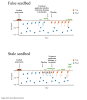
Several organic and non-organic herbicides are registered for use in vegetable crops as burndown products in stale and false seedbed systems. False seedbeds are prepared well in advance of vegetable seeding, and weed seedlings are encouraged to emerge before the crop is seeded. Fields with high weed population densities would benefit from more than one iteration of weed management before planting to reduce the weed populations.