
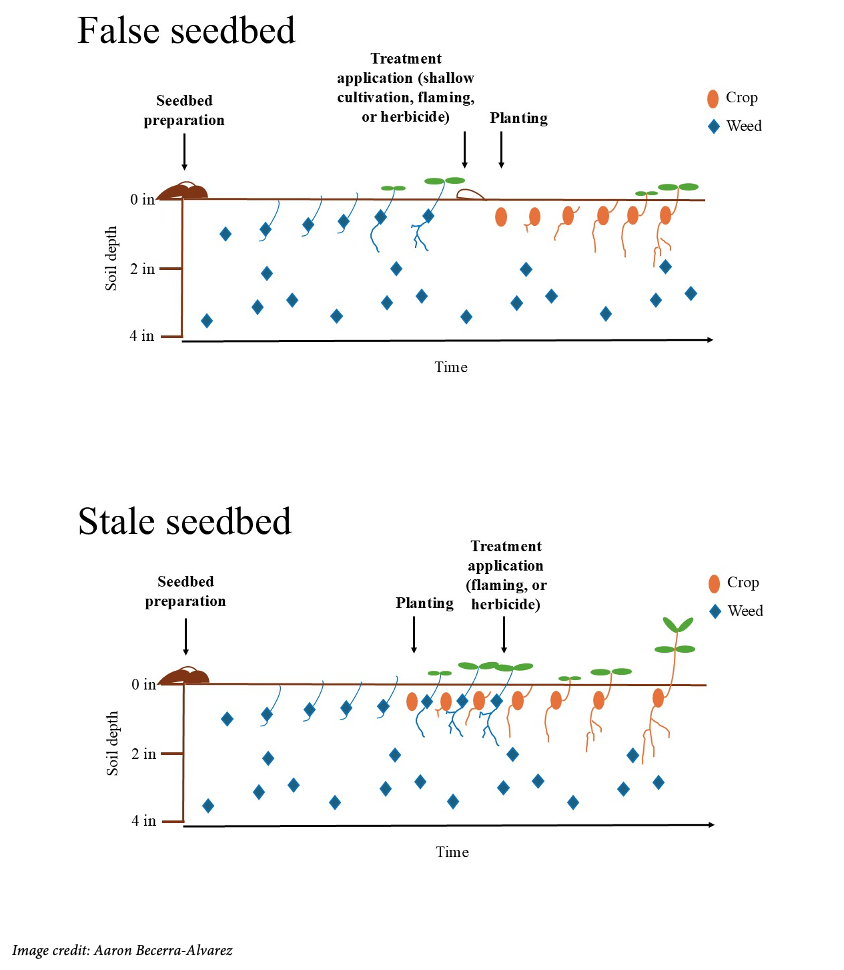
Several organic and non-organic herbicides are registered for use in vegetable crops as burndown products in stale and false seedbed systems. False seedbeds are prepared well in advance of vegetable seeding, and weed seedlings are encouraged to emerge before the crop is seeded. Fields with high weed population densities would benefit from more than one iteration of weed management before planting to reduce the weed populations. In high weed density fields, a late planting date may be more effective for weed control during the crop growing season, especially in organic production where herbicides can't be used after planting. Cultivation, herbicide application, or flaming are used to destroy the emerged seedlings. More recently, research at OSU is evaluating electric weeding as a new weed control tool in false seedbeds.
Stale seedbeds sometimes are used for vegetable production when other selective weed control practices are limited or unavailable. The soil is tilled, vegetables are planted and weed seedlings are killed using herbicides, flames, or blind tillage before the crop emerges. Use of tillage is only possible with large-seeded vegetable crops that are planted far enough below the soil that precision tillage implements can avoid contact with the crop seed. Success of these systems depends on controlling the first flush of emerged weeds before crop emergence, and on minimal soil disturbance, which reduces subsequent weed flushes while the crop establishes. After establishment, other weed control practices including cultivation or other herbicides can be used. Stale seedbed steps are:
- Prepare a seedbed, preferably 2 to 3 weeks before planting, to achieve maximum weed seed germination near the soil surface. Soil temperatures and moisture must be reasonable, or results will be erratic.
- Plant the crop with minimum soil disturbance to avoid exposing new weed seed to favorable germinating conditions.
- After planting (depending on herbicide or strategy), but before crop emerges, treat the field by flaming or with herbicide to kill all germinated or exposed weeds.
cultivation weeding
Rate Tractor speed and equipment used will determine effective control.
Time Apply to seedbeds before or shortly after the crop is planted, but before the crop emerges. Large-seeded vegetables are most suitable for application after planting deeper in the soil profile.
Caution Follow the equipment manufacturer's direction for safe use of cultivation.
Remarks Shallow cultivators are best to avoid excessive soil disruption that can bring up new weed seeds to the surface. Examples are tine cultivators, top knives, roller harrows, power harrows, or combinations on one equipment. A bed shaper may be enough to kill weeds if they are small and prepare the new seedbed following a false seedbed, if bed shaping is a common practice in your field. The weed population density should also be considered. Large population densities may require several passes with cultivators or incorporate several tools to reduce the weed population before planting.
flame weeding
Rate Tractor speed and equipment used will determine effective control. Propane rates of 5 gal/A (when applied to a 12-inch band over rows spaced at 30 inches) is usually adequate to kill small weeds in stale seedbed systems, assuming normal summertime temperatures and dry conditions.
Time Apply to seedbeds before or shortly after the crop is planted, but before the crop emerges. Large-seeded vegetables are most suitable for application after planting. Use liquid propane or similar fuel-burning equipment to quickly sear weeds.
Caution Follow the equipment manufacturer's direction for safe use of flame weeding.
Remarks Use the thumb pressure test to determine effectiveness: press a weed leaf between thumb and forefinger; if the leaf collapses and a thumb print remains, sufficient heat was applied to kill the leaves. There may be no other noticeable change in the plant immediately after flame is applied. The objective is to disrupt cell membranes, not to char the plant. Smaller weed seedlings will be more easily controlled than larger seedlings. Control or suppression can vary across weed species; grasses are not easily controlled with flame.
electric weeding
Rate Tractor speed and equipment used will determine effective control. Typically, slower speeds (0.6 mph) are most effective or two or more passes at faster speeds.
Time Apply to seedbeds before the crop is planted. Current research demonstrates electric weeding with Zasso equipment or similar equipment to be best used in false seedbeds to avoid potential crop injury in snap beans.
Caution Follow the equipment manufacturer's direction for safe use of electric weeding. Avoid passing over dry biomass which can be prone to catch fire.
Remarks This tool utilizes electric current to kill weeds on contact. A dense weed population may slow down the equipment. Moisture in the canopy results in more effective control, either by a well-irrigated seedbed or applications early in the day with dew in the canopy. The application is broad-spectrum; however, some weed species may not be easily controlled at higher speeds. Current research at OSU will expand recommendations.
caprylic plus capric acids (Suppress)
Rate 3% to 9% dilution in 25 to 100 gal water, depending on weed size, temperature, and sunlight intensity.
Time Preplant burn down.
Remarks OMRI approved burndown. Not selective in broadleaf vegetable crops, and crop will be injured any time the spray contacts plant tissue. Use false seedbed methods. Do not apply to weeds when wet from dew, rain or water. Do not water within 4 hr after application. Do not apply if rainfall is expected within 4 hr of spray. For mature weeds up to 6 inches tall, use the higher rates in up to 100 gal water/A.
carfentrazone (Aim EC)
Rate Up to 0.031 lb ai/A (2 fl oz Aim EC)
Time Preplant interval varies by crop. See PREPLANT BURNDOWN section of the product label for instructions.
Remarks The use of a nonionic surfactant, crop oil concentrate, or methylated seed oil is required. A high-quality sprayable liquid nitrogen fertilizer may be used at 2% to 4% v/v or AMS at 2 to 4 lb/A in addition to the nonionic surfactant, COC, or MSO. Tank mixes with other herbicides increase spectrum of control. Apply to actively growing weeds not more than 4 inches tall, or rosettes 3 inches in diameter. Thorough coverage is essential for good control.
Caution Do not apply to desirable vegetation.
Site of action Group 14: protoporphyrinogen oxidase inhibitor
Chemical family Triazolinone
pyraflufen-ethyl (Venue)
Rate Up to 0.004 to 0.0053 lb ai/A (3.0 to 4.0 fl oz Venue)
Time One (1) day following preplant burndown application. See Rotational Crop Restrictions section of the product label for instructions and crop groups allowed.
Remarks Apply in a minimum of 5 gal spray solution per acre by air or 10 gal spray solution per acre by ground.
Use of a COC adjuvant at a concentration of 1% to 2% is directed for optimum weed control. Use the higher COC rate
for larger labeled weed species or in low moisture conditions. COC adjuvants are advised, although other adjuvants may be used. Refer to Rotational Crop Restrictions table. Use the higher rate for hard-to-control weed
Caution Do not apply to desirable vegetation.
Site of action Group 14: protoporphyrinogen oxidase inhibitor
Chemical family Triazolinone
glyphosate
Rate 0.5 to 2 lb ae/A
Time Apply to seedbeds before or shortly after the crop is planted, but before the crop emerges. Allow at least 3 days between application and planting for cucurbit crops.
Caution Some crops may be injured by glyphosate if the soil is extremely sandy, or if the planter did not properly close the seed row. Do not allow glyphosate to contact seeds or any part of the seedling, as crop failure will result.
Site of action Group 9: inhibits EPSP synthase
Chemical family Glycine
paraquat (Gramoxone SL 3.0) or diquat (Reglone and others)
Rate Consult label
Time Apply during or after planting but before crop emerges.
Remarks Use paraquat if grasses are present. Add a nonionic surfactant or crop oil concentrate according to label specifications; take care to avoid anionic formulations that react in the tank to form insoluble precipitates. Exposed crop plants will be killed.
Caution Paraquat is a Restricted use pesticide due to acute toxicity. Pay particular attention to the personal protective equipment required for these products including respirators, face shields, and protective clothing. For retail sale to and use only by certified applicators - not to be used by uncertified persons working under the supervision of a certified applicator. Do not ingest or inhale spray mist. Applicators must wear required PPE such as long-sleeve shirt and long pants, shoes plus socks, protective eyewear, chemical-resistant gloves, and a NIOSH-approved particulate respirator or approved powered air-purifying respirator. Do not apply preplant or preemergence to soils lacking clay minerals, such as peat, muck, pure sand, or artificial planting media. Paraquat can be used in the following crops (not an exhaustive list): bean (lima and snap), broccoli, cabbage, cabbage (Chinese), cantaloupe, carrot, cauliflower, collards, corn (sweet), cucumber, eggplant, garlic, lettuce, melon (musk), onion (dry bulb and seeded), pea, pepper, squash, tomato, turnip, watermelon.
Site of action (both) Group 22: photosystem I electron diversion
Chemical family (both) Bipyridilium