

See:
Rose (Rosa spp.) and hybrids - Winter Injury
Rose (Rosa spp.) and hybrids - Bacterial Cane Blight
Cause Pseudomonas syringae pv. morsprunorum, a bacterium. Although diagnosed only ten times by the OSU Plant Clinic from 1962 to 2017, it does come up consistently over the years. Most common in cool, wet spring weather.
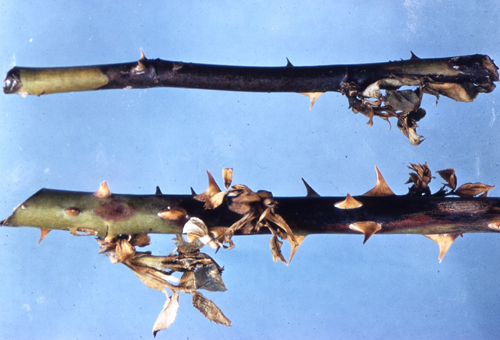
Symptoms Dark brown, sunken spots appear on leaves, flower stalks, and calyx parts. Flower buds may die without opening. Black streaks appear on 1-year-old stems.
Cultural control
- Remove and destroy infected leaves and stems.
- Disinfect pruning shears before cutting more stems. Clean shears and long soak times improve the disinfectant's efficacy. Disinfestants include bleach, peroxides, and quaternary ammonium products.
Chemical control Spray before fall rains begin and again when half the leaves have fallen. Repeat in spring to protect new growth.
Products available in home packaging:
- Bonide Copper Fungicide at 8 oz/3 gal water. Group M1 fungicide. H
- Monterey Liqui-Cop at 3 Tbsp/gal water. May discolor blooms. Group M1 fungicide. H
Products available for commercial use:
- Badge X2 at 1.5 to 2 lb/A. Group M1 fungicide. 48-hr reentry general or 24-hr reentry for greenhouse.O
- C-O-C-S WDG at 2 to 3.9 lb/100 gal water. Group M1 fungicide. 48-hr reentry general or 24-hr reentry for greenhouse.
- CuPRO 5000 at 1.5 to 5 lb/A but only up to 2 lb/A when new growth is present. May discolor foliage or blooms. Group M1 fungicide. 48-hr reentry.
- Junction at 1.5 to 3.5 lb/A. Some cultivars have shown discoloration of foliage and/or blooms. Group M1 + M3 fungicide. 48-hr reentry.
- Phyton 27 at 1.5 to 3.5 oz/10 gal water. Group M1 fungicide. 48-hr reentry.
Reference Pscheidt, J. W., and Rodriguez, T. G. 2018. Diseases of Rose. In McGovern, R.J. and Elmer, W.H. (eds.) Handbook of Florists' Crops Diseases. Springer Int.