

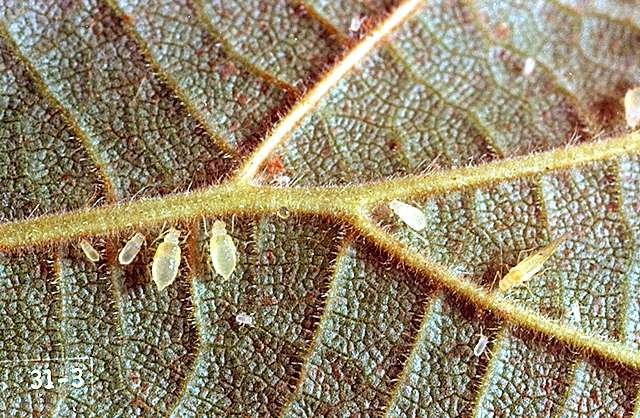
Filbert aphid (Myzocallis coryli)
Hazelnut aphid (Corylobium avellanae)
Pest description and crop damage Medium to small aphids that feed on leaves and husks and produce honeydew. Filbert aphid is typically light green or pale yellow and lacks well-developed cornicles, which are tube-like projections that emerge from the abdomen. Hazelnut aphid by contrast has well-developed cornicles, longer legs, and is a darker green color and may also have reddish coloration. Experimental evidence indicates that heavy infestations of filbert aphid should be controlled to prevent reduced kernel fill and smaller nut size. Less is known about the impact of hazelnut aphid or the potential synergistic impact of the two species occurring together. Damage caused by aphids is cumulative; benefits of control might not be seen during the first season, but they become evident after two years or more of aphid control. Honeydew produced by aphids is colonized by sooty mold fungus. Sooty mold fungus can impede photosynthesis and severely devitalize plants and retard growth. Honeydew is sweet and it attracts pollinators, so use caution when managing severe aphid infestations with insecticides. These aphid species are specific to hazelnut, they are not found on other plants outside the orchard other than wild or ornamental hazelnut plants.
Biology and life history Both aphid species overwinter as eggs in crevices in bark and on twigs, and around buds and leaf scales. Eggs turn from a greenish color when they are first laid, to black as they mature. Around the time of bud swell, aphid eggs of both species begin to hatch, and the tiny nymphs move to the green buds and commence feeding. As leaves begin to develop and shoots elongate, both species are found on the underside of leaves and along the shoots, with hazelnut aphid tending to be more dominate on shoots and along leaf midribs. Filbert aphid tends to remain on undersides of leaves where it feeds on phloem along marginal leaf veins throughout the season, while hazelnut aphid transitions onto stems, peduncles and nut husks as the nut clusters develop. The winged 'stem mothers', or fundatrices that develop from the first nymphs are capable of dispersing by flight, and they give live birth to nymphs that also give live birth when mature (viviparae). The population can increase rapidly, and there are 8 to 10 asexual generations per year. After nut drop, hazelnut aphids tend to move to catkin peduncles, and filbert aphids may persist on green leaves on suckers. In the fall, winged sexual males and wingless females (oviparae) are formed. These mate and the oviparae females lay overwintering eggs. Aphids become very active during the period of egg laying and they may be seen roaming throughout the branches of the tree.
Pest monitoring The sampling period is April 1-Sept 30. Check three terminal branches per tree and three leaves per terminal. Count the number of aphids per leaf and treat when the following thresholds for filbert aphid are reached: April: 20 per leaf, May: 30/leaf, June: 40/leaf, and July: 40/leaf with an increasing population. Because hazelnut aphid is a relative newcomer, action thresholds based on their density have not been developed. If there are signs of the parasitoid, Trioxys pallidus, hold off on treatment and check back on population levels in a week. Mummified aphids indicate that the parasitoid is active. Aphid mummies appear swollen, rounded, and darker and may have an exit hole chewed by the wasp. Note that populations of aphids typically peak by June and will decrease substantially by July regardless of management action. Black mummies may be apparent on husks, indicating hazelnut aphids are under attack by other parasitoid species. An increase in aphid populations tends to occur in the late growing season when conditions are cooler and the period of egg laying approaches.
Management-biological control
An introduced parasitoid wasp (Trioxys pallidus) that attacks both aphid species is well established in the Willamette Valley. This wasp makes aphid sprays unnecessary in many hazelnut orchards. Learn to recognize mummies and the wasps and avoid treating when biological control is active. The aphid has a lower temperature threshold for development than the wasp, and it typically emerges about two weeks after the aphids. As a result, there is lag time between population increase of aphids and the response of the wasp. Pest management practices that are detrimental to the wasp population can aggravate aphid problems. Broad-spectrum insecticide applications made against aphids or other orchard pests that harm natural enemies can free the aphid populations from biological control, causing populations to surge. Products labeled for aphid control that contain pyrethroid may ultimately aggravate aphid problems. There are a number of important predators of aphids that occur in hazelnut orchards including: ladybird beetles (both larvae and adult beetles are predaceous), syrphid fly larvae, Geocoris (big-eyed bugs, Geocoridae family), Deraeocoris (plant bugs, Miridae), Orius (minute pirate bugs, Anthocoridae) and lacewing larvae. Yellow jackets and paper wasps also prey on aphids.
Management-cultural control
Aphid populations tend to be higher in plants that are fertilized liberally with nitrogen. Avoid excess nitrogen applications, which produces flushes of succulent growth that are the ideal habitat for aphids. Home orchardists: Wash aphids from plants with a strong stream of water or by hand-wiping. Control ants, which "farm" the aphids for their honeydew and protect them from predators.
Management-chemical control: HOME USE
- azadirachtin (neem oil)-Some formulations are OMRI-listed for organic use.
- bifenthrin (often as a mix with other ingredients)-Highly toxic to bees.
- boscalid (often as a mix with other ingredients) (Bonide Fruit Tree & Plant Guard)
- esfenvalerate-PHI 21 days. Highly toxic to bees.
- imidacloprid-PHI 7 days. Highly toxic to bees.
- kaolin-Some formulations are OMRI-listed for organic use.
- Mineral or vegetable oils-Dormant or delayed dormant applications can kill aphid eggs. Use caution not to interfere with active pollination.
- plant-derived essential oils-Some formulations are OMRI-listed for organic use and have shown efficacy against aphids. Active ingredients include cinnamon oil, garlic oil, neem oil, clove oil, peppermint oil.
- potassium laurate/insecticidal soap -Good coverage is important with potassium salts of fatty acids. Some formulations are OMRI-listed for organic use. PHI 0 days. REI 12 hr.
- pyrethrins (often as a mix with other ingredients)-Some formulations are OMRI-listed for organic use. Highly toxic to bees.
- zeta-cypermethrin-PHI 7 days. Highly toxic to bees.
Management-chemical control: COMMERCIAL USE
Because filbert and hazelnut aphids are specific to hazelnuts and filbert aphids have a history of developing resistance to insecticides, rotating chemistries used for chemical control is important.
Organic:
- azadirachtin (neem oil)-Some formulations are OMRI-listed for organic use.
- azadirachtin + pyrethrins (Azera; see also Azera Pro) at 16 oz/30-100 gal water. PHI 0 days. REI 12 hr. Do not wet plants to the point of runoff.
- Beauveria bassiana (BioCeres WP and others)-Biological, entomopathogenic fungi. 1 to 3 lb/A. PHI 0 days. REI 4 hr. OMRI-listed for organic use.
- Burkolderia spp. (Venerate CG Bioinsecticide) Biological. 2 to 4 quarts per acre. Repeat applications on 3- to 10-day rotation. REI 4 hr. OMRI-listed for organic use.
- Isaria (Cordyceps) fumosoroseae (PFR-97 20% WDG Microbial Insecticide) at 1 to 2 lb/A (0.2 to 0.4 lb ai/A). Pre-agitate for 30 min. Reapply on 3- to 10-day intervals. OMRI-listed for organic use. REI 4 hr.
- kaolin-Particle film. Some formulations are OMRI-listed for organic use.
- oils-Various vegetable (non-mineral) oils are registered and may be useful as delayed dormant or postharvest and sprays as smothering agents for eggs. Botanical oil sprays can also be useful in-season. Many of these are OMRI-listed for organic use. Active ingredients include cinnamon oil, garlic oil, neem oil, clove oil, peppermint oil, rosemary oil.
- Potassium laurate (Incl. DES-X, M-PEDE, others) at 2 to 4% v/v. Good coverage is important with and of the potassium salts of fatty acids. OMRI-listed for organic use. PHI 0 days. REI 12 hr.
Conventional:
- acetamiprid (Assail 70WP) at 0.57 to 1.0 oz/100 gal water (2.3 to 4.1 oz/A) (0.10 to 0.18 lb ai/A). PHI 14 days. REI 12 hr. No more than 4 applications per season.
- aphidopyropen (Sefina Inscalis) at 3.0 to 6.0 oz. PHI 7 days. REI 12 days. Apply at first indication of infestation in a minimum of 50 gal water for ground applications. Use no more than 12 fl oz per year.
- clothianidin (Belay) at 3 to 6 oz/100 gal water. Use the low rate for smaller infestations or smaller trees. Apply no more than 0.2 lb ai/Acre per year.
- diazinon (Diazinon AG 500) at 1 pint/250 to 400 gal water/A. No more than one application per season. PHI 45 days. REI 18 days. Washington and Oregon only.
- flupyradifurone (Sivanto) at 7.0 to 10.5 fl oz/A. PHI 7 days. REI 4 hr. Use no more than 28 fl oz/Acre/year.
- flonicamid (Beleaf 50 SG) at 2.0 to 2.8 oz/A. Use low rate for building population, high rate for damaging population. PHI 40 days. REI 12 hr.
- imidacloprid (Admire Pro, generics) at 3.4 to 7 fl oz/A. PHI 7 days. REI 12 hr. Can be ground-applied or chemigated. See label details.
- imidacloprid+beta-cyfluthrin (Leverage 360) at 2.8 oz/A (0.22 lb ai/A). PHI 14 days. REI 12 hr.
- imidacloprid+cyfluthrin (Leverage 2.7) at 3.8 to 5.1 oz/A (0.03 to 0.04 lb ai/A). PHI 14 days. REI 12 hr.
- spirotetramat (Movento) at 6 to 9 fl oz/A (0.09 to 0.14 lb ai/A). PHI 7 days. REI 1 day.
- sulfoxaflor (Closer) at 1.5 to 2.75 oz/A. PHI 7 days.