


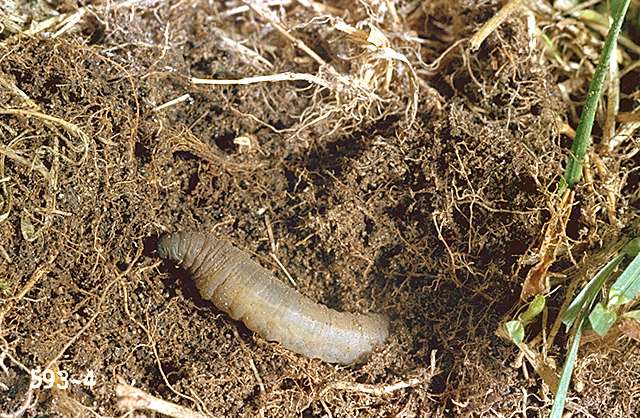

Tipula paludosa
Pest description and crop damage Crane fly larvae which resemble gray grubs that on pasture roots and crowns from October through May. Older larvae may feed above ground on stems and leaves during the night. Large numbers can thin stands in old pastures and kill seedlings in new stands.
Management-chemical control
- azadirachtin (Atrevia 3% SL) at 0.019 to 0.03 lb ai/A. REI 4 hr. PHI 0 days. OMRI-listed for organic use.
- chlorantraniliprole/lambda-cyhalothrin (Besiege, Voliam Xpress) at 0.0391 to 0.0652 lb ai/A for chlorantraniliprole and 0.0195 to 0.0325 lb ai/A for lambda-cyhalothrin. PHI 0 days for grazing or cut for forage; 7 days for cut grass to be dried and harvested for hay. Retreatment interval 7 days. REI 12 hr. Do not exceed 0.09 lb ai/A lambda-cyhalothrin or 0.2 lb ai/A chlorantraniliprole.
- gamma-cyhalothrin (Declare) at 0.01 to 0.015 lb ai/A. PHI 0 days for grazing or cut for forage; 7 days for cut grass to be dried and harvested. REI 24 hr. Do not exceed 0.45 lb ai/A per season.
- lambda-cyhalothrin (Warrior II, Lambda-Cy EC, Ravage II, Crusader 2ME) at 0.02 to 0.03 lb ai/A. PHI 0 days for grazing and forage; 7 days to be dried for hay. REI 24 hr. Do not exceed 0.03 lb ai/A per cutting or 0.09 lb ai/A per season.
Management-biological control
- An entomopathogenic nematode, Steinernema feltiae has been reported to be an effective biological control.
Management-cultural control
- Proper fertilization and irrigation.
- Application of nitrogen in the spring may reduce damage.
- Provide better drainage and reduce irrigation as crane flies thrive in wet soils.
- Proper weed management and aerifying soils facilitates water and nutrients movement into the soil.