Nematodes that tunnel partially into roots, their heads entering to establish permanent feeding sites while their bodies remain outside. The nematode does not move after this. (Examples: citrus nematode, Tylenchulus semipenetrans.)
Any foreign chemical (normally a protein) that induces antibody formation in animals.
Vapor-active chemical used in the gaseous phase to kill or inhibit the growth of microorganisms or other pests.
Having flagella all over the outside of the cell.
An infectious nucleic acid without a protein coat that causes hop stunt, potato spindle tuber, or chrysanthemum stunt.
Distinctive. A distinguishing characteristic serving to identify or determine the presence of a disease or other condition.
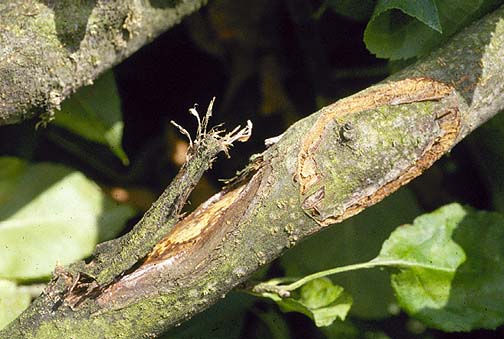
Death of cambium tissue and loss and/or malformation of bark; or by the formation of sharply delineated, dry, necrotic, localized lesions on the stem; the term canker also may be used to refer to the lesion itself, particularly in woody plants.
Cankers on side of this 'Golden Delicious' apple branch show how the bark becomes detached.
Photo by Jay W. Pscheidt, 2000.
An epidermal leaf structure specialized for secretion or exudation of water; leaf opening at terminus of vein.
The water droplets you see on the edge of these leaves are coming out of hydathodes.
Jay W. Pscheidt, 2010.
The sum of the qualities of the host and causal agent that retard the activities of the causal agent.
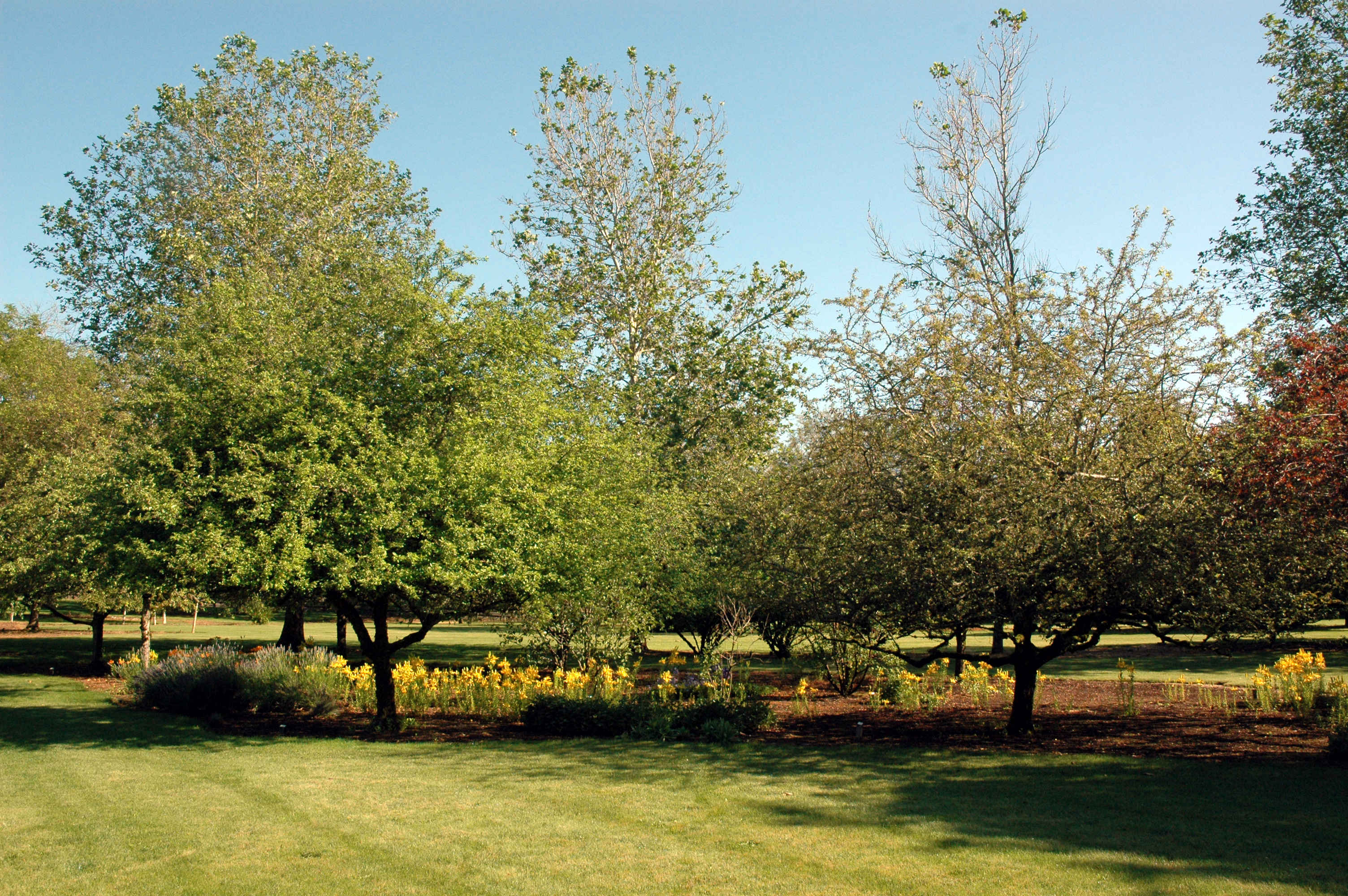
The crab-apple trees in the foreground have scab but the tree on the left has much more foliage since it is a resistant type. (The sycamores in the background have lost many leaves due to anthracnose).