


See:
Maple (Acer spp.) - Sooty Bark Disease
Maple (Acer macrophyllum) - Brittle Decay
Oak (Quercus spp.)-Inonotus Root and Butt Rot
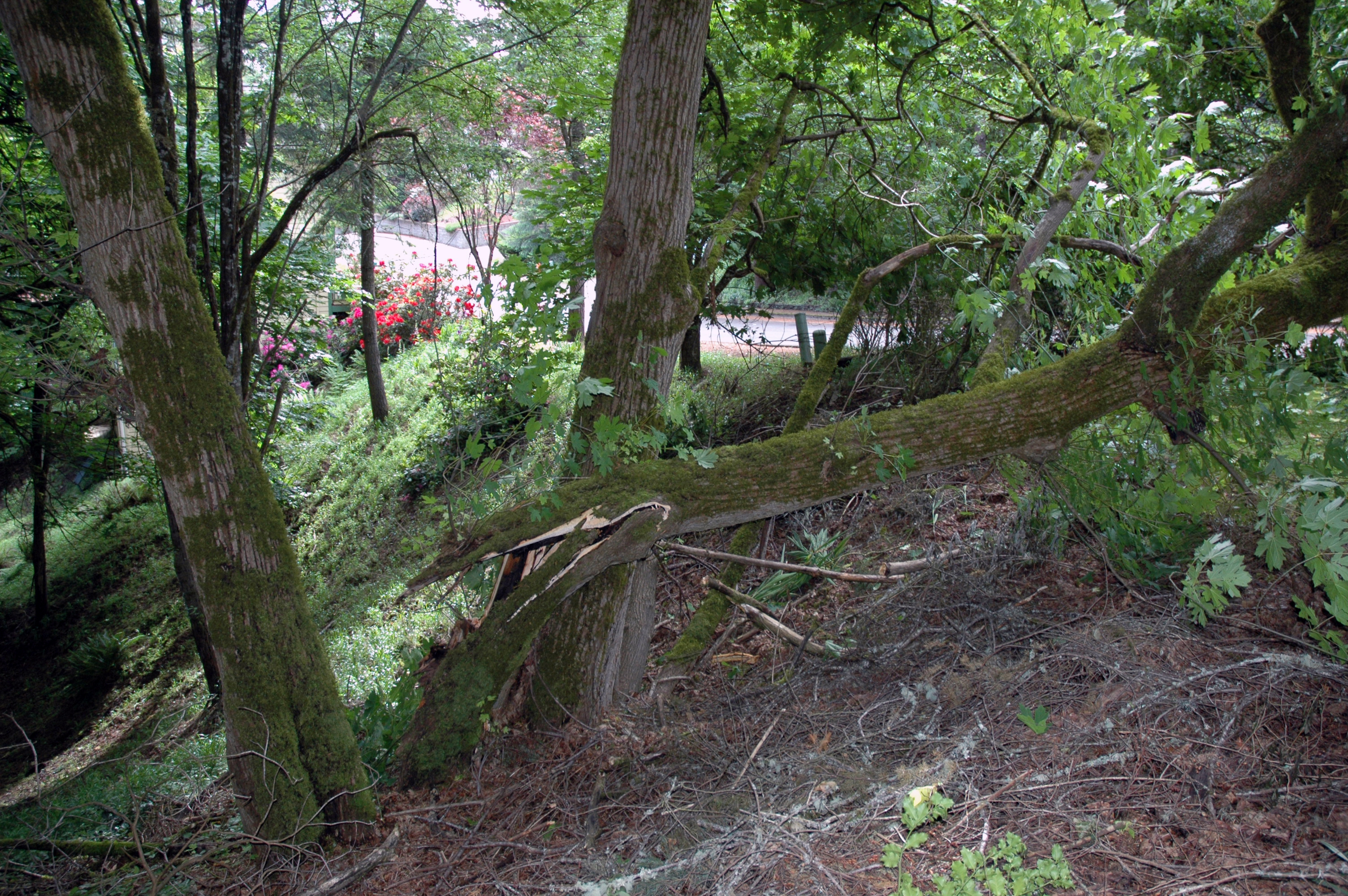
Cause Limb and/or trunk failure due to fungal wood decay is a common problem with old big leaf maples (Acer macrophyllum). Injuries from pruning cuts, sunburn, or storm damage can expose susceptible wood. Large wounds and stubs and horizontal cuts are often entry sites for decay fungi. Wood decay generally is observed in older trees after extensive fungal colonization. Decay fungi frequently function as secondary invaders following a succession of microorganisms, including bacteria, yeasts, and other fungi. Decay in a single tree may be caused by more than one fungal species. Live trees are able to limit wood decay by walling off and compartmentalizing decay fungi but this can vary between different species and individuals. The CODIT model/principle (compartmentalization of decay in trees) is used by certified arborists to manage landscape trees with decay.
Most fungi that cause extensive wood decay are Basidiomycetes. These fungi produce various fruiting bodies such as mushrooms and conks that contain basidia. These fruiting bodies develop after extensive colonization of the substrate in a suitable environment and under suitable physiological conditions. Basidiospores are forcibly discharged from basidia and usually are disseminated by air currents. Wood decay fungi enter trees primarily through wounds that expose sapwood or heartwood. Mycelial growth of the fungus proceeds with colonization and utilization of wood as a food source.
Two types of wood decay occur in living trees: white rots and brown rots. There are at least 6 different fungi causing white rots reported on big leaf maples from the PNW, including some familiar fungi such as Ganoderma applanatus, Pseudoinonotus dryadeus and Trametes versicolor. White rots cause all major structural components of the cell wall-cellulose, hemicellulose, and lignin-to degrade. The strength of white rotted wood decreases only in advanced stages of decay.
Brown rots, with at least 3 fungi reported on big leaf maples from the PNW, cause most of the cell wall polysaccharides to degrade, but the lignin component is unchanged or slightly modified. The strength of brown rotted wood is significantly reduced or lost entirely shortly after decay begins. These rots usually are in exposed wood and can cause extensive damage, resulting in structural failure.
Kretzschmaria deusta, brittle cinder fungus, is capable of decaying both lignin and cellulose, however, unlike many white rot fungi, cellulose is preferentially targeted during the decay process.
Some root rots, such as those caused by Armillaria sp. or Heterobasidion sp. can also extend up into the trunk and cause wood decay.
Symptoms White rots cause moist, soft, or spongy wood that is a lighter color than sound wood.
Brown rots of wood are brown, dry, and crumbly, with longitudinal and transverse cracks. These rots usually are in exposed wood and can cause extensive damage, resulting in structural failure.
Kretzschmaria deusta produces thick, rough, and lumpy fruiting bodies on the surface of the bark or wood, usually near ground level.
Each of these wood decays can lead to limb breakage and/or uprooted trees during wind or ice storms. Many trees have decreased vigor and dieback.
Cultural control
- Help prevent wood decay by using cultural practices that promote tree growth and vigor while minimizing injuries that expose wood.
- Irrigation water, especially from sprinklers, should not wet the trunks.
- Mowing equipment should not injure the roots, crown, or lower trunk.
- Make pruning cuts adjacent to, but not into, the supporting branch, and prune when branches are small to enhance callus formation and wound healing.
Reference Guglielmo, F., Michelotti, S., Nicolotti, G. and Gonthier, P. 2012. Population structure analysis provides insights into the infection biology and invasion strategies of Kretzschmaria deusta in trees. Fungal Ecology, 5:714-725.