


See:
Apple (Malus spp.) - Fire Blight
Pear (Pyrus spp.) - Fire Blight
Crabapple Cultivar Susceptibility
Cause Erwinia amylovora, a bacterium that overwinters in cankers on infected apple, pear and some ornamental trees. Risk of infection increases with the number of more active "holdover" cankers. Insects, pruning tools, and splashing rains spread this bacterium. Bacteria enter healthy, main bloom through the stigma, nectary, anthers, and sepals. A temperature of 65°F or higher in a 24-hour period plus a trace of rain or high humidity (greater than 65%) is necessary for infection. Recently open flowers support rapid growth of the bacteria while older flowers do not. Vigorously growing shoot tips, young leaves, and wounds also can be infection sites. Entrance into healthy appearing leaves and shoots may be through the base of epidermal hairs.
Primary insect vectors include ants, flies, and wasps. Aphids, flies, ants, leafhoppers and tarnished plant bugs have been implicated in the spread of fire blight. Flies and ants are attracted to the bacterial ooze and can then carry it to uninfected blossoms. Bees do not feed on bacterial ooze but can visit infected flowers and spread bacteria to uninfected flowers. Although bees have been shown to be capable of transmission in controlled conditions, field-collected pollinating bees in New York did not test positive for the bacterium.
Fire blight also severely attacks fruiting apples, pears, cotoneaster, photinia, pyracantha, hawthorn, quince, and mountain ash. Fire blight may be very serious some years but appears hardly at all in others. It is sporadic in Milton Freewater, Hood River, and Medford, OR and in Yakima and Wenatchee, WA. Since the mid-1990s, the disease has become very important to apple growers because susceptible cultivars have been planted widely. It may be confused with Pseudomonas blight.
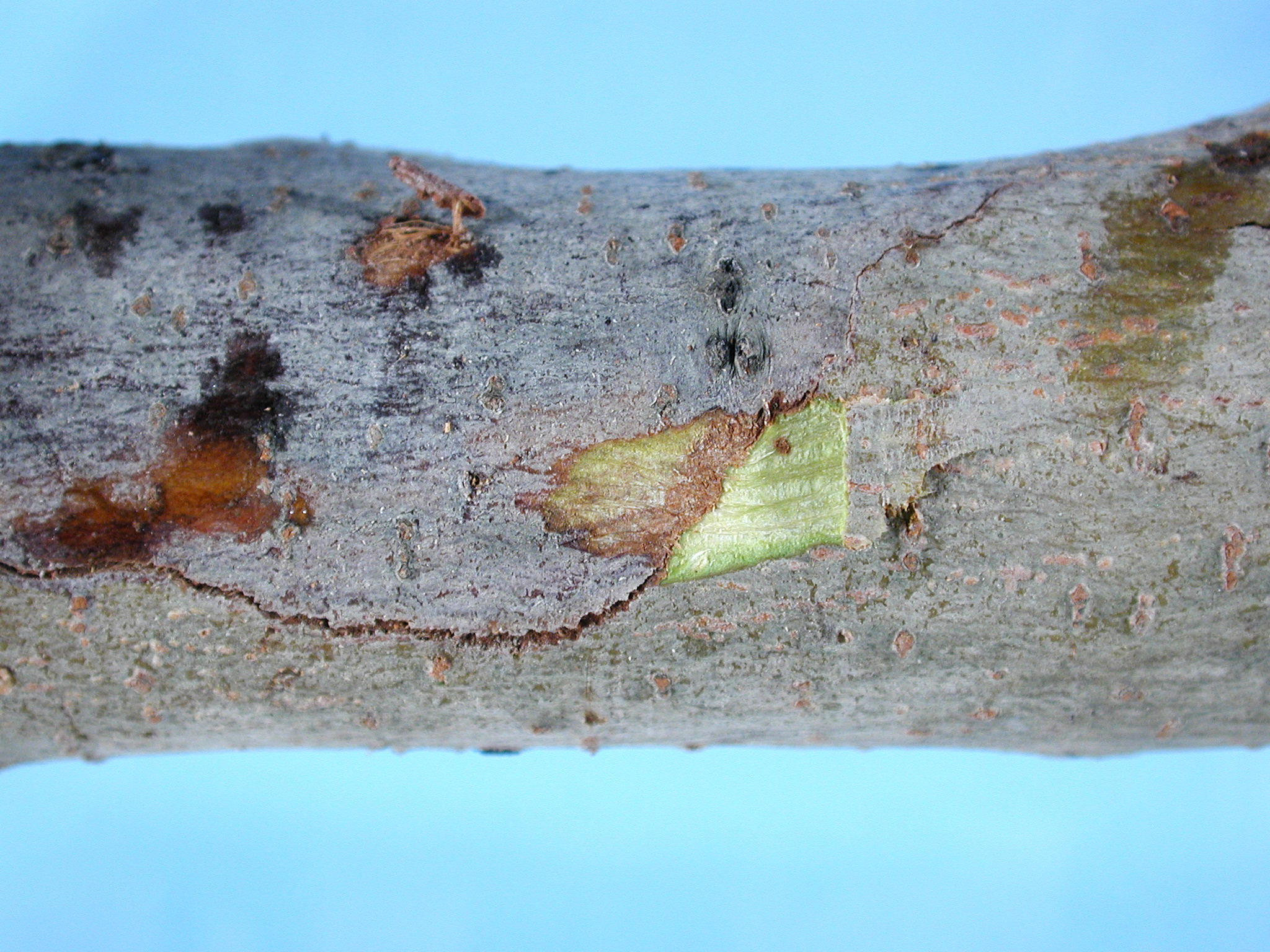
Symptoms During moist periods in the bloom season, spurs, blossoms, and twigs may become infected, developing a darker, water-soaked appearance. They turn brown to black and rapidly wilt and die. Infected blossoms frequently are distorted. A tan-yellow bacterial exudate (ooze) often appears where infection occurs. Cankers develop on trunks, limbs, and the graft union. Cankers are at first water soaked, later brownish red, and ultimately dark brown or black. Bark covering the cankered area is sunken, rougher and separates from injured tissue. Severe cankers girdle and kill infected limbs.
Several combinations of rootstock (M9 and M26) and cultivar (Braeburn, Fuji, and Gala) are very susceptible to fire blight. Trees may collapse without any sign of disease in the canopy. Disease symptoms can be confused with Phytophthora collar rot. Symptoms have been observed around the graft union area. Infection may spread from the collar to the roots or from the roots to the collar. Cankers near the base of the trunk often appear dark, water-soaked, and purplish on the outside. The margin may at first be indefinite or raised and blistered but becomes definite and marked by a crack or crevice later. When the bark is removed, the cankered area may show red-brown streaking. The younger the tree, the more likely the tree will die following infection.
Note: Resistant rootstocks can be used and include G. 11, 30, 41, 65, 202, 210, 214, 222, 814, 890, 935 and 969 in the Geneva series and Budagovsky 9 and 10.
Cultural control Use an integration of many tactics, from sanitation to timely application of chemical to biological products, to manage this disease.
- Remove and immediately burn infected trees as noticed. Do not combine pruning and blight cutting. Use lots of sterilizing solution on all tools and large cuts. Soak tools in solution after every cut. Use 10% Clorox (which is corrosive), 70% ethanol, 70% isopropanol (rubbing alcohol), or Pine-Sol. If used as a soak, change solutions every 2 to 3 hours. Do not cut when trees are wet from rain, irrigation, or dew. Do not break off infected shoots by hand.
- Prevent excessive shoot and sucker growth by using moderate amounts of nitrogen fertilizer. Nitrogen applications can be split using half the recommended amount before growth starts in the spring. If fire blight is not a major issue the rest of the nitrogen can be applied after bloom.
- If feasible, remove blooms before they open.
- Scion wood should not be collected from trees with fire blight or within 60 feet of trees with fire blight.
- Remove nearby landscape, such as hawthorns, or fence-row trees that can be a source of inoculum.
- Avoid overhead irrigation. In arid areas, reducing irrigation in the spring helps reduce the potential for dew formation on flowers.
- Some cultivars have resistance.
Chemical control Integration of chemical and biological tactics has worked well in the PNW. Keeping bacterial populations low during bloom, with various products and timing antibiotic applications to coincide with infection periods, has been a successful strategy in the PNW. Use a delayed dormant application of a copper-based product if fire blight was active last year. Use biological materials as trees go into bloom and again at full bloom supplemented with an antibiotic. Use antibiotics when infection periods are detected with the Cougarblight program.
- Delayed dormant sprays of copper compounds plus oil can delay and/or reduce inoculum production in holdover cankers missed after pruning. The use of copper-based products at this time is not always effective and was found in Israel to not reduce disease intensity during bloom. Work in the 2010's in California showed less infection during bloom. Group M1 fungicides. O
- Bonide Copper Fungicide at 2 to 4.3 oz/3 to 9 gal water. Group M1 fungicide. H
- Bordeaux 8-8-100.
- Champ WG at 12 to 16 lb/A. 48-hr reentry.
- C-O-C-S WDG at 12 to 15.6 lb/100 gal water. 48-hr reentry.
- Cuprofix Ultra 40 Disperss at 7.5 to 10 lb/A. 48-hr reentry.
- Instill at 20 to 40 fl oz/100 gal water. 48-hr reentry.
- Kocide 50 DF at 8 to 12 lb/A. 48-hr reentry.
- ManKocide at 1.5 lb/A. 48-hr reentry.
- Nu-Cop 50 DF at 4 to 12 lb/A. 48-hr reentry.
- Previsto at 2 to 4 quarts/A. Do not tank mix with any other product. 48-hr reentry. O
- Although regular bactericide sprays during main bloom season have been effective, they only encourage development of resistant bacteria. Tank-mix or alternate bactericides to prevent or delay development of resistant bacteria. Time initial and subsequent sprays according to one of several forecasting systems, or local recommendations, or as soon as possible after severe spring storms. Applications greater than 24 hours before or after infection give poor control. Good spray coverage is important in getting good results. Antibiotics such as oxytetracycline and kasugamycin are sensitive to rapid degradation in strong sunlight. Antibiotics also work better when the spray solution acidity is low. Although copper at full bloom is key for organic programs, copper hydroxide products are toxic to honey bees.
- Badge X2 at 0.5 to 1 lb/A. Group M1 fungicide. 48-hr reentry. O
- Champ WG at 1 to 3 lb/A. Group M1 fungicide. 48-hr reentry.
- C-O-C-S WDG at 0.5 to 1 lb/A. Group M1 fungicide. 48-hr reentry.
- CS 2005 at 19.2 oz/A. Group M1 fungicide. 48-hr reentry.
- Cueva at 0.5 to 1 gal/100 gal water/A. Rated as good as some of the antibiotics. Group M1 fungicide. 4-hr reentry. O
- Dart at 25.6 to 44.8 fl oz/100 gal water. Spray with continuous agitation. Was phytotoxic to Braeburn apple in one Western Oregon test. 24-hr reentry. O
- Grotto at 102 gal/A. Group M1 fungicide. 4-hr reentry.
- Kocide 50 DF at 1 lb/A. Group M1 fungicide. 48-hr reentry.
- Nu-Cop 50 DF at 1 to 3 lb/A. Group M1 fungicide. 48-hr reentry. O
- Oxytetracycline, is contained in several products including Fire Line and Mycoshield. For example, use Fire Line at 8 or 16 oz/A. Use 8 oz/50 gal/A water or 16 oz/100 gal/A water. Acidification of the spray tank with citric acid-based products may help improve efficacy. Do not apply within 60 days of harvest. Low resistance risk and provides fair to very good control. However, excessive use in one California pear orchard resulted in resistant fire blight bacteria. Group 41 fungicide. 12-hr reentry. O
- Previsto at 2 to 4 quarts/A. Do not tank mix with any other product. Group M1 fungicide. 48-hr reentry. O
- Streptomycin sulfate is contained in several products including Agri-Mycin, FireWall, and Harbour. For example, use Agri-Mycin 50 at 8 to 16 oz/A. Use once and mixed with oxytetracycline. Do not apply within 50 days of apple harvest. Resistant strains of the fire blight bacterium have been detected in most growing regions of the Pacific Northwest. About a 2-year shelf life. Excellent control if resistance is not a problem. Group 25 fungicide. 12-hr reentry. O
- The plant growth regulator Apogee is registered but not recommended for very young trees.
- Arbor-OTC is registered for trunk injection, see label for details. Group 41 fungicide (antibiotic). 12-hr reentry.
- Lime sulfur used for fruit thinning will also help manage fire blight by reducing both bacterial populations and flowers. May injure fruit on 'Delicious' apples and is not for use on 'Ginger Gold'. Do not use biological control agents close to lime sulfur applications. 48-hr reentry. O
- Mycoject Ultra is labeled as a tree injection for non-bearing trees only. Do not inject trees less than 2 inches in diameter. Group 41 fungicide. 12-hr rentry.
- Surface disinfectants such as Oxidate 5.0 or Jet-Ag are registered but have very short residual activity. Although use at late bloom helps to kill residual bacteria, under some conditions this application can mark fruit. Manufacturers recommend not to use past full bloom and should be applied only in fast drying conditions.
- Actigard 50 WG at 1 to 2 oz/A plus an antibiotic. Can also be used at 1 oz/quart of 1% penetrant (silicone surfactant), as a paint, to pruned limbs left after cutting out blight. Paint 1 to 1.5 ft starting from pruning cut. Do not apply within 60 days of harvest. Useful for infected trees 3-to-10-years old (replace younger infected trees). Group P01 fungicide. 12-hr reentry.
Notes: Group P7 fungicides such as Aliette and Rampart (or Monterey Garden Phos for the home) are registered for apple and pear, but these products are not recommended as foliar applications because control is too variable and the materials are not compatible with copper products. Trunk injection of a similar product was better than nothing in Michigan but has not been evaluated in the PNW.
Vacciplant is registered but was ineffective in the PNW and thus is not recommend for use.
Some registered products offer only suppression of this disease and thus are not recommended for use. These products include DoubleNickel 55, Regalia, and Stargus.
Biological control Use in conjunction with other control tactics such as thorough sanitation and antibiotics. Use only after the use of lime sulfur products. For organic production, however, use Blossom Protect at 70% bloom, a soluble copper at full bloom, and a Bacillus-based product at petal fall.
- AgriPhage-Fireblight at 1 to 2 quarts/50 to 100 gal water. Keep pH between 6.0 and 8.5. Do not mix with or apply within 4 days of iron or copper products. Variable results reported from eastern North America. 4-hr reentry. O
- Blossom Protect (Aureobasidium pullulans) at 2.5 lb/2 A plus 17.5 lb Buffer Protect. Use at 15% to 20% bloom and again at full bloom to petal fall. First application should be applied to all trees (rather than alternate row spraying.) If crop load thinning in early bloom with lime sulfur or ATS, delay first use of Blossom Protect until full bloom. Blossom Protect yeast need about 12 hours to grow on the flower to protect blooms before a wetting event. May enhance russeting on some cultivars when applied late bloom. Use in conjunction with other control tactics such as thorough sanitation and antibiotics. Not compatible with many pesticides or additives, a compatibility list is available. Do not use following an application of a copper-based product or severe russeting will occur. Excellent control. 4-hr reentry. O
- BotryStop (Urocladium oudemansii U3 strain) at 2 to 4 lb/A. Keep refrigerated before use. Compatible with many wetting agents, some fungicides and biologicals, but not all. Unknown efficacy in the PNW. 4-hr reentry. O
- LifeGard WG (Bacillus mycoides isolate J) at 4.5 oz/100 gal water. Does not have direct activity on pathogens but stimulates host defenses. Variable efficacy in Eastern States. Group P06 fungicide. 4-hr reentry. O
- Serenade Opti (Bacillus subtilis strain QST 713) at 14 to 20 oz/A. Active ingredient is basically an antibiotic so use late in bloom like you would oxytetracycline. It does not work if used like the biologicals early in the bloom season. Fair to good control. 4-hr reentry. O
References Wallis, A. E., and Cox, K. D. 2020. Management of Fire Blight Using Pre-bloom Application of Prohexadione-Calcium. Plant Disease, 104:1048-1054.
Johnson, K. B., and Temple, T. N. 2013. Evaluation of strategies for fire blight control in organic pome fruit without antibiotics. Plant Disease 97:402-409.