



By C. M. Ocamb
Cause Fusarium oxysporum f. sp. raphani (= F. oxysporum f. sp. conglutinans) or a Verticillium longisporum (a variant of V. dahliae, formerly known as V. dahliae var. longisporum) have both been found in red radish seed fields within the Pacific Northwest. Both fungi survive in soil as durable resting structures; chlamydospores produced by Fusarium and microsclerotia of V. longisporum can survive years between hosts. These fungi can be spread through soil movement on equipment, tools, and footwear as well as infested soil being windborne or waterborne. Fusarium can also produces spores that can be moved with wind or water. Both of these fungi can be seedborne. These pathogens can be introduced into a new region through the movement of infected transplants or the sowing of infected seed. The severity of wilt disease on radish increases as soil temperature increases; disease may develop when the soil temperature is between 64°F to 90°F.
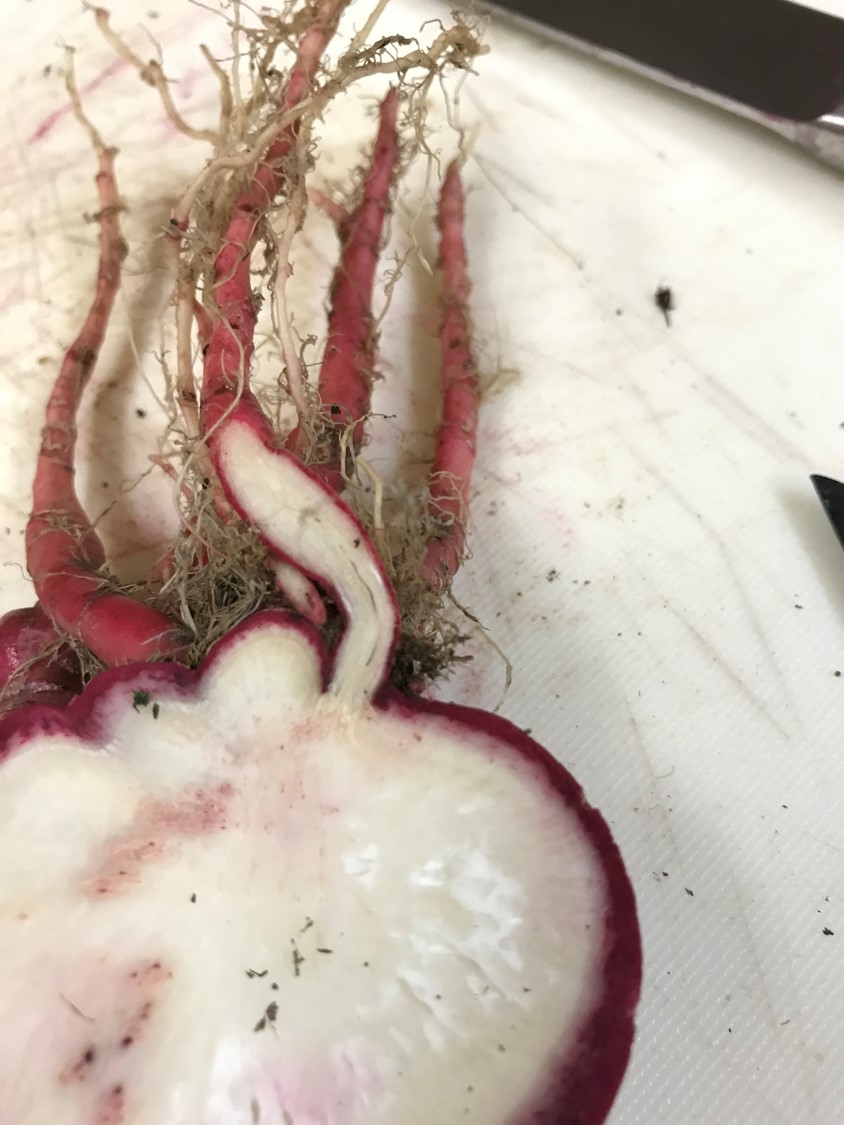
Symptoms Plants are susceptible at any stage. Early symptoms include yellowing of lower leaves, sometimes one-sided or V-shaped in appearance, and stunting of the plant. Leaves may die, and leaf yellowing as well as defoliation may progress up an affected plant. Wilting of plants is observed more commonly once flowering commences and yellowing spreads to younger leaves. Often the entire plant dies and remaining stems are silvery-tan in color. Dark-brown to blackish discoloration can found around vascular elements in roots and in storage roots (radish bulb). The vascular discoloration is commonly evident aboveground in plant stems and petioles, and may extend into the leaf veins. Vascular discoloration precedes wilting symptoms. A brown rot may develop on the tap root, storage roots, or the lower stem of affected plants. The root system may also be stunted with a brown rot of the lateral roots present.
Cultural control
- Plant pathogen-free seed in pathogen-free soil.
- Avoid establishment of seed fields in soils with high levels of plant residues or organic amendments.
- Time planting date to avoid warmer soil conditions.
- Radish varieties with resistance to Fusarium wilt have been compiled by the Cucurbit Genetic Cooperative and radish cultivar descriptions for North America can be found at https://cucurbit.info/2016/06/radish/ (accessed 21 Dec 2024). The red varieties with resistance or tolerance to Fusarium wilt include Altaglobe, Belle Glade (HXP 3763), Dandy, Diego, Fancy Red, Fireball (SRA3502), Fuego, Fures, Gloriette, Mister Red (PS91703), Red Baron, Red King, Red Silk, Scarlet Knight, and Vintage. The white varieties with resistance or tolerance to Fusarium wilt include Crystal White (HXP 2760), Whitella, and White Spike.
- Remove and destroy infected plants.
- Clean soil from equipment, tools, and clothing after working in an infested field.
- Long rotations are required to rid infested ground of this Fusarium strain; rotate out of susceptible red radish for 18 to 20 years.
Chemical control
- Regalia Biofungicide (Group P5) at 1 to 4 quarts/A as an in-furrow treatment. Does not benefit from the addition of an adjuvant. 4-hr reentry. O
Biological control
- Bexfond at 7 to 14 fl oz/A. 4-hr reentry. O
- Double Nickel LC at 1 to 2 quarts/A as a banded soil spray or drench on 4- to 6-week intervals or at 0.5 to 4.5 pints/A on 2- to 4-week intervals. Can be applied the day of harvest. 4-hr reentry. O
- Stargus at 2 to 4 quarts/A plus a nonionic surfactant on 7- to 10-day intervals. Preharvest interval is 0 days. 4-hr reentry. O
- Tenet WP at 2.5 to 5.0 lb/A at sowing will suppress certain fungal pathogens including Fusarium spp. See label for specific application types and timings. 4-hr reentry. O
References
Bomberger, R.A. 2013. Presence and Pathogenicity of Fusarium and Verticillium species in Commercial Red Radish (Raphanus sativus) Seed Production in the Willamette Valley of Oregon. MS Thesis. Oregon State University. 61 pp.
Bosland, P.W., Williams, P.H., and Morrison, R.H. 1988. Influence of soil temperature on the expression of yellows and wilt of crucifers by Fusarium oxysporum. Plant Dis. 72 (9):777-80.
du Toit, L.J., and Pelter, G.Q. 2003. Wilt of radish caused by Fusarium oxysporum f. sp. raphani in Washington State. Online. Plant Health Progress. doi:10.1094/PHP-2003-0616-01-HN.
Garibaldi, A., Gilardi, G., and Gullino, M.L. 2006. Evidence for an expanded host range of Fusarium oxysporum f. sp. raphani. Phytoparasitica 34(2):115-121.
Morrison, R.H. 2007. Yellows (Fusarium Wilt). In: Rimmer, S.R., Shattuck, V.I., and Buchwaldt, L., editors. Compendium of Brassica Diseases. St. Paul, (MN): APS Press; p. 56-58.