

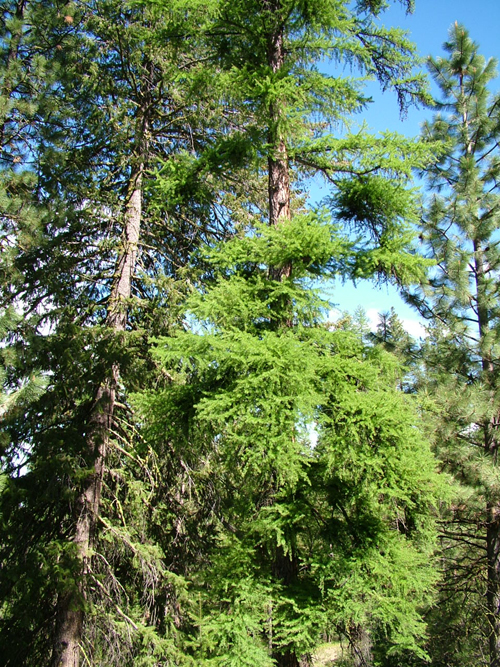
See:
Fir, Douglas and True - Dwarf Mistletoe
Cause Several Arceuthobium spp., parasitic plants, attack important forest species in the PNW. Western larch can be seriously damaged by A. laricis east of the Cascade Range in the Blue and Wallowa Mountains. Mountain hemlock is also a host. These mistletoes do not attack oak or other hardwoods. Fruit explodes when mature, dispersing seeds several feet away. Needles of the host tree intercept seeds. Rain then washes seeds down to twigs where germination and penetration occur. Once infection is established, there is an incubation period of 2 to 5 years before young shoots appear. A swelling at the point of infection usually precedes shoot production by a year or more. Pollen from male plants fertilize flowers on female plants, which produce the fruit after several months' development. They retard the growth of infected trees and cause extensive timber losses through direct and indirect mortality. Host seed production and wood quality can also be reduced. Decay fungi may gain entrance at the site of the mistletoe attachment.
Symptoms Small (0.75 to 4 inches) yellowish-green plants growing in clusters on branches. Witches' brooms are usually dense and of moderate size. Plant clusters arise from spindle-shaped swellings.
Cultural control
- Remove all plants by harvesting or pruning. This is easiest in mid- or late summer when plants are most easily seen. Aerial shoots will re-grow unless the entire host branch is removed.
- Forestry:
- Clear-cut severely infected stands.
- Remove infested overstory if a manageable susceptible understory is present.
- Favor non-hosts in mixed stands.
Reference Shaw, D. C., Oester, P. T. and Filip, G. M. 2009. Managing Insects and Diseases in Oregon Conifers. Oregon State University Extension Service. EM 8980.