

See:
Cause The OSU Plant Clinic has found many leaf spots due to the bacteria Pseudomonas syringae. In California, Pseudomonas quasicaspiana sp. nov. has been identified. Cool wet weather in the spring favors disease development. Bacteria overwinter on diseased twigs or as epiphytes on healthy wood. Factors that weaken or injure plants predispose them to disease. Such factors include wounds, both accidental and from pruning or budding, frost damage, incorrect soil pH, poor or improper nutrition, and infection by other pathogens. Bacterial sources can include old cankers, healthy buds, low populations within plants (with or without cankers), leaf surfaces, nearby weeds and grasses, even soil. Bacteria spread by wind, rain, insects, tools, and infected nursery stock.
In warmer areas of the US, the bacterium Xanthomonas campestris can cause a leaf spot as well. Warm wet weather in the spring favors this disease development. This disease seems to be most severe on oakleaf hydrangeas. Xanthomonas hydrangeae sp. nov. was described on oakleaf hydrangeas as well as other species in Belgium. This bacterium was found on nursery grown hydrangea in Michigan in 2025 and as a result a quarantine has been established for all infected plants throughout the US.
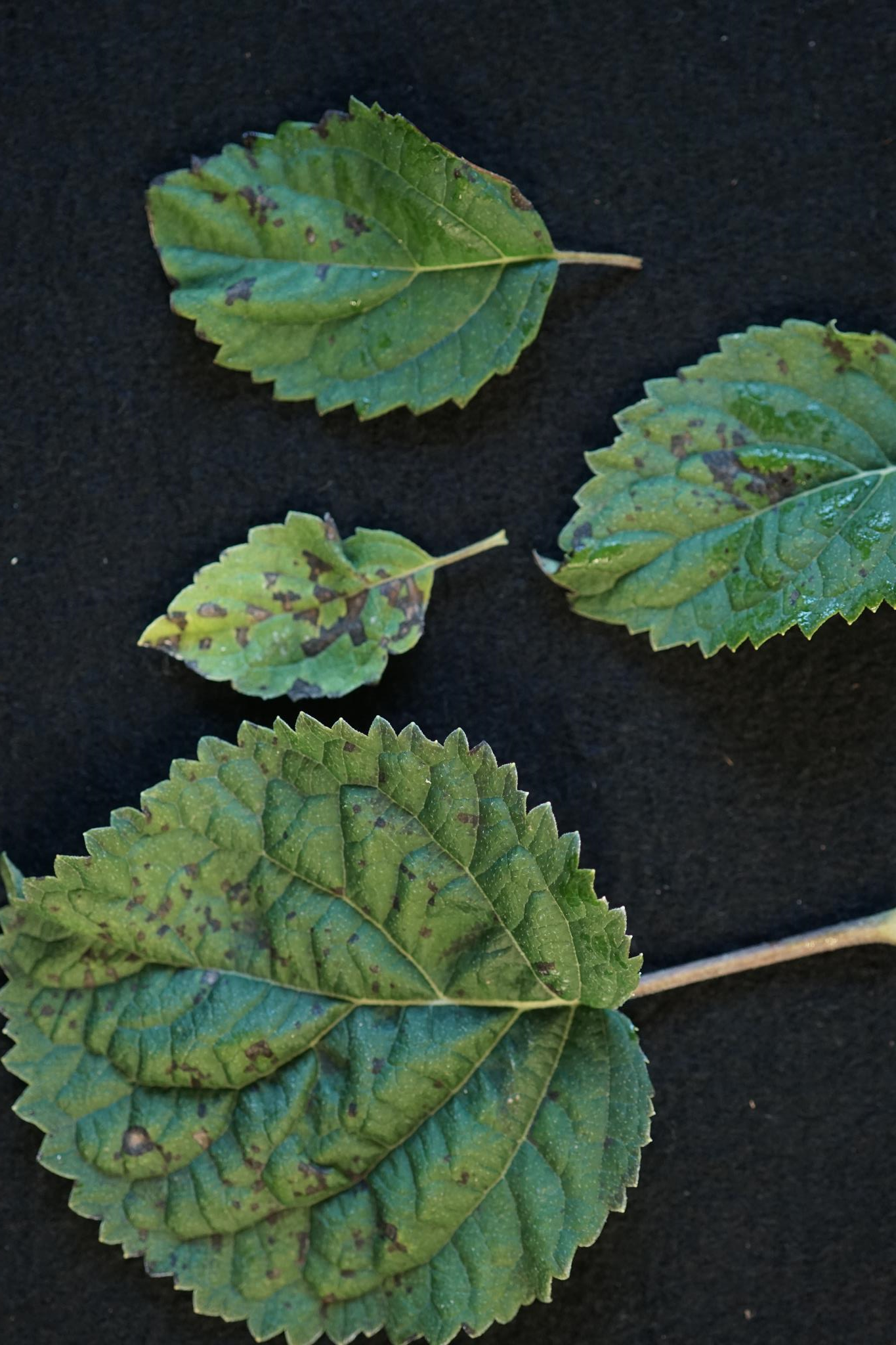
Symptoms Pseudomonas leaf spots are circular necrotic areas surrounded by a yellow halo.
Xanthomonas leaf spot symptoms are usually first observed on lower leaves as water-soaked spots that become more darken and develop an angular shape. Some of the spots may enlarge, coalesce and eventually cause death of mature leaves..
Cultural control
- Space and prune bushes to permit good air circulation.
- Avoid overhead irrigation that keeps leaves wet.
Chemical control Note that copper-based products (group M1) and antibiotics (Group 25) are useful for bacterial leaf spots.
- Agri-Mycin 50 at 5.3 to 16 oz/100 to 300 gal water/A. Tolerant strains of bacteria easily develop with repeated use of this product. Alternate with other bactericides to prevent or delay buildup of tolerant strains. Group 25 fungicide. 12-hr reentry.
- Copper-based group M1 fungicides.
- Camelot O at 0.5 to 2 gal/100 gal water. 4-hr reentry.
- Grotto at 0.5 to 2 gal/30 to 100 gal water/A. Group M1 fungicide. 4-hr reentry.
- Phyton 27 at 1.3 to 2.5 oz/10 gal water. Group M1 fungicide. 48-hr reentry.
Reference Carvalho, R., Albu, S., Timilsina, S., Minsavage, G. V., Paret, M. L. and Jones, J. B. 2022. Pseudomonas californiensis sp. nov. and Pseudomonas quasicaspiana sp. nov., isolated from ornamental crops in California. International Journal of Systematic and Evolutionary Microbiology, 72:005565. DOI 10.1099/ijsem.0.005565
Dia, N. C., Van Vaerenbergh, J., Van Malderghem, C., Blom, J., Smits, T. H., Cottyn, B. and Pothier, J. F. 2021. Xanthomonas hydrangeae sp. nov., a novel plant pathogen isolated from Hydrangea arborescens. International journal of systematic and evolutionary microbiology, 71(12), p.005163.