


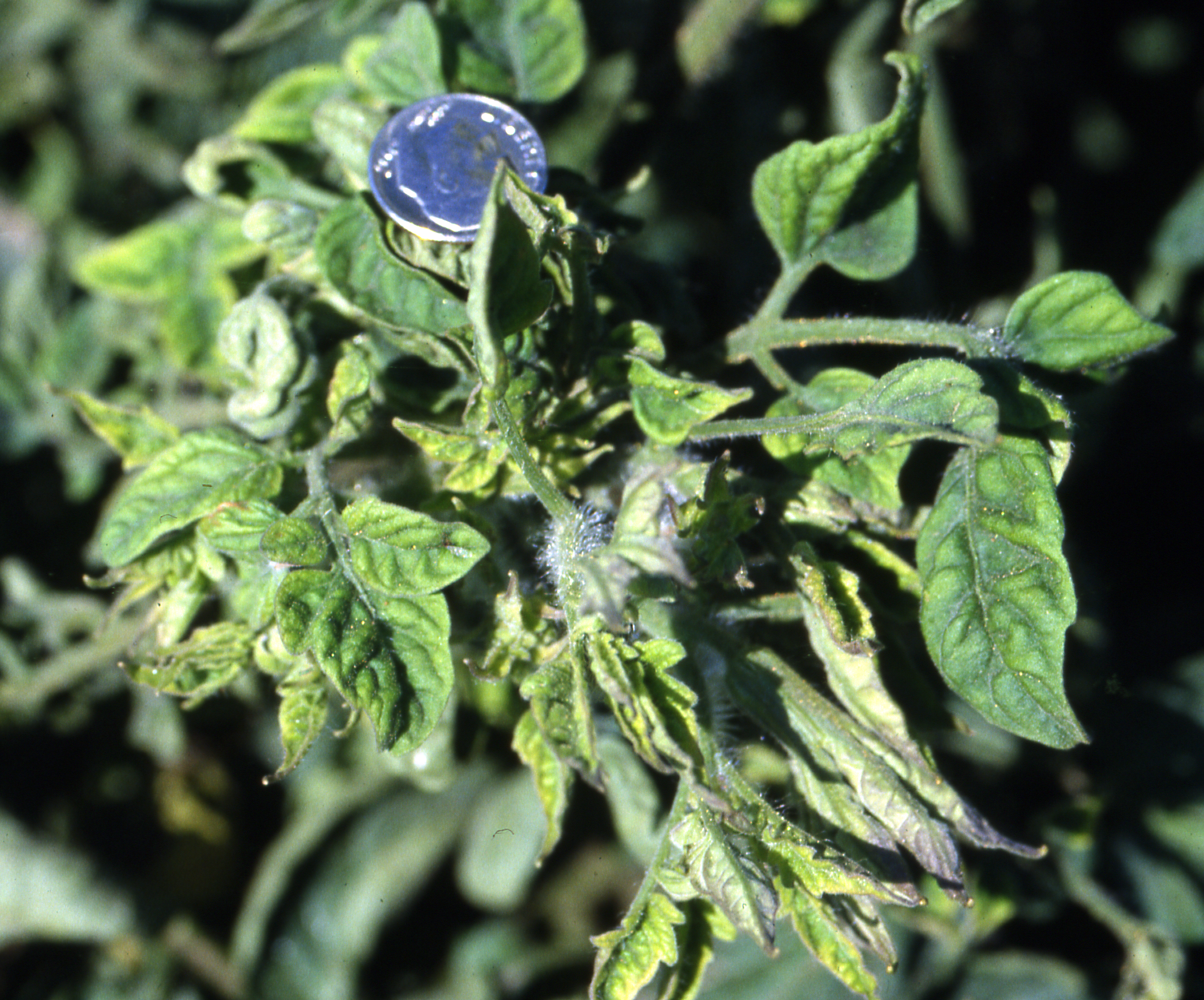
Cause The beet curly top virus, which also infects a wide range of crops such as bean, beet, cannabis, cucurbits, spinach, squash, and pepper. The virus is disseminated by the beet leafhopper, Circulifer tenellus. There are no current reports of seed transmission, however, there is preliminary evidence of this virus being seedborne in hemp. This disease is a problem in the western portion of North America. The disease may be severe in central and eastern Oregon and Washington. Although it is considered more of a problem of arid and semi-arid regions, this virus does occur in the Willamette Valley, especially the northern end when winds blowing through the Columbia Gorge transport the beet leafhopper from eastern Oregon. With the effects of the changing climate and new information on the host range of the beet leaf hopper, it may be possible that the virus and vector overwinter in western Oregon in the future.
The leafhopper takes up the virus when feeding and keeps it in its body the rest of its life. Normally, the virus must incubate 21 to 24 hours or longer in the insect's body before it can be transmitted to another plant, but if the temperature is very high incubation may be reduced to 4 to 6 hours. Leafhopper eggs never carry the virus. The beet leafhopper overwinters on a range of hosts, including perennial plants, and migrate to cropland as the landscape dries out in the spring in the arid/semi-arid regions, bringing the virus to susceptible crop plants.
Temperature affects the interval between the insect's feeding and the appearance of curly top symptoms. If it is very hot, symptoms may show in 24 hours; with normal temperatures, in 7 to 14 days; in cool weather, up to 30 days. The disease is in areas where light is intense, summer heat is prolonged, relative humidity is low, and evaporation is rapid. In years when average relative humidity is 35%, the disease is very severe; when it is over 50%, there is almost no curly top. Shading, which lowers light intensity and retards evaporation, probably delays leafhopper visits, decreases the infection rate, and reduces symptom expression.
Symptoms Leaflets roll up and twist sharply, exposing their undersurfaces. Foliage is stiff and leathery, and the entire plant is a peculiar dull yellow. Leaflet veins take on a purple coloration, and the plant often is stunted. Many roots and rootlets die, as do severely affected plants. This disease can be confused with aster yellows.
Cultural control Many controls, including trying to control the leafhopper vector, have not produced satisfactory results.
- These varieties are resistant to curly top (those marked VF also are resistant to Verticillium and Fusarium wilt): Payette, Owyhee, Super Star VF, Red Lode VF, Ida-Red VF, Parma VF, Bicentennial VF, Rowpac VF, Columbia VF, Roza VF, and Salad Master VF.
- Shading plants helps avoid leafhopper attack in home gardens.
- Control of important weed hosts, including Russian thistle and wild mustards, should be practiced.
References Bennett, C.W. 1971. The Curly Top Disease of Sugarbeet and Other Plants. Monograph 7. St. Paul. MN: American Phytpathological Society.
Jones, J.B., Zitter, T.A., Momol, T.M., and Miller, S.A. 2014. Compendium of Tomato Diseases, 2nd Ed. St. Paul, MN: APS Press.