

See:
Cause Myxomycetes (such as Diachea leucopodia and Physarum cinereum) are nonparasitic organisms that live in the soil or organic matter. They are favored by wet weather and an abundance of leaf litter. The appearance of slime mold (sporangia) can cause great concern but is not considered a disease and will recede after 1 to 2 weeks. Sporangia persist in the soil or litter where they have fallen, and they germinate during or after wet conditions. They release motile swarm spores (amoeba-like), which feed on the decaying organic litter as well as on bacteria and other microorganisms. Upon depleting their food source, they change morphologically, forming a plasmodium that grows up from the soil/litter onto the plant. They will grow up virtually any erect surface and when moist, give a "slimy" feel to the plant. The sporangia are then produced, and their presence is the only readily visible portion of their life cycle. Infrequently found in strawberry production fields or under poly tunnels. The organisms may smother individual leaves but it is a temporary issue. Out of hundreds of samples it has been diagnosed 20 times by the OSU Plant Clinic.
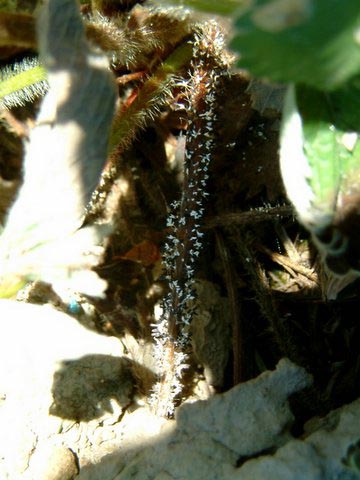
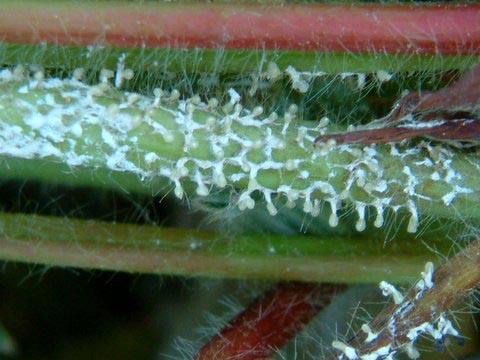
Symptoms Stems or leaves will be covered with a grayish or purplish brown, or a white mass of small, round fruiting bodies (sporangia).
Control No control measures usually needed. Some chemicals used for other diseases will manage slime molds.
References Maas, J. L. ed., 1984. Compendium of strawberry diseases. St, Paul, MN: APS Press.