

See:
Pear (Pyrus spp.) - Pacific Coast Pear Rust
Cause Gymnosporangium cornutum, G. libocedri, G. nelsonii, G. nootkatense, and G. tremelloides have been reported in the PNW. The spore stages of these fungi produced on mountain ash or others in the rose family do not reinfect these hosts. They infect only alternate hosts, which include junipers or cedars, during one summer. Spore stages produced on junipers and cedars infect only members of the rose family in early spring during wet weather. Infection on the conifer host is perennial where spores may be produced over a 2- to 3-year period.
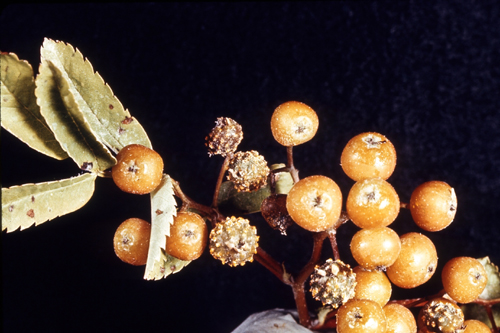
Symptoms Undersides of leaves develop circular yellow to orange lesions (aecia). When mature, aecia develop numerous spore horns, which protrude from the leaf surface in a rosette pattern. Aeciospores may be yellow or brown. Spore horns may form only on fruit, petiole, small twigs and/or leaves, depending on the rust species.
On the juniper or cedar host, witches' brooms or swellings and galls of branches can be observed. Yellow to orange telial horns are produced in the spring.
Cultural control
- Remove or widely separate from all junipers or cedars. Specific junipers or cedars can be removed only when the rust species has been correctly identified. Separating hosts by 0.5 to 2 miles has also been recommended.
Chemical control Use multiple applications at two-week intervals starting at bud break.
- Avelyo at 3 to 5 fl oz/100 gal water. Group 3 fungicide. 12-hr reentry.
- According to IR-4 data, Heritage is safe on some species of this genus. Use at 1 to 4 oz/100 gal water plus a non-silicone-based wetter sticker on a few plants first before wide spread use. Group 11 fungicide. 4-hr reentry.
- Mancozeb-based products. Group M3 fungicides. 24-hr reentry.
- Fore 80WP Rainshield at 1.5 lb/100 gal water plus a spreader-sticker.
- Protect DF at 1 to 2 lb/100 gal water plus 2 to 4 oz spreader-sticker.
- Phyton 27 at 2.5 to 4 oz/10 gal water. Group M1 fungicide. 48-hr reentry.
References Ziller, W. G. 1974. The Tree Rusts of Western Canada. Canadian Forestry Service Publication 1329.