

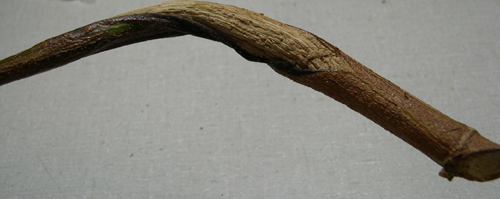


Cause The fungus, Fusarium sambucinum (teleomorph: Gibberella pulicaris), survives in soil and diseased plants and has been found in OR, WA, and ID. Confirmed by OSU and the USDA-ARS in 'Chinook', 'Citra', 'Fuggles', 'Galena', 'Glacier', 'Mt. Hood', 'Nugget', 'Sterling', 'Willamette', and 'Zeus' varieties in the Pacific Northwest. The incidence of hop canker in the field is sporadic, not every bine on a hill is affected. Field observations have suggested that the onset of disease appears to be more severe under wet conditions, including growing seasons following flooding during wet winters. Hops grown in areas where the water table is high or where there is poor drainage had higher levels of canker. Higher rainfall or over-irrigation may lead to increased soil moisture and in seasons where increased rainfall has occurred there have been more severe outbreaks of this disease. Fields with high levels of hop stunt viroid also have been observed to have very high incidences of Fusarium canker.
The disease usually occurred at a low incidence (<5% of plants) but catastrophic losses of entire crops or new plantings occur in some situations. This disease results in both reductions in yield and cone quality, as desiccated cones may be carried through the picking and drying process. However, OSU and the USDA-ARS have observed Fusarium canker occurring at greater frequency, particularly in Washington State where approximately three-quarters of U.S. hop production occurs.
Preliminary studies by OSU and the USDA-ARS with a small number of isolates of F. sambucinum derived from hop and potato point to host specialization within the pathogen; isolates obtained from hop are more pathogenic on hop relative to potato and vice versa.
Symptoms Canker disease leads to yellowing of leaves and generally unthrifty growth. Affected bines wilt rapidly and suddenly; often at flowering or during hot weather. Bines can detach and readily break from the crown with a gentle tug. The point of bine attachment to the crown usually is tapered or rounded off so that only a few central vascular elements connect the bine to the crown. Mechanical agitation (wind, tractors, sprayers, etc.) frequently break the connection; symptoms sometimes are attributed to "tractor blight." If the bine remains connected until late in the season, it can wilt and collapse in hot weather. The bine's base is typically swollen because carbohydrate movement has been inhibited; sometimes affected stems have a longitudinal split in the colonized cortical area of the bine. Vascular discoloration does not seem to be associated with the disease. Cankers can be found on rhizomes of affected plants. Wilted bines could potentially be confused with wilt caused by Verticillium species. The pattern of necrosis on leaves and vascular discoloration associated with Verticillium infection differentiates Verticillium wilt from canker.
Cultural control Specific control measures have not been researched; however, field observations indicate the following may help.
- Avoid injury to hop plants.
- Studies by OSU and the USDA-ARS in the state of Washington showed that chemical pruning in the spring reduced canker disease severity compared to mechanical pruning, but no difference was detected in Oregon field studies.
- Studies by OSU gave preliminary data showing that hilling up the plants enhances adventitious root growth above cankered bine portions, which can help maintain bine vigor and cone yield.
- Reduce crown wetness by hilling higher relative to rill irrigation ditches, by removing sucker growth that could shade the crown, and by reducing mulch.
- Lime to increase soil pH above 7. Maintain the higher pH by using less ammonium-based nitrogen fertilizer; use nitrate-based fertilizer instead.
Chemical control
- Mefenoxam applications are not an effective chemical treatment for Fusarium canker based on studies by OSU.
Biological control Efficacy of these products on this disease in the PNW is unknown.
- Asperello at 1.5 to 10.7 oz/A on 7- to 10-day intervals as a foliar spray or at 0.1 to 0.7 oz/100 gal water on 8- to 12-week intervals for chemigation at 2,000 to 5,000 gal/A. 12-hr reentry. O
- Bio-Tam 2 at 2.5 to 3 lb/A as a banded ground spray or at 2.5 to 5 lb/A on 14- to 21-day intervals for chemigation. 4-hr reentry. O
- Bexfond at 7 to 14 fl oz/A for soil applications via drenches, in-furrow applications, drip irrigation, or sprays, followed by irrigation, reapply on 4-week intervals. 4-hr reentry. O
- Theia at 1 to 5 lb/A for soil applications via drenches, in-furrow applications, drip irrigation, or sprays, followed by irrigation. Preharvest interval is 0 days. 4-hr reentry. O
References Borland, T.G. 2025. A Multifaceted Investigation of Fusarium sambucinum and Fusarium Canker of Hop: Insights into an Emerging Plant Disease in the United States. Ph.D. Thesis, Oregon State Univ., Corvallis. 167 pp.
Borland, T.G., Cauldron, N.C., Grunwald, N.J., Kronmiller, B., Thomas, W.J., Ocamb, C. M., and Gent, D. H. 2025. Genomic resources for Fusarium sambucinum, a causal agent of fusarium canker of hop and dry rot of potato. PhytoFrontiers. https://doi.org/10.1094/PHYTOFR-05-25-0052-A.
Cerruti, N.R. 2010. Examinations of Fusarium sambucinum on Humulus lupulus and Co-infection with Hop Stunt Viroid in Commercial Hop Fields. M.S. Thesis, Oregon State Univ., Corvallis. 67 pp.
Ocamb, C.M., and Gent, D.H. 2015. Fusarium canker. In Field Guide for Integrated Pest Management in Hops, 3rd Edition, ed DB Walsh, DH Gent, JD Barbour, RA Boydston, AE George, et al., pp. 22-23. Yakima, Washington: Hop Growers of America.
Salmon E.S., and Wormald H. 1922. Hop "canker" or "growing off." J. Minist. Agric. 29(4):354-59.
Thomas, W.J., Borland, T.G., Bergl, D.D., Claassen, B.J., Flodquist, T.A., Montgomery, A.S., Rivedal, H.M., Woodhall, J., Ocamb, C.M., and Gent, D.H. 2022. A quantitative PCR assay for detection and quantification of Fusarium sambucinum. Plant Dis. 106(10):2601-6.